
Ezekiel and the Valley of Dry Bones: Prophecy, Ruach, and Restoration
Please note that this article may contain affiliate links. As an Amazon Associate, I earn on qualifying purchases at no additional cost to you. You can read more at the bottom of this page or read my full disclosure on my Affiliate Disclosure Page
When you picture a valley covered in bones, you might think of something from a movie… a lifeless, silent place where nothing stirs and nothing grows. For the prophet Ezekiel, that image wasn’t fiction. It was a vision God gave him during one of the darkest seasons in Israel’s history. The people were scattered, their hope was gone, and their future seemed sealed.
This wasn’t just a strange scene meant to shock him. It was a message about God’s power to restore what looks far beyond saving; physically, spiritually, and even in the life to come.
In this post, we’ll explore Ezekiel and the valley of dry bones, looking at its history, its meaning, and how it still speaks to us today.
Be sure to download your free copy of our printable Valley of Dry Bones Bible Study, Reflection and Action Challenge guide with worksheets at the end of this post!
Who Was Ezekiel?
Ezekiel was a Hebrew prophet and priest who lived during the Babylonian exile in the 6th century BCE. Taken from Jerusalem to Babylon, he received visions and messages from God to encourage the Jewish people, call them to repentance, and assure them of restoration. He is the author of the book of Ezekiel in the Hebrew Bible.
What Do the Dry Bones Represent in Ezekiel 37?
In Ezekiel 37, the dry bones represent the people of Israel in exile… scattered, lifeless, and without hope. God’s vision to Ezekiel showed that He would restore them to their land, revive them spiritually, and ultimately bring about a future resurrection.
The Setting of Ezekiel’s Vision
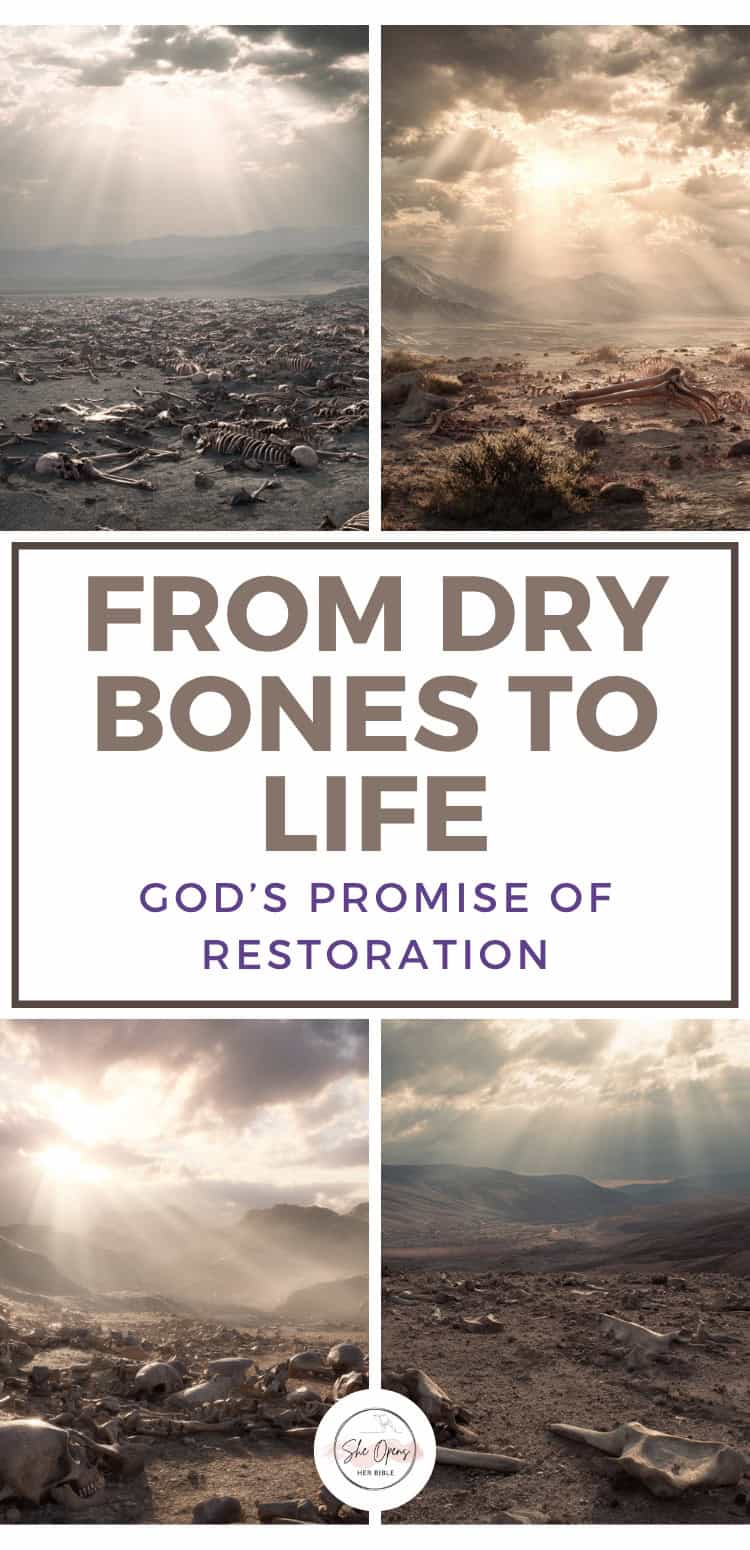
Ezekiel’s ministry took place during one of the most devastating times in Israel’s history. The Babylonian army had destroyed Jerusalem, the Temple was in ruins, and many of the people had been carried into exile. Their national identity was shattered. In Ezekiel 37, God gives the prophet a vision to address this deep hopelessness.
The Hebrew text describes the scene as a bik‘at ‘atzamot—a valley full of bones. Not just skeletons neatly laid out, but scattered remains, long dry and stripped of any flesh. This wasn’t a vision of recent death. It was the image of something gone for so long it seemed impossible to restore.
Then God asks Ezekiel a question that hangs heavy in the air:
“Son of man, can these bones live?”.
Ezekiel 37:3 TLV
Ezekiel, probably stunned by the sight, answers carefully, “Lord Adonai, You know.” He’s not saying yes or no… he’s putting the answer in God’s hands.
The Power of Ruach
At the heart of this passage is a word that runs like a current through the vision: ruach. This Hebrew word appears ten times in Ezekiel 37, and it’s layered with meaning.
- Breath – the literal life force that fills the lungs
- Wind – a movement from heaven that changes the earth
- Spirit – the presence and power of God
When God says, “I will put My ruach in you, and you will live” (Ezekiel 37:14), He’s not talking about simple resuscitation. This is full restoration; national, spiritual, and ultimately physical in the resurrection to come.
Jewish tradition has long seen ruach as the creative force of God. In Genesis 1:2, the ruach Elohim hovers over the waters at creation. In Genesis 2:7, God breathes into Adam’s nostrils the breath of life. Ezekiel’s vision intentionally echoes these creation moments, pointing to God’s power to re-create what was lost.
Layers of Prophecy in the Valley of Dry Bones
One of the most fascinating things about Ezekiel and the valley of dry bones is how the vision works on multiple levels at once.
Immediate National Restoration
For Ezekiel’s first hearers, the most obvious meaning was national revival. Israel would return from exile. God would bring His people back to their land. And He did… historically, the Jewish people returned from Babylon about 70 years after the destruction of the Temple.
Ongoing Spiritual Renewal
The vision also connects to the promises in the previous chapter, where God says He will give His people a new heart and put a new Spirit within them (Ezekiel 36:26–27). The physical return from exile was only part of the story. God wanted to change their hearts, to make them alive to Him again.
Final Bodily Resurrection
The clearest Old Testament statement of bodily resurrection is in Daniel 12:2:
“Multitudes who sleep in the dust of the earth will awake—some to everlasting life, and others to shame and everlasting contempt.”
TLV
Ezekiel 37 fits right into this theme. Jewish commentators and later believers in Yeshua have seen this as a promise of the resurrection at the end of the age.

The Two Stages of Restoration
In the vision, God brings the bones together, adding sinews, flesh, and skin. But they still have no breath in them. This first stage is physical form without life. Then comes the second stage: the breath enters, and they stand up as a vast army.
This two-step process mirrors creation in Genesis 2:7, where God forms Adam from the dust and then breathes life into him. It’s a reminder that restoration often happens in stages. Sometimes God puts the structure in place before filling it with life.
For Israel, the first stage was the physical return to the land. The second will be the fullness of spiritual renewal in the days to come.
Messiah and the Bones
Centuries later, Yeshua would say:
“Amen, amen I tell you, an hour is coming and is now here, when the dead will hear the voice of Ben-Elohim. Those who hear will live!”
John 5:25 TLV
His words connect directly to Ezekiel’s vision. Yeshua’s voice raises the physically dead, as with Lazarus, and brings spiritual life to those who believe. At the last trumpet, this voice will call the dead from their graves in the final resurrection (1 Corinthians 15:52).
Lessons for Believers Today
Ezekiel and the valley of dry bones isn’t just a historical or prophetic curiosity. It’s a living word for us right now.
God’s Word Brings Life
Ezekiel didn’t invent a motivational speech. He spoke exactly what God told him to say. Life came when God’s Word was spoken into the hopeless place. In our own “dry bones” moments, we need His Word more than our own ideas.
No Situation is Beyond God’s Reach
If God can reassemble bones that have been dry for decades, He can restore whatever looks impossible in your life. That includes relationships, callings, health, and faith that feels gone.
The Spirit is Essential
The bones came together before the ruach entered them, but they were still lifeless. Effort and organization without the Spirit will always fall short. The Spirit is what turns structure into life.
God Keeps His Covenant
Even in judgment, God remained faithful to His covenant people. That same faithfulness extends to all believers in Yeshua today.
Reflection and Application
You might be looking at your own “valley” right now. Maybe it’s your marriage, your ministry, your health, or your walk with God. It feels dry, lifeless, scattered. If God could bring life to those bones, He can breathe into your situation too.
- What areas of your life feel like dry bones?
- Where might God be rebuilding structure before breathing life into it?
- How is He calling you to speak His Word into hopeless places?
My Final Thoughts
Ezekiel and the valley of dry bones is one of the most hope-filled visions in the Bible. It tells us that God’s power is not limited by the depth of our loss or the length of our waiting. Whether you’re facing personal brokenness, praying for national revival, or longing for the resurrection to come, this passage assures you that God is not finished.
If this spoke to you, I’d love to hear your thoughts in the comments. And if you want to connect with others who love digging into Scripture, join us in our She’s So Scripture Substack. We’d love to have you there.
And don’t forget to download your free copy of our Valley of Dry Bones Bible Study, Reflection and Action Challenge guide below!
FAQs
-
What does Ezekiel and the valley of dry bones symbolize?
It symbolizes Israel’s restoration from exile, ongoing spiritual renewal, and the final resurrection. It’s also a powerful picture of God’s ability to bring life to hopeless situations.
-
Why are the bones described as very dry?
The dryness shows how long they had been dead and how hopeless the situation was from a human point of view. It makes the restoration even more dramatic.
-
What does the word ruach mean in Ezekiel 37?
Ruach can mean breath, wind, or spirit. In this vision, it carries all three meanings at once, pointing to God’s life-giving power.
-
Did this vision actually happen?
Ezekiel’s vision was symbolic, but it pointed to real events—Israel’s return from exile, the coming of the Spirit, and the future resurrection.
-
How can this apply to me today?
It’s a reminder that no matter how impossible your situation seems, God can restore and renew it by His Spirit. It calls you to trust His Word and power.
We Now Have Merch!
Love what you’re learning here? We’ve got a whole shop full of faith-inspired goodies (some with some sass!) to keep you encouraged every day — t-shirts, mugs, notebooks, coffee, tea, and so much more. Every purchase helps support the ministry and keeps resources like this free for readers.
Check out the full collection here:
Download Your Printable Study Guide

About Our Author
Diane Ferreira is a Jewish believer in Yeshua, a published author, speaker, seminary student, wife, and proud mom. She is the author of several books, including The Proverbs 31-ish Woman, which debuted as Amazon’s #1 New Release in Religious Humor. She is currently pursuing her graduate degree in Jewish Studies, with her favorite topics being the early church and Biblical Hebrew. Diane writes and teaches from a unique perspective, bridging her Jewish heritage with vibrant faith in the Messiah to bring clarity, depth, and devotion to everyday believers.
When she’s not writing, studying, or teaching, you’ll find her curled up with a good book, crocheting something cozy, or researching her next trip.
📚 Learn more here! | 💬 Join the discussion on our Substack!
Tree of Life (TLV) – Scripture taken from the Holy Scriptures, Tree of Life Version*. Copyright © 2014,2016 by the Tree of Life Bible Society. Used by permission of the Tree of Life Bible Society.