
Elisha and the Chariots of Fire: What Happened When God Opened the Servant’s Eyes
Please note that this article may contain affiliate links. As an Amazon Associate, I earn on qualifying purchases at no additional cost to you. You can read more at the bottom of this page or read my full disclosure on my Affiliate Disclosure Page
You know the feeling. The bills are stacked on the counter. The diagnosis sits in your inbox, unread. The relationship that once felt solid has been quiet for weeks. You open your eyes in the morning and the first thing you see — before you even reach for your phone — is the problem.
You don’t choose to look at it. It’s just there. Enormous. And everything else disappears behind it.
The servant of Elisha had the same experience — except his problem had horses, armor, and enough military firepower to level a city. And in that moment of wide-eyed terror, God did something extraordinary. He didn’t remove the threat. He opened the servant’s eyes to something that had been there the whole time.
What we focus on shapes what we see. And what we see shapes whether we live in fear or in faith.
That is the heartbeat of 2 Kings 6 — and it may be one of the most quietly radical passages in all of Scripture for women who are staring down something that feels too big.
Let’s explore Elisha and the chariots of fire.
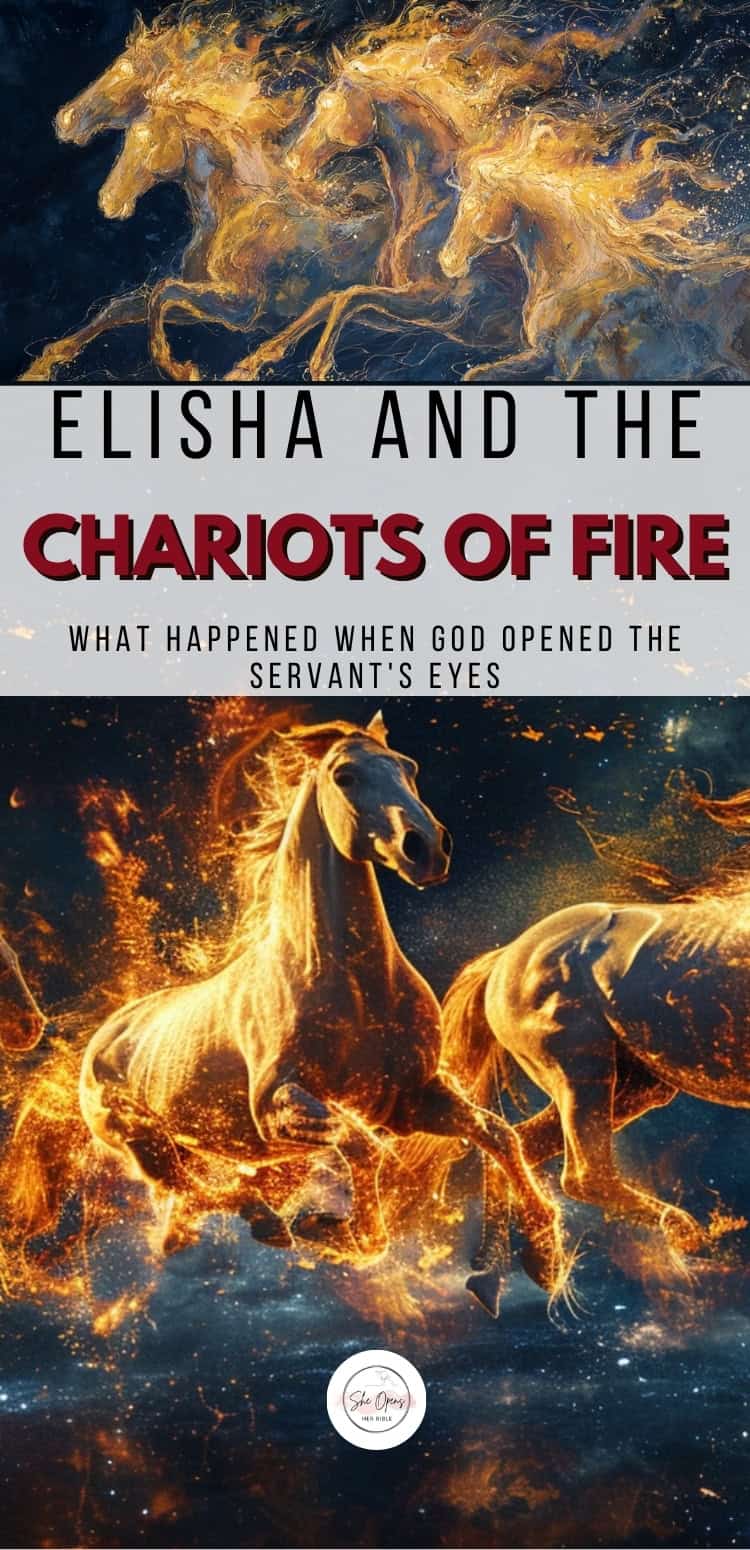
Setting the Scene: Elisha at Dothan
To understand the chariots of fire, we need to understand what led to them. The backstory of 2 Kings 6:8–23 is a story of spiritual intelligence warfare and a prophet who was so attuned to the voice of God that the king of Aram thought he had a spy in his own war room.
The king of Aram had been at war with Israel, laying out military strategy in his private chambers only to have the king of Israel evade every single ambush. Frustrated and furious, the king summoned his officers. Surely there was a traitor among them. But his officers had a different answer: there was no traitor. There was a prophet.
“The heart of the king of Aram was troubled over this thing. He called his servants and said to them, ‘Will you not tell me which of us is for the king of Israel?’ One of his servants said, ‘None, my lord, O king. Elisha, the prophet who is in Israel, tells the king of Israel the words that you speak in your bedroom.'”
2 Kings 6:11–12 (TLV)
Elisha wasn’t a spy. He was a man of God who walked so closely with the Holy One of Israel that the secrets of enemy camps were an open scroll to him. And the king of Aram, unable to defeat what he couldn’t understand, made a decision that would set the scene for one of the Bible’s most breathtaking moments: he sent his army to capture one man.
That man was sleeping in the hilltop town of Dothan. And by morning, he and his servant would wake up to find themselves completely surrounded.
The Servant’s Morning and the Question That Still Echoes
“When the servant of the man of God had risen early and gone out, behold, an army with horses and chariots was surrounding the city. His servant said to him, ‘Alas, my master! What shall we do?'”
2 Kings 6:15 (TLV)
Four words. What shall we do?
If we’re honest, most of us have asked some version of this question. Maybe not in the face of an advancing army, but in the face of something that has surrounded us; a season of loss, a battle we didn’t choose, a circumstance that arrived in the night while we were sleeping and by morning had us completely hemmed in.
The servant did exactly what our human nature tells us to do: he looked at what was in front of him. Horses. Chariots. Soldiers. A wall of enemies. And what he saw produced exactly what fear always produces… paralysis and despair.
This is where the story turns on a single hinge: Elisha’s response.
“But he said, ‘Do not be afraid, for those who are with us are more than those who are with them.'”
2 Kings 6:16 (TLV)
In the natural, this made no sense. There were two of them. There was an army. The mathematics of fear were clear and devastating. But Elisha was not operating in the mathematics of fear. He was operating in the mathematics of the Kingdom… and in that accounting, something the servant could not yet see was already fully present.
Hebrew Word Study: The Two Kinds of Seeing
This is where the Hebrew opens the passage wide open for us. There are two key words embedded in this story that carry the entire devotional weight of the text, and they are meant to stand in direct contrast to each other.
✦ HEBREW WORD STUDY
יָרֵא (yare’) — yaw-RAY
Meaning: to fear, to be afraid; also — to be in awe of
The servant’s first response was yare’ — the kind of fear that comes when we fix our eyes on the power of the enemy. But yare’ has a second meaning: reverential awe before God. The word itself contains the invitation. The very feeling that paralyzes us before the enemy is the same capacity we were designed to direct toward God.
✦ HEBREW WORD STUDY
רָאָה (ra’ah) — raw-AW
Meaning: to see; to perceive, to discern, to behold with understanding
Ra’ah is not just physical sight. It carries the idea of perceiving reality as it truly is — seeing beneath the surface of circumstances into what God is doing. When Elisha prayed “open his eyes,” he used ra’ah. He wasn’t asking for better eyesight. He was asking for a different category of seeing entirely.
Here is the contrast this passage is building: the servant’s yare’ was rooted in what his physical eyes could see. Elisha’s peace was rooted in ra’ah… the ability to perceive what God was doing that the natural eye cannot register.
And this is the invitation to every woman reading this today. The question is not whether the threatening thing in front of you is real. It IS real. The Aramean army was real. The question is: what else is real that you haven’t yet been given eyes to see?
The Prayer That Changed Everything
“Then Elisha prayed and said, ‘Adonai, please open his eyes so that he may see.’ Then Adonai opened the servant’s eyes and he saw — and behold, the mountain was full of horses and chariots of fire all around Elisha.”
2 Kings 6:17 (TLV)
Notice what Elisha did NOT pray. He did not pray for God to remove the army. He did not pray for a miracle of escape. He did not ask for the enemy to be defeated — at least, not yet. His very first prayer was for his servant’s perception to change.
Because Elisha understood something that we often miss: the battle for our peace is primarily a battle for what we choose to look at.
The chariots of fire were already there. They were there before the servant woke up. They were there when the Aramean army arrived. They were there through every terrifying moment of that morning. The servant was not experiencing the absence of God’s protection, he was experiencing the absence of eyes to see it.
And the moment God opened those eyes? Everything changed. Not the circumstances. Not the army. Not the military reality on the ground. What changed was the servant’s vision — and with it, his entire experience of the situation.
Elisha and the Chariots of Fire
It’s worth pausing here to ask the exegetical question that every serious student of this passage wrestles with: what exactly were these horses and chariots of fire?
The Angelic Host
Hebrews 1:7 tells us plainly that God “makes His angels winds, and His ministers a flame of fire”. Angels are not the soft-featured, decorative figures of popular imagination. In Scripture, they are ministering spirits of staggering power, sent forth to serve those who are heirs of salvation (Hebrews 1:14). Psalm 34:7 adds: “The angel of Adonai encamps around those who fear Him, and He rescues them.”
The chariots of fire that surrounded Elisha may well have been angelic forces… the host of heaven in their battle array, visible for one extraordinary moment to a frightened young man who needed to know that he was not alone.
The Visible Presence of God
There is also a second thread. Fire in Scripture is consistently associated with the manifest presence of God Himself; the burning bush where Moses encountered the Holy One, the pillar of fire that led Israel through the wilderness, the tongues of fire at Pentecost. The Hebrew word for fire here is eesh (אֵשׁ)… the same word used across the Old Testament to describe the consuming, purifying, glorious presence of the Lord.
Whether the chariots were angels, a theophany of God’s presence, or something beyond our categories entirely, the theological point is the same: God’s protective power was not smaller than the threat. It was categorically, overwhelmingly greater.
The enemy brought horses and chariots of iron… the most feared military technology of the Iron Age. God answered with horses and chariots of fire. He did not merely match the threat. He transcended it entirely.

The New Testament Thread: Eyes That See
This theme of seeing — of having our spiritual eyes opened — runs like a bright thread from Dothan all the way into the New Testament.
In Ephesians 1:17–18, Paul prays for believers with an unmistakable echo of Elisha’s prayer:
“I keep asking that the God of our Lord Yeshua the Messiah, the Father of glory, may give you a spirit of wisdom and revelation in the knowledge of Him — the eyes of your heart having been enlightened.”
(TLV)
The eyes of your heart. Paul is not talking about better intellectual understanding. He is talking about ra’ah… the deep, Spirit-given perception that allows us to see what is invisibly, immovably true about our situation in God.
And in 2 Corinthians 4:18, Paul pulls back the curtain even further:
“We look not at what is seen, but at what is unseen. For what is seen is temporary, but what is unseen is eternal.”
TLV
Elisha’s servant saw what was seen. Elisha saw what was unseen. And Elisha prayed for his servant to cross that threshold — from one kind of seeing to another. That is the same prayer Paul prayed. It is the same invitation Jesus extended when He said, over and over again: “Let anyone who has eyes, see.”
What We Focus on Is Often the Enemy
Here is the devotional truth that this passage presses gently but firmly into our hands:
The servant was not wrong to see the army. He was wrong to see ONLY the army.
His fear was not sinful. It was human. But it was rooted in a narrowed vision; one that had fixed on the threat and could not see past it to the One who was already present, already surrounding, already positioned between Elisha and everything that meant him harm.
How often do we live in this exact posture? We wake in the night turning the problem over in our minds. We carry it into our morning coffee, our commute, our quiet time. We pray… but even our prayers circle the fear, naming it over and over, giving it more and more real estate in our interior landscape. We are seeing the army. We are not seeing the chariots.
This is not a rebuke. It is an invitation to a different kind of prayer — the kind Elisha modeled. Not “Lord, remove this army from my life,” but “Lord, open my eyes to what You are already doing around me.”
Because here is what 2 Kings 6 insists is true: the chariots are already there. God’s protection, God’s presence, God’s purposes for your life… they are not waiting to arrive. They are already in position. What changes is not the reality, but your ability to perceive it.
✦ S E L A H — Pause & Reflect
Where have you fixed your gaze lately? Name the “army” you wake up thinking about.
Can you think of a time — looking back — when God’s protection was present even though you couldn’t see it in the moment?
What would it look like this week to shift from praying about the army to praying for opened eyes?
Read 2 Kings 6:15–17 slowly in the Tree of Life Version. What single word or phrase lands most heavily? Sit with it for a few minutes before you move on.
What Happened After the Eyes Were Opened
The story does not end with the servant’s vision. It continues… and the continuation is remarkable.
Elisha prayed a second prayer: that the Aramean army would be struck with blindness. And then Elisha did something extraordinary: he walked directly into the blinded army and led them, gently and without violence, all the way to Samaria; into the heart of Israelite territory.
When their eyes were opened and they found themselves surrounded by the very king they had been fighting against, the king of Israel wanted to kill them. But Elisha, the man who had every human reason to call for vengeance, said: feed them. Give them bread and water. And send them home.
“But he said, ‘You shall not strike them down. Would you strike down those you have taken captive with your own sword and bow? Set bread and water before them, that they may eat and drink and go back to their master.’ So he prepared a great feast for them, and after they ate and drank, he sent them away, and they went to their master. And the marauding bands of Aram did not come again into the land of Israel.”
2 Kings 6:22–23 (TLV)
The story that began with a military siege ended with a feast. The enemies who came to capture a prophet went home with full stomachs and, it seems, a permanently changed posture toward Israel.
This is what happens when we stop focusing on the enemy long enough to see what God is doing. We become capable of responses the world cannot explain: generosity, mercy, peace. We become women who host feasts where others would wage wars.
My Final Thoughts
Whatever surrounds you today — whatever army arrived in the night and is waiting for you this morning — you are not seeing the full picture.
There is a reality that your physical eyes cannot register. There is a faithful, powerful, present God whose chariots of fire already ring the mountain of your life. His protection is not contingent on your ability to perceive it. His presence does not require your awareness to be real.
But He is gracious enough…as He was gracious to a frightened young servant in Dothan…to pray that your eyes would be opened. To invite you to shift your focus. To show you, in His mercy, what has been there all along.
Elisha prayed: “Lord, open his eyes that he may see.”
Maybe that is your prayer today. Not for the army to retreat. Not for the circumstances to change. But for the kind of seeing that changes everything; the ra’ah that perceives the unseen, the eternal, the already-present reality of a God who surrounds His own.
Lord, open our eyes that we may see.
Hungry for more? Your study doesn’t have to stop here!
Join us on Substack at She’s So Scripture — a community built for women who want to go deeper in the Word.
Choose the level that fits your season:
Free members get regular Bible studies, Hebrew word breakdowns, and devotional content delivered straight to your inbox.
Paid members go even deeper — with exclusive studies, resources, and access to our live weekly Zoom studies where you can open your Bible alongside other women and study together in real time.
Whether you’re just starting out or ready to go all in, there’s a place for you here.
👉 Join here at She’s So Scripture!
Continue the Elisha Series
This post is part of a new ongoing study through the life of Elisha. Explore the other posts in the series:
10 Powerful Characteristics of Elisha and Lessons for Modern Believers
Frequently Asked Questions
-
Is the Elisha chariots of fire story the same as Elijah’s chariots of fire?
No — they are two separate events. In 2 Kings 2:11, chariots and horses of fire appear when Elijah is taken up to heaven in a whirlwind, and Elisha witnesses it. In 2 Kings 6:17, the chariots appear again — this time surrounding Elisha himself at Dothan to protect him from the Aramean army. Elisha is the only person in Scripture who saw the chariots of fire on both occasions.
-
Where exactly is Dothan in the Bible, and why was Elisha there?
Dothan was a real city in ancient Israel, located in the hill country of Samaria about 13 miles north of Shechem. It appears earlier in Genesis 37:17 — the very place where Joseph’s brothers threw him into the pit. Elisha’s presence there is not explained in the text, which suggests he was simply going about his prophetic ministry. The city’s hilltop position made it both strategically visible and militarily vulnerable — which is why the Aramean army could surround it overnight.
-
Why could Elisha see the chariots of fire but his servant couldn’t?
Scripture doesn’t give us an explicit answer, but the pattern throughout the prophetic books is that God grants spiritual perception according to His purpose and a person’s spiritual maturity. Elisha had already witnessed the chariots of fire once before (2 Kings 2:11) and had walked in intimate communion with God for years. His servant was new to this level of spiritual reality. This is consistent with 1 Corinthians 2:14, which tells us that spiritual things are spiritually discerned.
-
Did the Aramean army ever attack Israel again after this incident?
Interestingly, 2 Kings 6:23 notes that after Elisha fed the blinded army and sent them home, the marauding bands of Aram did not come again into the land of Israel — at least for a season. However, 2 Kings 6:24 introduces a new and more serious threat: Ben-Hadad king of Aram later mustered his entire army and besieged Samaria, leading to a severe famine. The mercy shown to the soldiers did not produce lasting peace — a sobering reminder that enemy pressure in our lives rarely disappears permanently this side of eternity.
-
What is the significance of Elisha feeding the enemy army instead of killing them?
This act was radical by ancient Near Eastern standards. Prisoners of war were typically killed or enslaved — not feasted. Elisha’s instruction to feed them and send them home foreshadows Jesus’ command in Matthew 5:44 to love your enemies and pray for those who persecute you. Some scholars see it as an early Old Testament picture of the gospel breaking through enemy lines not with the sword, but with bread — the same pattern Jesus would establish at the Last Supper and beyond.
-
Are there other times in the Bible when God opened someone’s spiritual eyes?
Yes — this is a recurring theme across both Testaments. In Numbers 22:31, God opened Balaam’s eyes to see the angel of the Lord blocking his path. In Luke 24:31, the eyes of the disciples on the road to Emmaus were opened to recognize the risen Jesus. In Acts 9:18, scales fell from Saul’s eyes after his Damascus road encounter. And in Revelation 1, John was given eyes to see the glorified Christ. Each instance follows the same pattern as Dothan: what was already present became visible through an act of divine grace.

About Our Author
Diane Ferreira is a Jewish believer in Yeshua, a published author, speaker, seminary student, wife, and proud mom. She is the author of several books, including The Proverbs 31-ish Woman, which debuted as Amazon’s #1 New Release in Religious Humor. She is currently pursuing her graduate degree in Jewish Studies, with her favorite topics being the early church and Biblical Hebrew. Diane writes and teaches from a unique perspective, bridging her Jewish heritage with vibrant faith in the Messiah to bring clarity, depth, and devotion to everyday believers.
When she’s not writing, studying, or teaching, you’ll find her curled up with a good book, crocheting something cozy, or researching her next trip.
📚 Learn more here! | 💬 Join the discussion on our Substack!
Tree of Life (TLV) – Scripture taken from the Holy Scriptures, Tree of Life Version*. Copyright © 2014,2016 by the Tree of Life Bible Society. Used by permission of the Tree of Life Bible Society.