
Josiah in the Bible: What Happened When a King Found the Lost Word of God
Please note that this article may contain affiliate links. As an Amazon Associate, I earn on qualifying purchases at no additional cost to you. You can read more at the bottom of this page or read my full disclosure on my Affiliate Disclosure Page
Josiah in the Bible stands as one of the most quietly extraordinary figures in all of Scripture. Not because he was born into spiritual greatness, because he wasn’t. He was born into a royal family soaked in idolatry, the son of a wicked king and the grandson of one of the most evil rulers Judah ever had.
And yet, against every expectation his lineage set for him, Josiah became the king Scripture describes as having “no equal”, a man who turned to God with his whole heart, his whole soul, and all his might.
But perhaps the most startling thing about Josiah isn’t what he did, but what he found. Buried in the rubble of a neglected Temple, covered by years of spiritual dust and national forgetfulness, was the Book of the Law. The Word of God had been lost; not stolen, not destroyed, simply forgotten in the house where it was supposed to be most honored.
When Josiah heard it read aloud for the first time, he tore his clothes.
That image, a king, undone by the Word of God, is the heartbeat of everything we’re going to study together.
Be sure to download your free copy of our printable Josiah Bible Study guide at the end of this post!
Who Was Josiah in the Bible?
His Name: Yoshiyahu
✦ HEBREW WORD STUDY
יֹאשִׁיָּהוּ (Yoshiyahu), yoh-shee-YAH-hoo
Strong’s H2977 | Root: ʾashya (support/heal) + Yahu (Yahweh)
Meaning 1: “Yahweh supports”, from ʾashya, meaning to prop up, to lean upon, to be sustained
Meaning 2: “Yahweh heals”, pointing to divine restoration and renewal
His very name was a prophecy about who he would become. In a kingdom that had collapsed spiritually, Yoshiyahu would be the one Yahweh both supported and used to bring healing. The name he carried his entire life whispered the story before it was lived.
His Family and Background
Josiah was born into the royal line of David, but the immediate family tree around him was anything but godly. His grandfather was Manasseh, Scripture’s candidate for Judah’s most wicked king.
Manasseh filled Jerusalem with idols, rebuilt the high places his father Hezekiah had torn down, practiced child sacrifice, and led the nation so far into apostasy that God declared Judah’s judgment was now inevitable (2 Kings 21:11–16).
Josiah’s father, Amon, followed in Manasseh’s footsteps and was so corrupt that his own servants assassinated him in his palace, after just two years on the throne.
Josiah was eight years old when they brought him out and placed the crown on his head.
His mother’s name was Jedidah, daughter of Adaiah of Bozkath (2 Kings 22:1). Her name means “beloved”, and while Scripture gives us little else about her, many scholars believe she was a significant spiritual influence on the young king. In a palace steeped in idolatry, someone lit a flame of faithfulness in Josiah’s heart. His mother may well have been that someone.
“He did what was right in the eyes of Adonai and walked in all the ways of David his father. He didn’t turn aside to the right or to the left.”
2 Kings 22:2 (TLV)
His Reign: A Timeline
Josiah reigned as king of Judah for 31 years, from approximately 640 to 609 BC. He was the 16th king of Judah. His story is recorded in two parallel accounts: 2 Kings 22–23 and 2 Chronicles 34–35.
Age 8: Became king after his father’s assassination
Age 16 (year 8 of his reign): Began seeking the God of David (2 Chronicles 34:3)
Age 20 (year 12): Began purging Judah and Jerusalem of high places, Asherah poles, and idols
Age 26 (year 18): Commissioned the repair of the Temple, and the Book of the Law was found
Age 39: Died at Megiddo in battle against Pharaoh Necho of Egypt
The Book of the Law: Found in the House of God
In the eighteenth year of his reign, Josiah commissioned the repair and restoration of the Temple in Jerusalem. The Temple had fallen into disrepair after decades of neglect and pagan desecration. As workers began clearing and rebuilding, something extraordinary happened.
The high priest Hilkiah found a scroll.
“Hilkiah the kohen gadol said to Shaphan the scribe, ‘I’ve found the Book of the Torah in the House of Adonai.’ So Hilkiah gave the book to Shaphan, and he read it.”
2 Kings 22:8 (TLV)
Scholars widely believe this was likely an early form of the book of Deuteronomy, the covenant renewal document Moses had written and commanded to be kept beside the Ark. It had been there. In the Temple. Buried under years of accumulated neglect, pagan objects, and spiritual indifference.
The Word of God hadn’t disappeared. It had been forgotten.
When Shaphan the scribe read it aloud to King Josiah, something happened that no political maneuver, military campaign, or religious reform could manufacture: Josiah’s heart broke.
“When the king heard the words of the Book of Torah, he tore his clothes.”
2 Kings 22:11 (TLV)
✦ HEBREW WORD STUDY
קָרַע (qara’), kaw-RAH
Strong’s H7167 | Meaning: to tear, to rend; specifically to tear one’s garments as a sign of grief, horror, or repentance
Tearing one’s garments (קָרַע) wasn’t a casual gesture in ancient Israelite culture. It was the outward expression of an inward devastation, used at moments of deepest grief (Jacob when he believed Joseph was dead, Genesis 37:34), crisis (Ezra 9:3), and holy horror at blasphemy (the high priest at Yeshua’s trial, Matthew 26:65). When Josiah tore his clothes upon hearing the Word of God, he was saying: what I’ve just heard has broken open something in me that can’t be put back together the way it was.
This is the moment everything in Josiah’s story turns on. Not a military victory. Not a political achievement. A king, alone with the Word of God, undone.
He immediately sent his officials to “inquire of Adonai” about the words of the scroll, because he understood what it meant. The Law had been neglected. The covenant had been broken. God’s wrath, according to the very words he’d just heard, was kindled against Judah.
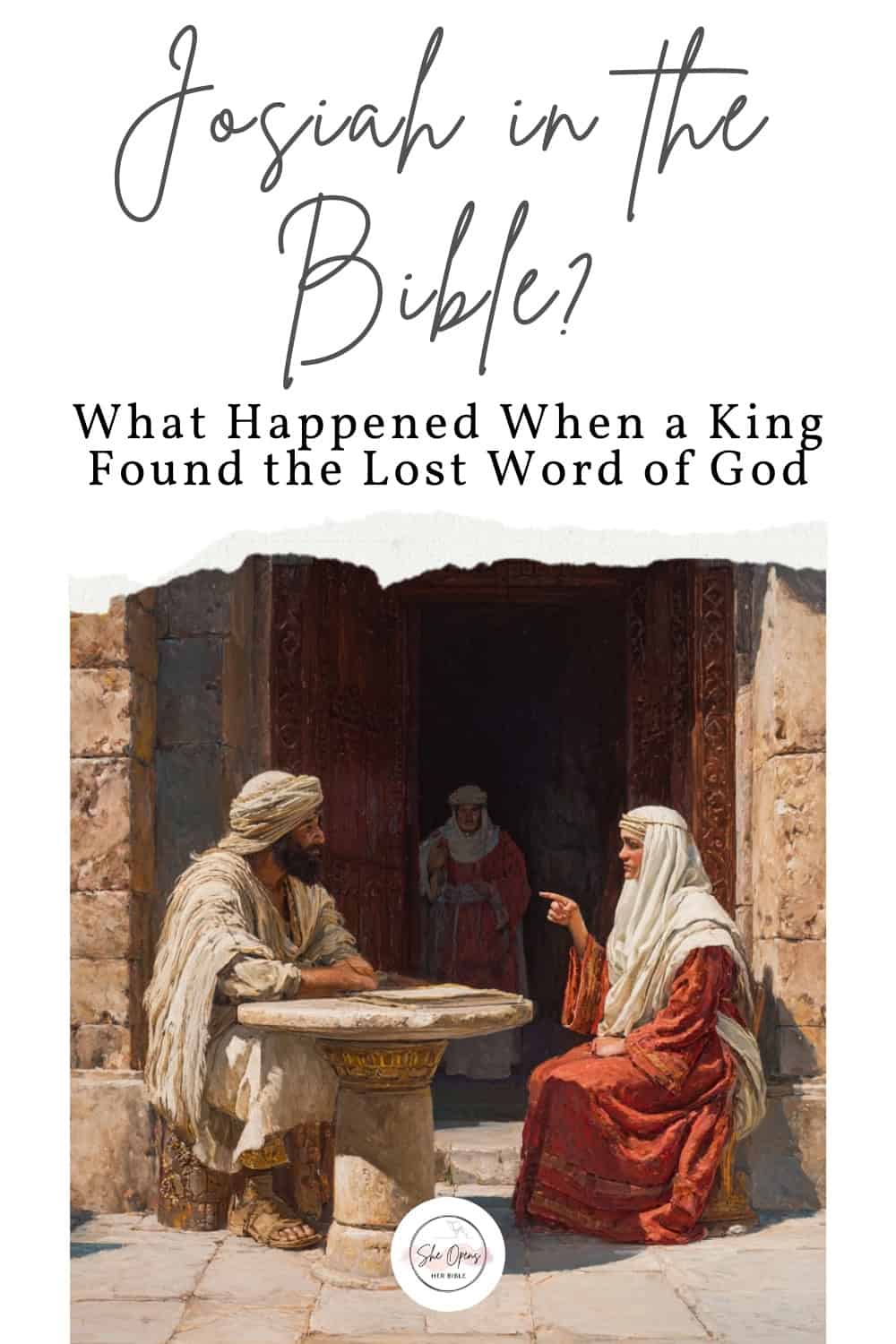
And so he sent his men to a prophetess.

Huldah the Prophetess: When a King Listened to a Woman
This is the detail that every woman studying Scripture should pause and sit with.
When the king of Judah needed someone to interpret the Word of God and speak the word of Adonai over a national crisis, he didn’t send for a male prophet. Jeremiah was alive and prophesying during this exact period. Zephaniah was active. And yet King Josiah sent his delegation specifically to Huldah.
“So Hilkiah the kohen and Ahikam, Achbor, Shaphan and Asaiah went to Huldah the prophetess, wife of Shallum the son of Tikvah, son of Harhas, keeper of the wardrobe. Now she lived in Jerusalem in the Second Quarter. They spoke with her.”
2 Kings 22:14 (TLV)
Huldah lived in the Second Quarter (also called the Mishneh) of Jerusalem, the newer section of the city, near the Temple. She was a woman with a known prophetic ministry, accessible and recognized. And when the five officials arrived at her door, she didn’t shrink from the weight of what was being asked. She delivered one of the most sobering and yet merciful prophetic messages in the book of Kings.
She confirmed the scroll’s authenticity and declared that yes, God’s judgment was coming upon Judah. But because Josiah had heard, humbled himself, and torn his clothes before God, the judgment wouldn’t come in his lifetime.
“Because your heart was tender and you humbled yourself before Adonai when you heard what I spoke against this place and against its inhabitants… I also have heard you, it’s a declaration of Adonai.”
2 Kings 22:19 (TLV)
Two things leap off the page here that are worth naming plainly:
First, the text presents Huldah’s prophetic authority without qualification or apology. She was a prophetess. The king’s men came to her. She spoke. God spoke through her. There is no editorial footnote suggesting this was unusual or secondary.
Second, Josiah’s responsiveness to the Word of God, specifically the tearing of his clothes, that act of qara’, is the thing God saw and honored. The tender heart. The humbled posture. The willingness to be broken by Scripture rather than managing it from a comfortable distance.
That is a word for every woman reading this.
To learn more about Huldah, visit our post Powerful Lessons from Huldah in the Bible: Faith, Courage, and Prophecy
Josiah’s Reforms: What Covenant Renewal Actually Looks Like
After receiving Huldah’s prophetic word, Josiah didn’t sit quietly with private conviction. He gathered all the elders of Judah and Jerusalem. He read the entire Book of the Covenant aloud to the people. And then he stood beside the pillar and made a covenant.
“The king stood by the pillar and made a covenant before Adonai, to walk after Adonai, and to keep His mitzvot and His testimonies and His statutes with all his heart and all his soul, to perform the words of this covenant that were written in this book. All the people stood by the covenant.”
2 Kings 23:3 (TLV)
What followed was a sweeping national reformation. The scope of what Josiah dismantled tells us just how deeply idolatry had embedded itself in Judah’s worship life:
- He removed all pagan vessels from the Temple, objects dedicated to Baal, Asherah, and the host of heaven
- He tore down the houses of the male cult prostitutes
- He desecrated the high places throughout the land, including the altar at Bethel that had stood since Jeroboam’s rebellion, fulfilling a prophecy spoken 300 years earlier (1 Kings 13:2)
- He removed mediums and spiritualists from the land
- He restored the observance of Passover, which hadn’t been properly kept since the days of the judges
“Before him there was no king like him, who turned to Adonai with all his heart and with all his soul and with all his might, according to all the Torah of Moses. Nor did any like him arise after him.”
2 Kings 23:25 (TLV)
This verse is remarkable. Josiah receives a commendation that neither David nor Solomon received in the same terms. The threefold “all”, all his heart, all his soul, all his might, is the language of the Shema itself (Deuteronomy 6:5). Josiah didn’t just recite the Shema. He lived it.
The New Testament Thread: Covenant Renewal Fulfilled in Yeshua
The story of Josiah is a beautiful foreshadowing of what Yeshua would accomplish in the New Covenant.
Josiah found a forgotten scroll and used it to call a nation back to covenant with God. Yeshua is Himself the living Word (John 1:1, 14), the fullness of everything the Torah pointed toward.
Where Josiah’s covenant renewal was partial and temporary (Judah still went into exile a generation later), the New Covenant Yeshua inaugurated is eternal and written not on scrolls but on human hearts (Jeremiah 31:33, Hebrews 10:16).
Josiah’s response to hearing the Word, tearing his clothes in grief and repentance, foreshadows what Yeshua called “poverty of spirit” in the Beatitudes: the mourning that leads to comfort, the hunger that leads to satisfaction, the humility that inherits the Kingdom. Josiah was Shema-shaped. And the New Covenant calls every believer to the same interior orientation.
Josiah also appears in Matthew’s genealogy of Yeshua (Matthew 1:10–11). He is part of the royal line through which the Messiah came. His life of faithful covenant-keeping was woven into the fabric of the story that would culminate in the One who’s the fulfillment of every covenant God ever made.
The Devotional Question: What Happens When You Find the Lost Word?
Here is the question this passage presses quietly but firmly into our hands:
Is it possible that the Word of God has become lost, not stolen, not destroyed, simply forgotten, buried under the busyness and familiarity of our days?
Josiah’s Temple was in terrible disrepair, but it was still standing. People were still going through the motions of worship. There was religious activity happening in the very building where the scroll had been buried. The tragedy here wasn’t absence but familiarity; God’s Word present but unread, honored in name but not in practice.
How many of us live in that space? Bibles on our shelves, apps on our phones, verses on our walls, and yet we can’t remember the last time Scripture genuinely broke us open the way it broke Josiah?
The invitation in 2 Kings 22 isn’t primarily about national revival. It is an invitation to a personal qara’ moment; a tearing, a softening, a willingness to let the Word of God say something uncomfortable and respond with humility rather than defense.
What would it look like if you read Scripture this week not to check a box, but the way Josiah heard it, as if for the first time, with everything at stake?
✦ S E L A H, Pause & Reflect
Has the Word of God ever genuinely broken you open? What was that moment, and what changed?
Where in your life has Scripture become familiar rather than formative? What might it look like to approach it with fresh eyes this week?
Josiah sent his men to a woman, Huldah, to hear the word of God. Who in your life speaks the truth of Scripture to you? Do you give that voice access?
Read 2 Kings 22:1–20 slowly in the Tree of Life Version. What word or phrase carries the most weight for you today? Sit with it before you move on.
A Faithful King’s Unexpected End
The story of Josiah has a shadow over it that must be named honestly. Despite his faithfulness, perhaps the most complete faithfulness of any king in Judah’s history, Josiah died in battle at Megiddo at the age of 39.
Pharaoh Necho of Egypt was marching north to fight the Babylonians, and Josiah went out to confront him. The Chronicles account (2 Chronicles 35:21–24) suggests Pharaoh explicitly warned Josiah that this wasn’t his battle, that God had sent Necho on this mission and Josiah should stand down. Josiah didn’t listen, disguised himself, and was struck by archers. He died in Jerusalem shortly after.
This is one of the hardest moments in the Kings narrative. A righteous king, obedient to God’s Word, dead too soon. It doesn’t resolve neatly. And perhaps that’s exactly the point.
Josiah’s faithfulness wasn’t rewarded with a long, comfortable life. It was rewarded with something Huldah had promised him: he wouldn’t see the disaster that was coming. He was spared the grief of watching Jerusalem fall, the Temple burn, and the people he loved marched into exile. God’s protection doesn’t always look the way we expect it to.
The people of Judah mourned him deeply. Jeremiah composed laments for him (2 Chronicles 35:25). And for a generation, his memory was held as the high-water mark of what a life fully turned toward God could look like.
My Final Thoughts: The God Who Supports and Heals
Yoshiyahu. Yahweh supports. Yahweh heals.
The man who bore that name spent his life proving it true, not because his circumstances were easy or his ending triumphant by human standards, but because in him, the character of God was on full display. A God who supports the heart that turns to Him. A God who heals what generations of sin have broken. A God whose Word, even when buried, never loses its power to break open and restore.
Josiah in the Bible isn’t primarily a story about a great king. It is a story about what happens when an ordinary human being, born into difficult circumstances, surrounded by spiritual wreckage, hears the Word of God and responds with an undivided heart.
That story is available to every one of us.
Lord, give us ears to hear. And hearts tender enough to tear.
And don’t forget to download your free copy of our Josiah Bible Study guide below!
Want to Study the Bible With Me?
If you enjoyed this study on King Josiah and want to keep going deeper into Scripture, I invite you to join me over at She’s So Scripture on Substack.
That’s where I share ongoing Bible teaching designed to help you read Scripture with more clarity, context, and confidence.
As part of the community, you’ll receive things like:
- Weekly deep dives into key passages
- Word Nerd Wednesday insights into Hebrew and Greek
- Context studies that uncover what many of us were never taught about the Bible
- Reflections that help you apply Scripture to real life
There are free and paid options, so you can join at whatever level works best for you.
Free subscribers receive regular teaching posts and reflections, while paid members get access to deeper studies, weekly Mussar lessons, live group Bible studies, and additional resources designed to help you grow in biblical literacy.
If you’d like to study Scripture together, you can join here:
👉 Join She’s So Scripture on Substack at https://shessoscripture.com
Let’s keep opening the Word together.
Download Your Study Guide
Frequently Asked Questions
-
What is Josiah in the Bible known for?
Josiah is known for three things above all: becoming king at the remarkably young age of eight, discovering the long-lost Book of the Law during Temple renovations, and launching the most sweeping religious reformation in Judah’s history.
Scripture gives him a unique commendation in 2 Kings 23:25, that no king before or after him turned to God with all his heart, all his soul, and all his might according to the Torah of Moses. He is also notable for restoring the Passover observance, which hadn’t been properly kept since the days of the judges.
-
What does the name Josiah mean in Hebrew?
The name Josiah comes from the Hebrew יֹאשִׁיָּהוּ (Yoshiyahu), Strong’s H2977. It carries two intertwined meanings: ‘Yahweh supports’, from the root ʾashya, meaning to prop up or sustain, and ‘Yahweh heals,’ pointing to divine restoration. Both meanings are deeply prophetic. Josiah was born into a dynasty of wicked kings, and yet God sustained and used him to bring national healing and covenant renewal. His very name foretold his mission.
-
How is Josiah related to Jesus?
Josiah appears directly in Matthew’s genealogy of Yeshua (Jesus) in Matthew 1:10–11, making him a direct ancestor of the Messiah through the royal line of David.
Beyond the genealogical connection, Josiah’s life foreshadows the New Covenant in several ways: his discovery of the lost Word of God points to Yeshua, who’s Himself the living Word (John 1:1, 14); his covenant renewal anticipates the New Covenant written on hearts (Jeremiah 31:33); and his response of deep repentance echoes the ‘poverty of spirit’ Yeshua describes in the Beatitudes.
-
Who was Huldah in the Bible and what was her role in Josiah’s story?
Huldah was a prophetess living in the Second Quarter (Mishneh) of Jerusalem during Josiah’s reign. When the Book of the Law was discovered and Josiah needed someone to interpret its words and discern God’s message for the nation, he sent five senior officials, including the high priest Hilkiah, specifically to Huldah, even though both Jeremiah and Zephaniah were active at the same time.
She confirmed the scroll’s authenticity, declared God’s judgment on Judah for their idolatry, and delivered a merciful word to Josiah: because his heart was tender and he’d humbled himself, the judgment wouldn’t come in his lifetime (2 Kings 22:14–20).
-
Did Josiah turn away from God?
No, Josiah never turned away from God. Scripture never records any moral failure or spiritual apostasy in his life. He is one of only a handful of kings in Judah’s history who receives an entirely positive evaluation.
The one decision that ended his life, going out to confront Pharaoh Necho at Megiddo against Necho’s own warning (2 Chronicles 35:21–23), is presented as a tragic miscalculation rather than a spiritual rebellion. His death came not from unfaithfulness but from a failure to listen in a specific military moment.
-
What can women learn from Josiah in the Bible today?
Several things stand out for women in particular. First, the story of Huldah shows that God has always spoken through women, and that a king sought out a woman’s prophetic voice at a moment of national crisis.
Second, Josiah’s response to Scripture, being genuinely broken by the Word rather than managing it from a safe distance, is a model for every believer. The Hebrew word qara’ (to tear) describes not just his clothes but his heart posture.
Third, his story asks us a personal question: has the Word of God become lost in our own lives, present but unread, honored in name but not transforming us in practice?

About Our Author
Diane Ferreira is a Jewish believer in Yeshua, a published author, speaker, seminary student, wife, and proud mom. She is the author of several books, including The Proverbs 31-ish Woman, which debuted as Amazon’s #1 New Release in Religious Humor. She is currently pursuing her graduate degree in Jewish Studies, with her favorite topics being the early church and Biblical Hebrew. Diane writes and teaches from a unique perspective, bridging her Jewish heritage with vibrant faith in the Messiah to bring clarity, depth, and devotion to everyday believers.
When she’s not writing, studying, or teaching, you’ll find her curled up with a good book, crocheting something cozy, or researching her next trip.
📚 Learn more here! | 💬 Join the discussion on our Substack!
Tree of Life (TLV) – Scripture taken from the Holy Scriptures, Tree of Life Version*. Copyright © 2014,2016 by the Tree of Life Bible Society. Used by permission of the Tree of Life Bible Society.