
Legacy of the Tribe of Manasseh: From Forgotten to Forever Sealed
Please note that this article may contain affiliate links. As an Amazon Associate, I earn on qualifying purchases at no additional cost to you. You can read more at the bottom of this page or read my full disclosure on my Affiliate Disclosure Page
The Tribe of Manasseh stands out among the twelve tribes of Israel. With a story that spans Egypt, the Promised Land, exile, and future prophecy, this tribe gives us a lot to think about. From its unusual division across the Jordan River to its role in the book of Revelation, Manasseh’s journey offers lessons about identity, leadership, and faith.
Whether you’re a student of the Bible, a history enthusiast, or someone seeking deeper meaning in Scripture, the story of the Tribe of Manasseh offers insights that are still relevant today.
Let’s explore what makes this tribe important and what believers in Yeshua can take from its legacy.
Be sure to download your free copy of our printable Tribe of Manasseh Bible study, Reflection and Action Challenge guide with worksheets at the end of this post! No sign up required!
Who Was Manasseh?
Manasseh (מְנַשֶּׁה, Menasheh) was Joseph’s firstborn son, born in Egypt to Joseph and Asenath, an Egyptian woman and the daughter of Potiphera, priest of On (Genesis 41:50–52). Joseph named him Manasseh because “God has made me forget all my trouble and all my father’s house.”
The name Menasheh comes from the Hebrew root nashah (נָשָׁה), meaning “to forget.” For Joseph, this name marked a turning point. He had gone through hardship, but now things were better. The mixed heritage of Asenath may also remind us that God’s covenant purposes are not limited by ancestry—a point later echoed in the presence of the Bnei Menashe communities in India, who claim descent from this tribe.
Jacob’s Blessing and the Double Portion
Manasseh was part of something unusual. When Jacob was near death, he called Joseph and his sons to him. In Genesis 48, Jacob gave a blessing to Joseph’s sons—Ephraim and Manasseh. But instead of giving the firstborn blessing to Manasseh, he placed his right hand on Ephraim, the younger son.
Joseph tried to correct his father, but Jacob said he knew what he was doing; Ephraim would become greater, but Manasseh would also grow into a people (Genesis 48:19).
Yet this moment was about more than just who got the bigger blessing. Jacob says in Genesis 48:5, “Now your two sons, who were born to you in the land of Egypt before I came to you in Egypt, they are mine… just as Reuben and Simeon are.” That was an act of adoption.
By adopting Ephraim and Manasseh, Jacob gave Joseph the double portion typically reserved for the firstborn. Instead of one tribe under Joseph’s name, there would be two. This moment also tied the House of Joseph permanently into the tribal structure of Israel.
Nachmanides (Ramban) explains that this was not symbolic… it was a real and legal transfer of status and inheritance. Rashi and Ibn Ezra also comment on the significance of this blessing, seeing it as a prophetic act rooted in covenant promises.
Manasseh’s Tribal Division: East and West
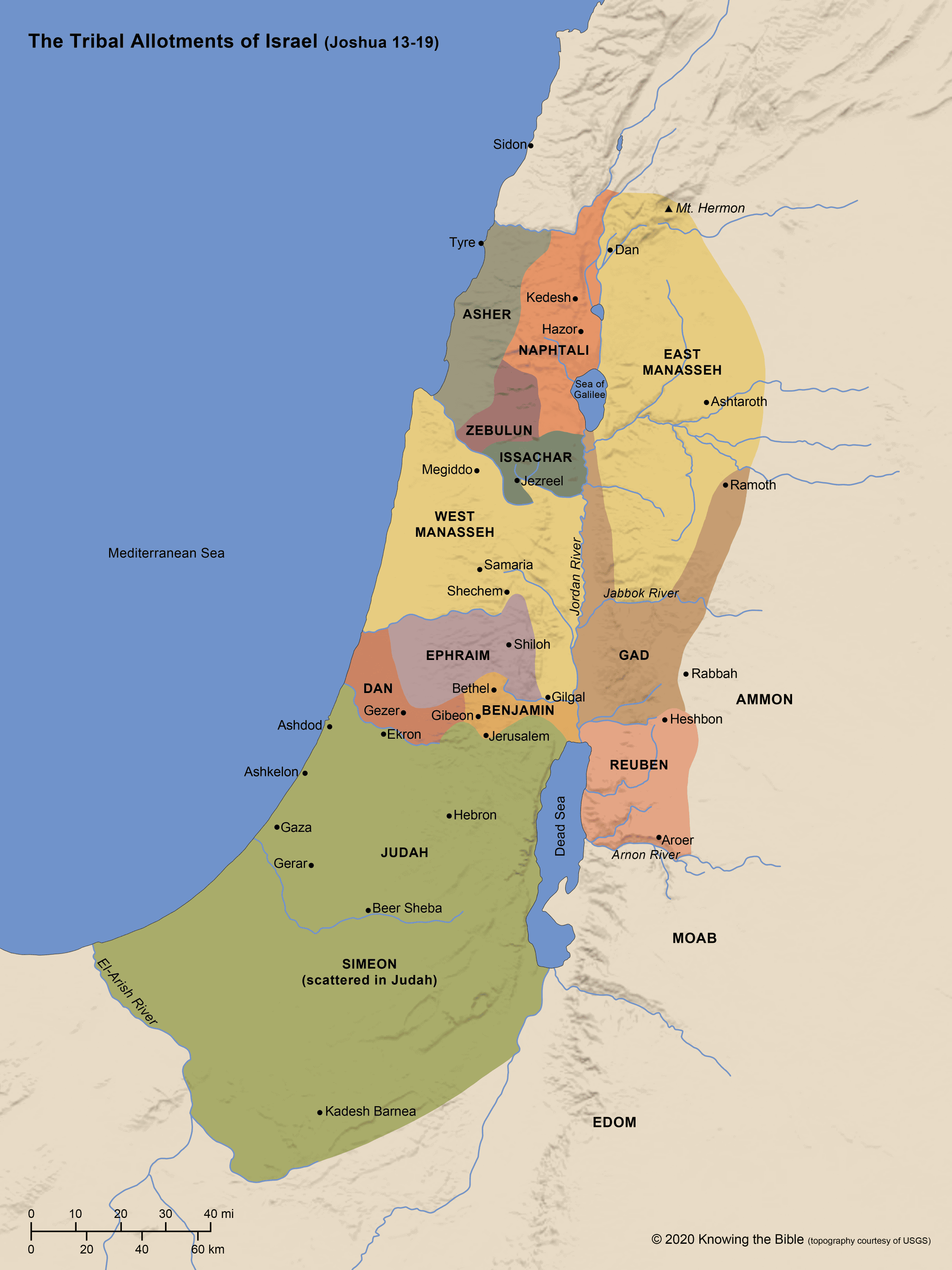
Manasseh is the only tribe split across both sides of the Jordan River. Half of the tribe settled east of the river in Gilead, alongside the tribes of Reuben and Gad (Numbers 32). Their territory extended from the Jabbok River in the south to Mount Hermon in the north—an area known for its strategic and agricultural value.
The western half received land in central Canaan, near Mount Carmel and Shechem. This dual placement gave the tribe influence in both agricultural trade and military strategy.
Table: Tribal Territories of East and West Manasseh
| Feature | East Manasseh | West Manasseh |
|---|---|---|
| Location | East of the Jordan River, region of Gilead and Bashan | West of the Jordan, central Canaan hill country |
| Modern Equivalents | Northern Jordan, part of modern-day Amman region | West Bank region, including Nablus (Shechem) |
| Key Cities | Golan, Edrei, Ashtaroth (Deuteronomy 1:4) | Shechem, Taanach, Megiddo (Joshua 17:11) |
| Tribal Allies | Reuben, Gad (Numbers 32:33) | Ephraim (Joshua 16:4, 17:8-10) |
| Cities of Refuge | Golan (Joshua 20:8) | Shechem (Joshua 20:7) |
| Military Role | Defenders of northern frontier; warriors under Jair and Machir (1 Chronicles 5:24) | Conquerors of Canaan hill towns (Joshua 17:12-13) |
| Spiritual Issues | Idolatry and exile under Tiglath-Pileser III (1 Chronicles 5:25-26) | Incomplete conquest and coexistence with Canaanites (Judges 1:27) |
Notable Leaders and Lineages
One of Manasseh’s key ancestors was Machir, who helped conquer Gilead and Bashan. His descendants took leadership roles, especially in the eastern region. Jair, a judge from this line, captured towns in Gilead (Numbers 32:41). The Book of Judges also references Machir in the Song of Deborah (Judges 5:14), linking the tribe to early resistance movements in Israel.
Zelophehad, another descendant of Manasseh, had no sons—only five daughters. Their story will take on fuller significance in a later section.
Military Might of the Tribe of Manasseh
Manasseh had a strong military reputation. They fought alongside other tribes to defeat powerful enemies like Og and Sihon. They also played a role in Joshua’s conquest of Canaan and held lands with strategic military importance.
1 Chronicles 5:18 calls the eastern half “valiant men,” trained in warfare. These warriors helped defend Israel’s northern and eastern borders. Unfortunately, their later idolatry would lead to their downfall.
The Land Inheritance of Manasseh
In Joshua 17, we see the land divided. Manasseh received a large area stretching from the Jordan River to the Mediterranean Sea. Key cities included Shechem, Megiddo, and Taanach. Shechem, located near Mount Gerizim and Mount Ebal, was part of Manasseh’s land and held both geographic and covenantal importance.
Despite this vast territory, they didn’t fully take control of it. Instead of driving out the Canaanites, they allowed them to stay and used them for forced labor (Joshua 17:12–13).
Manasseh’s Spiritual Decline
The tribe started strong but later turned away from God. 1 Chronicles 5:25–26 says they worshipped the gods of the people around them. Because of this, God allowed Tiglath-Pileser III, king of Assyria, to take them into exile.
This marked the beginning of the Ten Lost Tribes of Israel—those from the Northern Kingdom, including East Manasseh, who were scattered and never fully restored.
Sacred Geography: Cities of Refuge and Levitical Infrastructure
Manasseh’s territory included two cities of refuge—Shechem (west) and Golan (east) (Joshua 20:7–8). As one of the designated cities of refuge, Shechem offered protection for the accused and stood as a symbol of covenantal justice within tribal boundaries.
Levite clans were also assigned towns in Manasseh’s land. The Kohathites and Gershonites were among the families serving in these areas. These priestly groups helped teach Torah and lead worship, reinforcing the covenant in daily life.
The Daughters of Zelophehad: A Legal Precedent
As first mentioned in Manasseh’s lineage, the daughters of Zelophehad became central figures in shaping biblical inheritance laws.
When Zelophehad died, his daughters—Mahlah, Noah, Hoglah, Milcah, and Tirzah—appealed directly to Moses for their father’s inheritance (Numbers 27). God affirmed their claim and changed Israel’s laws about property and lineage.
Their story shows the importance of courage and faith. They preserved their father’s name and helped establish justice for future generations.

The House of Joseph: Ephraim and Manasseh
As noted earlier in Jacob’s blessing (Genesis 48), Manasseh and Ephraim were adopted as full tribal heirs. This act firmly established the House of Joseph as a central figure in Israel’s tribal framework.
In the days of the Kingdom of Israel (the Northern Kingdom), this house was politically dominant. Samaria, the capital city, was within their territory and became a major religious and cultural hub.
Ephraim and Manasseh in the Blessing of Children
While many biblical tribes fade into history, Ephraim and Manasseh live on in a unique way—through the blessing spoken over sons in Jewish homes every Shabbat evening.
Based on Genesis 48:20, where Jacob blesses Joseph’s sons saying:
“By you shall Israel bless, saying, ‘May God make you like Ephraim and like Manasseh,’”
This tradition is still practiced today. Parents place their hands on their sons and say:
“May God make you like Ephraim and Manasseh.”
(Y’simcha Elohim k’Ephraim v’chi’Menasseh)
Why these two? They were born in Egypt, outside the Promised Land, to a Hebrew father and an Egyptian mother. Yet they stayed within the covenant and were fully integrated into the people of Israel.
Their example of faithfulness in a foreign culture, unity despite differences, and acceptance into the family of God makes them a lasting model for future generations.
This blessing is usually followed by the Aaronic or Priestly Blessing from Numbers 6:24–26, reminding children that they are both loved by their family and held under God’s protective favor:
“The Lord bless you and keep you;
The Lord make His face shine upon you and be gracious to you;
The Lord lift up His countenance upon you and give you peace.”
Theological Interpretations
Manasseh is sometimes seen as representing quiet faithfulness. His name—“forgetting”—symbolizes moving past pain without letting it define the future. Rabbinic commentaries highlight his role as essential but understated.
Rashi notes how Manasseh, though passed over for the larger blessing, still received honor and land. Ramban sees this as a reminder that God uses both the strong and the overlooked for His purposes.
Archaeological and Historical Insights
Cities like Shechem, Edrei, and Golan have shown archaeological layers that match biblical accounts. Mount Ebal and Mount Gerizim, near Shechem, are known for the covenant ceremonies in Joshua 8. These sites provide important context for understanding Israel’s life and worship.
Mount Hermon, at the northern edge of Manasseh’s territory, also served as a boundary marker.
Visual Timeline: Tribe of Manasseh from Joseph to Revelation
- Joseph in Egypt (Genesis 41:50–52) – Manasseh and Ephraim are born.
- Jacob’s Blessing (Genesis 48) – Adoption and tribal elevation.
- Tribal Allotment (Joshua 13, 17) – Land divided East and West.
- Judges Era (Judges 5, Numbers 32) – Machir and Jair lead battles.
- Monarchy Period (1 Kings 4) – Incorporated into Solomon’s districts.
- Exile by Assyria (1 Chronicles 5:25–26) – Tiglath-Pileser III exiles East Manasseh.
- Ten Lost Tribes Era – Manasseh vanishes from history.
- Revelation 7:6 – Manasseh named among the sealed tribes.
Tribe of Manasseh in Prophecy
Revelation 7 includes Manasseh among the 144,000 sealed servants of God. Interestingly, Ephraim is not named—though Joseph is—suggesting that Manasseh may symbolically carry forward the identity of the House of Joseph in the end times.
Modern Relevance and Geography
Much of ancient Manasseh’s territory today lies in the West Bank and northern Jordan. Modern cities like Amman were built near ancient Rabbah, part of the region historically tied to Gilead and the eastern half of the tribe.
Claims of descent from Manasseh, such as those made by the Bnei Menashe in India, show how this tribe’s story still resonates around the world.
Lessons from the Tribe of Manasseh
- Faith requires follow-through
- God values inclusion
- Justice matters
- Even the scattered are remembered
- Quiet strength has value
My Final Thoughts
The Tribe of Manasseh shows us how God weaves blessing, responsibility, and justice through His people’s story. Their land, legacy, and faith choices still speak today. Whether you’re navigating leadership, injustice, or uncertainty, their story offers direction.
Now I’d love to hear from you—What part of Manasseh’s story speaks to your life right now? Share your thoughts in the comments below, and don’t forget to join our She Opens the Bible Study group for deeper conversation and community.
Don’t forget to download your free copy of our Tribe of Manasseh Bible study, Reflection and Action Challenge guide below!
FAQs on the Tribe of Manasseh in the Bible
Who was Manasseh in the Bible?
Manasseh was the firstborn son of Joseph and Asenath in Egypt. He later became the founder of one of the twelve tribes of Israel. Though he was the older brother, his younger brother Ephraim received the greater blessing from their grandfather Jacob.
What land did the tribe of Manasseh inherit?
The tribe of Manasseh received territory on both sides of the Jordan River. East Manasseh settled in the region of Gilead and Bashan, while West Manasseh settled in the hill country of central Canaan. This made them the only tribe with land in both areas.
Why was Manasseh split into two half-tribes?
This division happened because part of the tribe requested land on the east side of the Jordan, which was granted by Moses. The rest of the tribe received land west of the Jordan during the general tribal allotment under Joshua.
What happened to the tribe of Manasseh?
Over time, the tribe experienced both military success and spiritual failure. The eastern portion eventually fell into idolatry and was exiled by the Assyrians, becoming part of what is known as the Ten Lost Tribes.
Who were Zelophehad’s daughters and why are they important?
Zelophehad had no sons, only five daughters. They boldly requested a land inheritance so their father’s name wouldn’t disappear from his tribe. God honored their request and established a law through them that allowed daughters to inherit if no sons were present.
Why are Ephraim and Manasseh mentioned in blessings over children?
Jewish tradition blesses sons by saying, May God make you like Ephraim and Manasseh. This comes from Genesis 48, where Jacob declares that all of Israel will bless their children in the names of these two brothers, honoring their faithfulness and unity.
Why is Manasseh mentioned in Revelation but not Ephraim?
In Revelation 7, Manasseh is included among the 144,000 sealed servants, while Ephraim is not named. Instead, the name Joseph is used, which may represent Ephraim’s inclusion. The exact reason is not explained, but it highlights how God still remembers the tribe of Manasseh.
What spiritual lessons can we learn from the tribe of Manasseh?
Their story teaches the importance of obedience, the danger of compromise, the power of inheritance, and God’s faithfulness even to scattered and forgotten people.
What modern regions correspond to the land of Manasseh?
East Manasseh’s territory is in modern-day Jordan, including areas near Amman. West Manasseh’s land is in today’s West Bank, including cities like Nablus, which sits near ancient Shechem.
Are there people today who claim descent from Manasseh?
Yes, groups like the Bnei Menashe in India claim to descend from the tribe of Manasseh. While their claims are debated, they reflect a continued interest in tribal identity and biblical heritage.
Download Free Bible Study Workbook

About Our Author
Diane Ferreira is a Jewish believer in Yeshua, a published author, speaker, seminary student, wife, and proud mom. She is the author of several books, including The Proverbs 31-ish Woman, which debuted as Amazon’s #1 New Release in Religious Humor. She is currently pursuing her graduate degree in Jewish Studies, with her favorite topics being the early church and Biblical Hebrew. Diane writes and teaches from a unique perspective, bridging her Jewish heritage with vibrant faith in the Messiah to bring clarity, depth, and devotion to everyday believers.
When she’s not writing, studying, or teaching, you’ll find her curled up with a good book, crocheting something cozy, or researching her next trip.
📚 Learn more here! | 💬 Join the discussion on our Substack!
Tree of Life (TLV) – Scripture taken from the Holy Scriptures, Tree of Life Version*. Copyright © 2014,2016 by the Tree of Life Bible Society. Used by permission of the Tree of Life Bible Society.
Thank you. Really enjoyed this great article about the half-tribe of Manasseh. I found it while searching for a reason why it was delt with in halves. Wondering if free will is the answer. Will keep looking though.