
Why There Is No Tribe of Joseph: Ephraim & Manasseh Explained
Please note that this article may contain affiliate links. As an Amazon Associate, I earn on qualifying purchases at no additional cost to you. You can read more at the bottom of this page or read my full disclosure on my Affiliate Disclosure Page
When people first hear the phrase tribe of Joseph, they usually picture a nice, neat twelfth slice of Israel’s family tree. Then they open their Bible and realize Joseph isn’t listed as a tribe in most places. Ephraim shows up. Manasseh shows up. Levi sometimes goes missing. Dan mysteriously disappears in Revelation. And Joseph is just sitting there like that one relative everyone swears was at the family reunion, even though the photos tell a different story.
So today we are going to walk through the whole story behind why there is no tribe of Joseph in the traditional tribal listings, why Ephraim and Manasseh take his place, and how this choice by Jacob carries some deep biblical meaning. If you love understanding the Bible in a way that helps the stories click, this topic is going to be your new favorite thing.
Let’s get into who Joseph was, what his sons received, and how the house of Joseph shaped Israel’s history.
Be sure to download your free copy of our printable Tribe of Joseph Bible Study, Reflection and Action Challenge guide with worksheets at the end of this post!
Who Was Joseph? The Man Behind the Tribe
Joseph’s story is one of the most dramatic and emotional accounts in Scripture. He wasn’t just another son; he was the firstborn of Rachel, Jacob’s great love.
His Hebrew name, Yosef, comes from the root yasaf, which means “to add” or “to increase.” When Rachel named him, she said, “May the Lord add to me another son.” She saw Joseph as the beginning of something God would expand in her life.
Joseph grew up as the favored son. If you ever had siblings, you already know that being the obvious favorite is a bold life choice. That famous coat didn’t help the situation. His brothers already struggled with jealousy, and when Joseph started sharing his dreams that pretty much announced, “Hey everyone, I’m going to outrank you,” it was over. You can practically hear the ancient sibling drama from here.
Joseph was sold into slavery in Egypt and served in Potiphar’s household. Despite the betrayal, he held onto faith and integrity. Even when falsely accused and thrown into prison, he stayed steady. God used him there too, giving him the ability to interpret dreams. Those dreams eventually opened the door to his rise in Egypt.
By the time Pharaoh made him second in command, Joseph was thirty. He was given authority, wealth, and an Egyptian name, Zaphenath-Paneah. The famine came just as God revealed, and Joseph’s leadership saved not only Egypt but the surrounding regions. His own brothers arrived seeking food and bowed before him without recognizing him, fulfilling the dreams Joseph had as a teenager.
Eventually, Joseph revealed himself, forgave them, brought his entire family to Egypt, and lived to see his grandchildren. This is where the roots of the tribe of Joseph shift. Joseph never received a tribe under his own name. Instead, the blessing went to his sons.
Jacob’s Blessing and the Double Portion
Genesis 48 and 49 are some of the most significant chapters for understanding why we don’t see the tribe of Joseph listed in the usual way.
Right before Jacob died, he essentially adopted Joseph’s sons, Ephraim and Manasseh, as his own. He said, “Ephraim and Manasseh shall be mine, as Reuben and Simeon are.” In the ancient world, this was huge. Adoption in that context wasn’t casual. Jacob was giving Joseph’s sons the full status of his firstborn sons.
This brings us to the idea of the “double portion.” In Hebrew culture, the bekhor, the firstborn son, received twice the inheritance of the other sons. Not because he was the favorite but because he carried the responsibility of leading the family and preserving the family lineage.
Reuben was Jacob’s actual firstborn, but he forfeited the firstborn blessing due to serious moral failure. That place moved to Joseph. Instead of giving Joseph a double portion in the form of extra land under the name tribe of Joseph, Jacob split Joseph’s blessing between Ephraim and Manasseh. This created two tribes from Joseph’s line.
And then Jacob did something unexpected. When blessing the boys, he crossed his hands. Manasseh was older, so Joseph assumed he would receive the more significant blessing. Jacob knew better. He placed his right hand on Ephraim, the younger, and his left hand on Manasseh.
Joseph tried to correct him, but Jacob said, “I know, my son, I know. He also will become a people, and he also will be great. Yet his younger brother shall be greater than he, and his seed shall become a multitude of nations.”
So instead of a tribe of Joseph, we get Ephraim and Manasseh stepping into that inheritance. Joseph received the double portion through them.
Is There Actually a Tribe of Joseph?
Now here’s where it gets interesting.
If you’re reading through the Old Testament, you’re going to notice something. The tribe of Joseph almost never appears as a separate tribe. You get Ephraim. You get Manasseh. Sometimes you get the phrase house of Joseph, especially in books like Joshua and Judges.
But the tribe of Joseph does show up in Revelation 7 when John lists the tribes sealed in the last days. That makes people wonder what happened.
Old Testament tribal lists usually include:
That’s thirteen if you’re counting. But Levi often isn’t included in land allotments because they served as priests. Joseph isn’t listed by his name because his sons represent him. Dan sometimes drops out entirely depending on the list.
Numbers 26 and Joshua’s territory assignments both show Ephraim and Manasseh instead of Joseph. Yet Revelation 7 uses “Joseph” and “Manasseh.” Ephraim’s name is not used, but many interpreters understand that “Joseph” in Revelation covers Ephraim’s descendants.
The tribe of Joseph exists, but not in the usual way. It’s expressed through Ephraim and Manasseh. The house of Joseph refers to both tribes together.
Think of it like a parent whose legacy lives on in their children. Joseph’s blessing didn’t vanish. It expanded.
The Territories of Ephraim and Manasseh
The land of Ephraim and Manasseh was some of the most desirable land in ancient Israel. When you look at a map of the tribal allotments, the house of Joseph sits right in the central highlands.
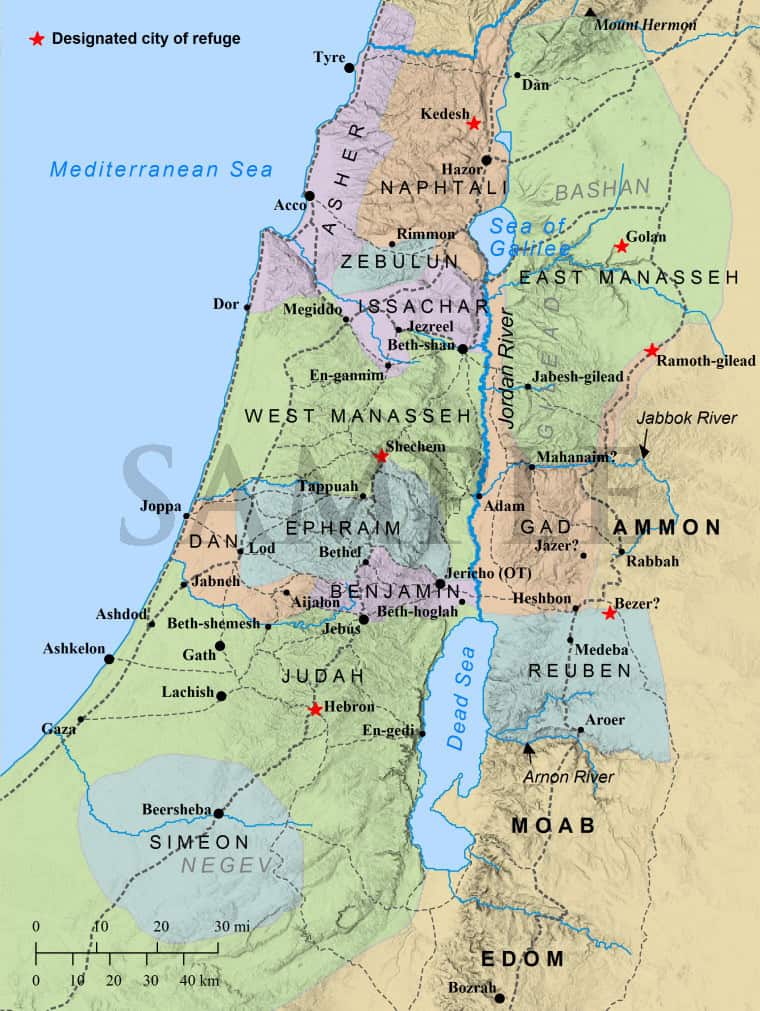
Ephraim’s Territory
Ephraim received the central portion. This included Shiloh, which became the early center of worship before the Temple existed. The ark was there for a long time. This made Ephraim spiritually influential.
Ephraim’s land was fertile, full of water sources, and placed in a location that gave the tribe strategic control. Many judges and leaders came from Ephraim, and later on, the Northern Kingdom was often identified with Ephraim as a whole.
Manasseh’s Territory
Manasseh received an even larger region. Half of the tribe lived on the west side of the Jordan River, and the other half lived east of the Jordan.
The western side included cities like Shechem and Megiddo. Shechem holds a special place in Israel’s history. It’s where Joshua renewed the covenant and where Joseph’s bones were buried.
The eastern side was known for vast grazing lands. Manasseh had room to grow, and they often did. Some of Israel’s strongest warriors came from Manasseh.
Together, the territories of Ephraim and Manasseh formed the backbone of the Northern Kingdom. When prophets talk about the sins of “Ephraim,” they’re often speaking to the whole region.

Symbols and Prophetic Significance
Joseph’s tribe, represented by Ephraim and Manasseh, carries some beautiful symbolic meaning.
One traditional symbol associated with Joseph’s tribe is the sheaf of wheat. This ties back to Joseph’s dreams about the grain sheaves bowing down. Wheat imagery also connects to themes of provision, blessing, and abundance.
Jacob’s prophetic blessing in Genesis 49 speaks of Joseph as a “fruitful bough by a spring; its branches run over a wall.” This imagery captures Joseph’s life perfectly. He grew, endured, extended himself, and bore blessing far beyond what anyone expected. His life overflowed into nations.
Many Jewish commentators see Joseph as the example of someone who thrived in exile, stayed faithful, and brought blessing to others. He showed integrity in a foreign land and demonstrated wisdom under pressure. His story is one of resilience, but it’s also one of God’s quiet faithfulness.
Some Christian interpreters see Joseph as a type of Messiah because of the patterns in his life.
- He suffered unjustly.
- He was betrayed by his own brothers.
- He was elevated to a place of authority.
- His actions brought salvation to both Jews and Gentiles.
While this is not the same as direct prophecy, the parallel is meaningful to many believers in Yeshua.
Lessons and Takeaways
Joseph’s story always feels personal. Maybe it’s because he went from favored son to forgotten slave, then from prisoner to leader. Maybe it’s because we know what it feels like when life takes an unexpected turn. Joseph’s life reminds us that God never wastes our pain.
Here are a few simple lessons we can take with us.
Your circumstances don’t define God’s plan.
Joseph lived years in situations that looked like failure. Yet God was positioning him the entire time. You may have seasons when things don’t make sense. You’re not forgotten.
Obedience shapes legacy.
Joseph remained faithful. His choices affected generations. Ephraim and Manasseh became tribes because Joseph stayed the course. The choices you make matter, even when no one notices yet.
God can turn loss into fruitfulness.
The meaning of Joseph’s name, “He will add,” became true in ways his mother never imagined. God multiplied his story through his sons. God still works that way in our lives. What feels like an ending can become the beginning of something new.
Blessing can flow through unexpected channels.
The younger son, Ephraim, received the larger blessing. God doesn’t always work according to human order or expectation. Sometimes He surprises us with where the blessing lands.
My Final Thoughts
The tribe of Joseph sits in this fascinating space where it exists and doesn’t exist at the same time. Joseph’s name isn’t stamped on a single portion of land, yet his inheritance expands through Ephraim and Manasseh. The house of Joseph shaped Israel’s history, carried spiritual influence, and still raises questions people are curious about today.
If the tribe of Joseph teaches us anything, it’s that God knows how to multiply what we hand Him. Joseph handed God his trust, his integrity, and his faith through some rough seasons. God turned it into a legacy that reached far beyond one man.
If this helped you understand the tribe of Joseph a little better, I’d love to hear your thoughts in the comments. And if you want to study Scripture with people who love digging into the Word together, come join our She’s So Scripture Substack. Subscriptions are free and there are other options for people who want to get into deeper study! We would love to have you there.
If you’re feeling called to dig deeper into God’s Word, grow in your spiritual identity, or even build your ministry with confidence, I’d love to walk that journey with you. My Biblical Mentorship Program is open now — you can check out all the details and sign up below.
And don’t forget to download your free copy of our Tribe of Joseph Bible Study, Reflection and Action Challenge guide below!
Frequently Asked Questions About the Tribe of Joseph
Why is there no tribe of Joseph listed among the twelve tribes of Israel?
Because Jacob gave Joseph’s blessing to Ephraim and Manasseh. Joseph received the double portion through his sons. They became tribes in his place.
What’s the difference between the house of Joseph and the tribe of Joseph?
The house of Joseph refers to Ephraim and Manasseh together. The tribe of Joseph in Revelation is a reference that includes Ephraim through the broader identity of Joseph’s line.
How are Ephraim and Manasseh connected to modern claims about the lost tribes?
Some groups claim descent from Ephraim or Manasseh, but the historical evidence is very limited. The tribes were scattered after the Assyrian exile, but Scripture focuses more on spiritual restoration than DNA tracking.
Is the tribe of Joseph the same as Joseph’s descendants?
Yes, but with a twist. Joseph’s descendants became two tribes instead of one. Revelation 7 uses Joseph’s name, but Old Testament lists generally use Ephraim and Manasseh.
Why is Ephraim sometimes used as a nickname for the Northern Kingdom?
Because Ephraim became the most dominant tribe in the north. Prophets often called the entire Northern Kingdom “Ephraim” due to its influence.
Why does Dan disappear in Revelation 7?
There is no universally agreed answer. Some believe it relates to idolatry associated with Dan’s territory. Others see it as symbolic. Joseph’s inclusion helps complete the number twelve.
Download Your Printable Study Guide


About Our Author
Diane Ferreira is a Jewish believer in Yeshua, a published author, speaker, seminary student, wife, and proud mom. She is the author of several books, including The Proverbs 31-ish Woman, which debuted as Amazon’s #1 New Release in Religious Humor. She is currently pursuing her graduate degree in Jewish Studies, with her favorite topics being the early church and Biblical Hebrew. Diane writes and teaches from a unique perspective, bridging her Jewish heritage with vibrant faith in the Messiah to bring clarity, depth, and devotion to everyday believers.
When she’s not writing, studying, or teaching, you’ll find her curled up with a good book, crocheting something cozy, or researching her next trip.
📚 Learn more here! | 💬 Join the discussion on our Substack!