
Tribe of Gad: Hebrew Meaning, Military History, and What Scripture Teaches Us
Please note that this article may contain affiliate links. As an Amazon Associate, I earn on qualifying purchases at no additional cost to you. You can read more at the bottom of this page or read my full disclosure on my Affiliate Disclosure Page
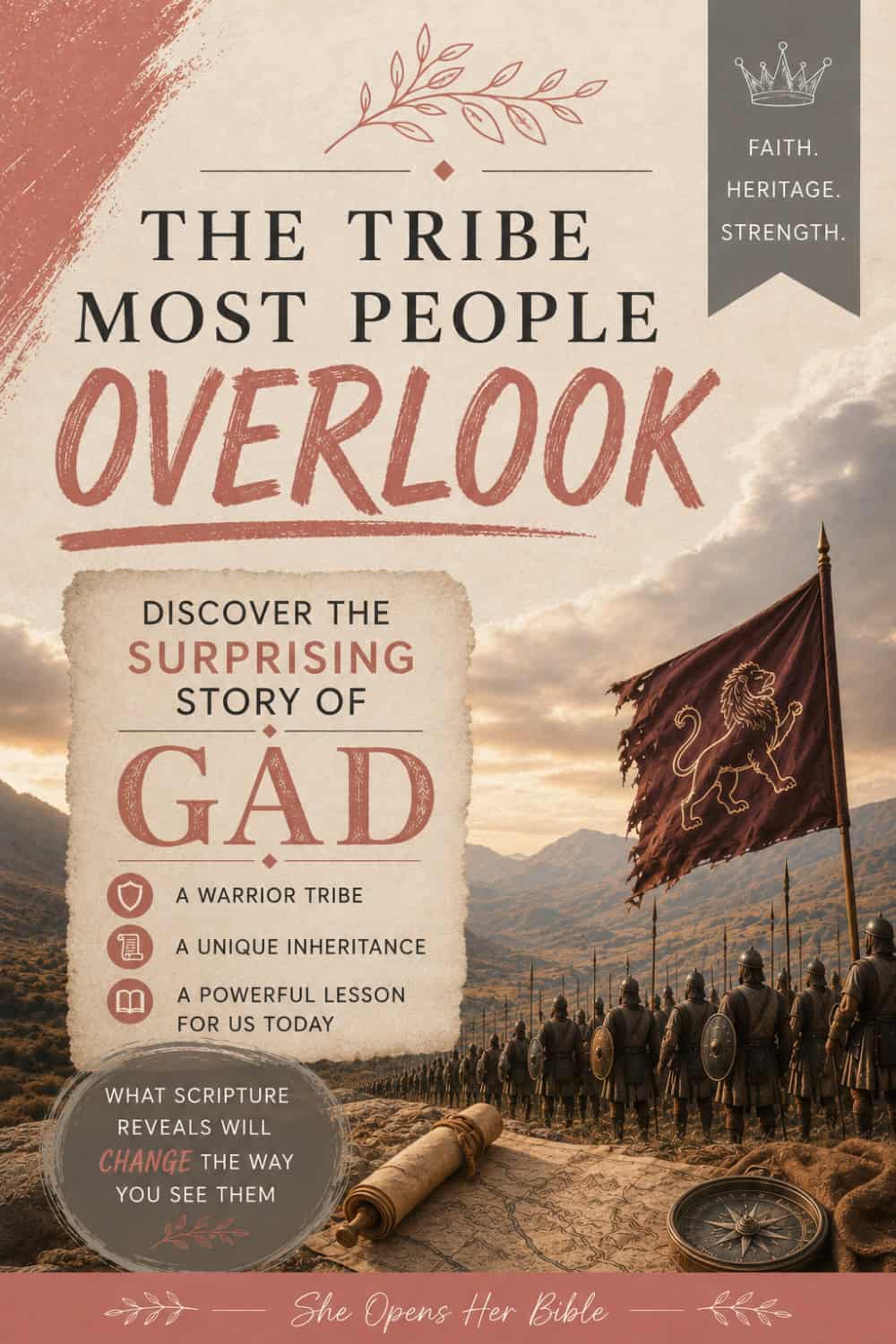
Of the twelve sons of Jacob, Gad is probably the one most associated with a single image: the warrior at the border, crouched low, watching the horizon like somebody is absolutely about to try him.
Jacob describes him as a raider who gets raided but never stays down. Moses compares him to a lion tearing at arm and scalp. The warriors descended from Gad are described as having faces like lions and moving with the speed of gazelles across the mountains. Honestly, the tribe carries big “don’t start none, won’t be none” energy throughout the biblical text.
But underneath all of that battlefield imagery is something deeper. Gad’s story is really about covenant faithfulness. This was a tribe that intentionally chose a difficult inheritance, kept its word when it would have been easier not to, and spent generations guarding the edges of Israel’s story where pressure was often highest.
In this study, we’re going to follow Gad from his birth in Genesis through the wilderness years, the conquest, the monarchy, exile, and finally the prophetic visions of restoration. Along the way, we’ll unpack the Hebrew name in depth, the prophetic blessings spoken by both Jacob and Moses, the geography of Gad’s territory, the lion-faced warriors of 1 Chronicles 12, and what Gad’s faithfulness at the border still teaches us as students of Scripture today.
Because if we’re honest, some of the strongest faith in Scripture is found at the edges. Not in comfort. Not in visibility. At the border where people have to decide whether they’re still going to keep showing up, keep standing watch, and keep their covenant when life gets costly. Gad understood that assignment.
This study also pairs with the Tribe of Gad Bible Study Guide linked at the end of this post, featuring six sessions of printable worksheets, Hebrew word studies, and reflection questions.
What Is the Tribe of Gad? An Overview
The tribe of Gad was one of the twelve tribes of Israel, descended from Gad, the seventh son of the patriarch Jacob. Gad’s mother was Zilpah, the handmaid of Jacob’s wife Leah, which made Gad a full brother to Asher and a half-brother to the sons of Leah and Rachel.
After the Exodus from Egypt, the tribe of Gad settled on the eastern side of the Jordan River in the region of Gilead, where they became known for their exceptional military strength.
They were among the first tribes to receive their inheritance, choosing the Transjordan territory before the conquest of Canaan even began. And in doing so, they made a binding commitment to fight alongside their brothers until every tribe had received its portion of the Promised Land.
Gad’s story spans nearly every major movement of the Hebrew Bible: the wilderness census, the Transjordan request, the conquest under Joshua, the era of Saul and David, the Assyrian exile, and the prophetic visions of restoration in Ezekiel and Revelation. Gad is never the most visible tribe, but at almost every turning point, they are there, at the border, keeping their word.
The Birth of Gad: Zilpah and the Cry of Fortune
To understand Gad, you have to step back into the deeply complicated household of Jacob, where every birth carried the weight of grief, rivalry, longing, and somebody trying not to lose their place in the family narrative. The sons of Jacob were not born into a peaceful little pastoral scene with soft lighting and harp music in the background. This family was messy from the beginning.
Leah, Jacob’s first wife, spent years watching her sister Rachel receive the affection she herself desperately wanted. Meanwhile, Leah kept bearing sons, almost as though every child became both a blessing and another silent plea to be fully loved. Then Leah stopped conceiving for a season, and in the middle of that heartbreak, she gave her servant Zilpah to Jacob as a wife.
When Zilpah gave birth to a son, it was Leah who named him:
“Now Leah’s servant Zilpah bore Jacob a son. Leah said, ‘Good fortune!’ So she called his name Gad.”
(Genesis 30:10-11, TLV)
And honestly, the naming itself already tells you something important about this family dynamic. Nobody in Jacob’s household is naming children casually. Every name is loaded. Every birth comes wrapped in emotion, competition, desperation, relief, or hope. These women are essentially naming their pain in real time.
Those words, good fortune, are the Hebrew word גָד (gad), which is the name itself. But the naming moment is richer than it appears, because the Hebrew of this verse has generated significant discussion among both ancient and modern scholars.
The Hebrew Name Gad: A Word Study
The name Gad carries two closely related meanings that scholars have discussed for centuries, and that layered wordplay becomes part of the story itself.
| Hebrew | Transliteration | Core Meaning |
| גָּד | gad | Troop, raiding band |
| גָּד | gad | Good fortune, luck |
Fortune / Luck
The most straightforward reading of Genesis 30:11, and the one reflected in most English translations, is that Leah exclaimed ‘good fortune!’ when Zilpah’s son was born. This reading is supported by the Septuagint, which translates the phrase as ‘with fortune.’ It’s also reflected in the TLV, the ESV, and most modern translations.
Troop / Raiding Band
The other meaning comes from the Hebrew root גדד (gadad), meaning a troop, raiding band, or company of warriors. This is the meaning that surfaces in Jacob’s deathbed blessing in Genesis 49, where Gad is described in language that plays directly on this root. The ancient rabbis picked up on this almost immediately and connected both meanings together. Gad was both a sign of Leah’s “good fortune” in gaining another son and a foreshadowing of the fierce warrior identity that would later define the tribe.
And honestly, that layered meaning fits Gad perfectly. This becomes a tribe associated with fertile land, strategic positioning, and aggressive military strength all at the same time. Gad carries this fascinating tension throughout Scripture. Blessing and battle seem to travel together in their story. Favor and warfare keep sharing the same sentence.
Which, if we’re honest, is true for a lot of biblical people.
Sometimes the very place God blesses you is also the place where you’ll experience the greatest pressure.
There’s also another appearance of “Gad” in Scripture that adds even more theological texture to the name. In Isaiah 65:11, Gad appears as the name of a deity associated with fortune, a false god Israel was tempted to follow. Most English translations capitalize it as “Fortune.”
And this is where the biblical world starts getting really interesting because Scripture is constantly interacting with the cultures around Israel whether modern readers notice it or not. The Hebrew Bible is not unfolding in isolation somewhere. Israel lived surrounded by rival gods, competing belief systems, and neighboring nations attaching spiritual meaning to all kinds of things.
So when Leah cries out “good fortune,” she is proclaiming the provision of the Lord using language that surrounding cultures had already connected to a pagan deity. That tension is sitting quietly underneath the text from the very beginning.
And honestly? That is such a Hebrew Bible moment.
The biblical authors constantly take language, imagery, or ideas familiar in the surrounding culture and pull them back under the authority of the God of Israel. What the nations attached to false worship, Israel was supposed to understand rightly through covenant relationship with the Lord.
Jacob’s Blessing to His Son Gad
Genesis 49:19
Near the end of his life, Jacob gathered his twelve sons and spoke a prophetic word over each of them. What he said to Gad is compact, vivid, and built on a dense wordplay in the Hebrew:
“Gad — a raiding band will raid him, but he will raid at their heels.”
(Genesis 49:19, TLV)
This is one of the most phonetically concentrated verses in the Hebrew Bible. In the original, it sounds something like this:
Gad gedûd yegüdennû, ve’hû yagûd ‘āqēv.
The word gedûd (raiding band), the name Gad, and the verb yagûd (to raid, attack) all share the same root. Jacob is essentially saying: the man named Raider will be raided by raiders, but he will raid back and get the last strike. That’s a lot of raids! It’s a prophecy of pressure, resilience, and ultimate triumph written directly into the sounds of the name itself.
That description fits the tribe’s history precisely. Gad settled on the eastern side of the Jordan, in territory that bordered Ammon, Moab, and eventually the Arameans to the north. They lived on the frontier, exposed and frequently under attack. They would be raided, and the historical books confirm it. But Jacob’s word was that the tribe of Gad would never be permanently overcome. They would always strike back at the heels of their enemies.

Moses’ Blessing Over the Tribe of Gad
Deuteronomy 33:20-21
Decades later, as Moses prepared to die on the eastern side of the Jordan (in the territory that would become Gad’s), he also pronounced a blessing over the tribe. His words are among the most vivid in all of Deuteronomy:
“About Gad he said: Blessed is the one who enlarges Gad’s territory! He dwells there like a lion, tearing at arm or head. He chose the best land for himself, for there a commander’s portion was reserved. He came with the leaders of the people; he carried out Adonai’s justice and His judgments with Israel.”
(Deuteronomy 33:20-21, TLV)
Moses doesn’t open with a description of Gad, but with a blessing on whoever enlarges Gad’s territory. That’s significant. It recognizes that Gad’s borders were always under pressure and invites God’s favor on anyone who pushes those borders back in Israel’s direction.
Then the lion image:
“He dwells there like a lion, tearing at arm or head.”
This is a picture of decisive, aggressive strength in battle. The arm represents an enemy’s power, the ability to fight back and exert force. The head represents authority itself. So when Moses describes Gad as a lion tearing at both arm and scalp, this is not defensive imagery. Gad is not hiding behind walls hoping trouble passes by. The tribe is portrayed as going straight for the source of the threat.
And honestly, that fits everything we see about Gad throughout Scripture. They were a border tribe. Border tribes do not survive by being passive.
Moses also says Gad “chose the best land for himself,” referring to the tribe’s decision in Numbers 32 to settle east of the Jordan in the Transjordan region. Some commentators read that negatively, almost as though Gad settled early because they lacked faith or accepted something less than God’s best. But Moses does not frame it as compromise. He openly calls it good land. More than that, he says a commander’s portion was reserved there.
That matters because Christians sometimes have a habit of treating difficult callings as though they must automatically be lesser callings. But Gad’s inheritance was difficult, exposed, and strategically vulnerable while still being good. Those things are not mutually exclusive.
And honestly, there’s a word in that all by itself.
Some territory carries both blessing and pressure at the same time.
The final line of Moses’ blessing is what really anchors the entire picture though: “he came with the leaders of the people; he carried out the Lord’s justice.” That statement reaches back to Numbers and Joshua when the eastern tribes promised they would cross the Jordan and fight alongside the rest of Israel before settling fully into their own inheritance.
And Gad kept its word.
They could have stayed comfortably on the eastern side protecting only their own households and livestock. Instead, they crossed over armed alongside their brothers because covenant responsibility mattered more than convenience.
That is why Gad’s warrior identity matters biblically. Their strength was never disconnected from covenant faithfulness. Their warfare became an expression of it.
And honestly, that is one of the most important theological tensions in Gad’s story. Scripture does not always present gentleness and strength as opposites. Sometimes covenant faithfulness looks like tenderness. Sometimes it looks like endurance. And sometimes it looks like standing at the border refusing to abandon your post while everyone else gets safely home.
The Tribe of Gad in the Wilderness
Numbers 1 and 26
The tribe of Gad was a substantial presence in the wilderness. At the first census recorded in Numbers 1, Gad was counted at 45,650 fighting men, males twenty years old and older who were able to go to war.
(Numbers 1:24-25, TLV)
In the arrangement of Israel’s wilderness camp, Gad was positioned on the south side of the tabernacle under the banner of Reuben alongside Reuben and Simeon (Numbers 2:10–14). Even that placement feels fitting for Gad when you look at the tribe’s larger story.
The camp itself functioned almost like a living formation surrounding the presence of God, and Gad occupied one of the outward-facing positions within that structure. There was both liturgical meaning and military wisdom built into the arrangement. Israel worshiped as a people, but they also traveled as a people prepared for movement, pressure, and conflict.
And Gad’s placement tells you something about the tribe immediately. They were close to the center, but positioned toward the edge.
Honestly, that becomes a theme with them.
The tribe’s leader during the wilderness years was Eliasaph son of Reuel (Numbers 1:14), who presented Gad’s offering during the dedication of the altar on the sixth day (Numbers 7:42–47). Gad was also represented among the twelve spies sent into Canaan through Geuel son of Machi (Numbers 13:15). So even early in the narrative, the tribe is fully participating in the covenant life of Israel. Worship. Leadership. Exploration of the land. Warfare. Gad is knit into all of it.
By the time we reach the second census in Numbers 26, nearly forty years have passed. An entire generation has died in the wilderness. And you can feel the weight of that reality in the numbers themselves. Gad decreases from 45,650 fighting men to 40,500.
It is a quiet detail, but Scripture is full of quiet details that preach if you let them.
The wilderness cost them something.
And honestly, that is part of the tragedy of Israel’s wilderness generation overall. Wandering always carries consequences even when God is still preserving His people in the middle of it. The census numbers become little memorial stones to an entire generation that never crossed over.
But Gad endured.
Reduced, yes. Weathered, absolutely. But still standing. Still organized. Still covenant-bound. And eventually, still arriving at the Jordan intact.
The Transjordan Request: Numbers 32
The pivotal moment in Gad’s history, the decision that would shape its entire inheritance, came in Numbers 32, and it nearly ended in a crisis.
As the eastern Amorite territories had been conquered (Numbers 21), the tribes of Reuben, Gad, and the half-tribe of Manasseh looked at the land of Jazer and Gilead and saw what they needed: open country capable of supporting large herds of livestock. So they approached Moses, Eleazar, and the tribal leaders with a request.
“The people of Reuben and Gad had a very large number of livestock. When they saw that the land of Jazer and the land of Gilead were a suitable place for livestock, they said…”
(Numbers 32:1, TLV)
Moses’ initial reaction was sharp. He heard the request as a repetition of the spies’ failure forty years earlier: another generation losing heart and refusing to go forward, discouraging the rest of Israel just as the promised land was within reach.
But the leaders of Gad and Reuben were not asking to stay behind. They made a careful counter-proposal: let their women, children, and livestock settle in the fortified cities of the Transjordan, while every fighting man crossed the Jordan and marched at the forefront of Israel’s army until every other tribe had received its inheritance.
“Your servants will cross over, every man armed for war, before Adonai to battle, just as my lord says.”
(Numbers 32:27, TLV)
Moses accepted and made the terms explicit: if they kept their word, the land east of the Jordan was theirs. If they didn’t cross with their brothers, they would be sinning against the Lord, and their sin would find them out (Numbers 32:23).
Gad and Reuben kept their word completely. Joshua confirmed this at the end of the conquest (Joshua 22:1-4), commending them for obeying every command Moses had given and for not forsaking their brothers through the years of the campaign.
The eastern tribes had chosen a harder path. They would fight for land they would never even live in, separated from their families for years, before returning to their own inheritance. That kind of faithfulness is not the behavior of men who settled for second best.
The Territory of Gad
Joshua 13:24-28
When Joshua formally assigned the land, the tribe of Gad received the central portion of the Transjordan, a region rich in both challenges and gifts.
Their territory ran through the heart of Gilead, the highland country east of the Jordan River. It stretched from the Arnon gorge in the south toward Mahanaim in the north, bordered by Ammon to the east and the Jordan Valley to the west. Key cities within Gad’s allotment included Jazer, Ramoth in Gilead, Mahanaim, and Succoth.
Gilead itself was known for its forests, pastures, and healing balm. The famous ‘balm of Gilead’ referenced in Jeremiah 8:22 likely came from this region. The land was genuinely good, which confirms Moses’ words that Gad had chosen the best land for himself. But it was also a border territory, exposed on the east to the Ammonites and Moabites and eventually to the Arameans from the north.
Living at the border meant living in a state of permanent alertness. There was no comfortable interior position for the tribe of Gad. Their inheritance placed them precisely where the pressure came from, and that position required exactly the kind of warrior culture that Jacob and Moses had prophesied over them.
The Altar at the Jordan: Joshua 22
One of the most theologically rich moments in the tribe of Gad’s history comes at the end of the conquest, and it nearly ended in civil war.
When the fighting was done and Joshua released the eastern tribes to return home, the tribes of Gad, Reuben, and the half-tribe of Manasseh stopped at the Jordan and built a large, conspicuous altar on its bank.
Word reached the other tribes, and the response was immediate and alarmed: the western tribes assembled at Shiloh, ready to go to war. They assumed the altar was an act of rebellion against the Lord, a sign that the eastern tribes were breaking from the worship at the tabernacle and setting up a rival site.
Before the armies moved, a delegation led by Phinehas the priest crossed the Jordan to confront the eastern tribes. What they heard stopped the conflict entirely.
The altar was not for sacrifice. It was not for worship at all. It was a witness, a monument built so that future generations, both east and west of the Jordan, would have visible proof that the eastern tribes were fully part of Israel and shared in the covenant with the God of Israel.
“Far be it from us to rebel against Adonai or to turn away this day from following Adonai, by building an altar for burnt offering, grain offering or sacrifice, other than the altar of Adonai our God that stands before His tabernacle.”
(Joshua 22:29, TLV)
The fear was a real one. The Jordan River was a natural boundary that could easily become a theological one. Future generations west of the Jordan might tell the children of Gad and Reuben that they had no share in the Lord. The altar was built to prevent exactly that, a standing declaration in stone that the eastern tribes worshipped the same God at the same tabernacle as the rest of Israel.
“The people of Reuben and the people of Gad called the altar Witness, ‘For,’ they said, ‘it is a witness between us that Adonai is God.'”
(Joshua 22:34, TLV)
The western tribes accepted this. Phinehas blessed them and returned. Civil war was avoided. And the tribe of Gad had demonstrated something important about its character: when accused of rebellion, it didn’t defend itself with swords but with theological clarity, a clear statement of what the altar meant and what it did not mean.
Gad’s Warriors: 1 Chronicles 12
No passage better captures the legacy of the tribe of Gad than 1 Chronicles 12:8-15, which describes the warriors who crossed the Jordan to join David when he was hiding from King Saul in the wilderness stronghold:
“From the Gadites there went over to David at the stronghold in the wilderness, mighty men of valor, men trained for war, who could handle shield and spear, whose faces were like the faces of lions, and who were swift as gazelles upon the mountains…”
(1 Chronicles 12:8, TLV)
The description is extraordinary. These were not ordinary soldiers. The text says their faces were like the faces of lions, an echo of Moses’ blessing, and that they moved across mountain terrain with the speed of gazelles. These are images of complete physical mastery, the kind of warrior whose presence on a battlefield changes the dynamics entirely.
The passage goes further:
“These Gadites were officers of the army; the least of them was equal to a hundred men and the greatest to a thousand.”
(1 Chronicles 12:14, TLV)
And then there’s a detail that’s easy to overlook but deeply significant: these warriors crossed the Jordan when it had overflowed all its banks, in the first month of the year. That’s the same time of year when the spring flooding would have made crossing nearly impossible (1 Chronicles 12:15).
They came to David at the moment when the crossing was hardest. That’s not accidental. These were men who were not deterred by difficulty, who moved toward the mission even when conditions made it difficult.
And it’s worth noting the timing. David was in exile, not yet king, with the legitimacy of his future still very much in question. The Gadites who crossed to him were making a costly, irreversible decision. They were declaring allegiance to a man who had not yet won. That kind of covenant loyalty, offered before the outcome is certain, is one of the most consistent threads in Gad’s story.
Gad in the Prophetic Literature: Ezekiel and Revelation
The tribe of Gad doesn’t disappear from Scripture as the monarchy collapses and the exile arrives. It surfaces again in two of Scripture’s great visions of restoration.
Ezekiel 48
In Ezekiel’s vision of the restored land, the twelve tribes are once again allocated their portions. Gad is given a territory in the southern portion of the land, adjacent to Zebulun:
“Adjoining the territory of Zebulun, from the east side to the west side, Gad, one portion.”
(Ezekiel 48:27, TLV)
And in Ezekiel’s restored city, one of the twelve gates is named for Gad:
“On the west side, which is 4,500 cubits wide, three gates: the gate of Gad, the gate of Asher, and the gate of Naphtali.”
(Ezekiel 48:34, TLV)
The warrior tribe that guarded Israel’s eastern border in Gilead is given a gate in the restored city on the western wall. What had been a border position becomes an entrance. What had been a defensive post becomes a threshold into the city of God.
Revelation 7
In John’s vision of the 144,000, twelve thousand are sealed from every tribe of Israel. Gad is listed:
“From the tribe of Gad, 12,000 were sealed.”
(Revelation 7:5, TLV)
After the Assyrian conquest in 722 BC, Gad became part of what history commonly refers to as the ten lost tribes of the northern kingdom. But the tribe’s story doesn’t end in exile. It appears, sealed and counted, in the New Testament’s great eschatological (end times) vision.
God doesn’t lose track of the frontier tribes. He doesn’t overlook the ones who held the borders. Gad is present from Genesis to Revelation: named at birth, prophesied over in the desert, faithful at the Jordan crossing, celebrated in David’s army, given a gate in the restored city, and sealed in the age to come.
Selah: A Pause for Reflection
Selah. A word seen throughout the Psalms, often understood as an invitation to stop, lift your eyes, and let what you’ve just read actually settle.
The tribe of Gad was given an inheritance at the border. They didn’t request an easier position or a more protected location. They looked at the Transjordan territory, exposed, demanding, dangerous, and said: this is what we need, and we will cross to fight for our brothers before we claim it.
There’s something quietly compelling about a people who understood that the good thing they had been given came with a cost and then paid that cost without complaint.
Not everyone gets a border calling. But some of us do. Some of us are positioned in the places that are more exposed, more demanding, more consistently under pressure. The story of Gad suggests that those positions are not lesser positions. They are border positions: chosen, prophesied over, and entrusted with a purpose that the people in the more comfortable interior never have to carry.
The lion that dwells at the border, the warrior with the face of courage, the one who crosses the Jordan at flood season to stand with a not-yet-king: Scripture honors all of it.
What you are guarding matters, even when the work is hard and the position is exposed.
Key Theological Themes in the Tribe of Gad
Covenant Faithfulness Over Convenience
The eastern tribes made a promise, and they kept it through years of separation from their families. The tribe of Gad’s story is fundamentally a story about what happens when people do what they said they would do, even when it costs them.
The Border as Calling, Not Consolation Prize
Several commentators have read Gad’s Transjordan request as a failure of faith, settling for less than God’s best. But Moses’ blessing doesn’t read that way, and neither does the narrative of Joshua 22. Gad chose the border deliberately, accepted the weight of what came with it, and held it. The border was the calling, not a second-tier alternative to it.
Strength in Service
Gad’s warriors were among the fiercest in all of Israel, faces like lions, as swift as gazelles, and they used that strength to serve others. They crossed the Jordan to fight for tribes that were not their own. They joined David in exile, before the victory. Strength in Gad’s story is consistently oriented outward, toward covenant community, not kept for personal advantage.
Theological Clarity Under Pressure
The altar of witness in Joshua 22 reveals something important about the tribe’s character: when accused of rebellion, they responded with careful, precise theological argument. They knew what the altar meant. They knew what the Lord required. They could articulate both. That kind of theological clarity isn’t accidental. It’s the fruit of a people who have been thinking carefully about their covenant identity.
My Final Thoughts on the Tribe of Gad
The tribe of Gad doesn’t get a lot of time in the Sunday school curriculum. They’re not as theologically prominent as Judah, not as symbolically rich as Issachar, not as evangelically favorite as Benjamin. They are the border tribe: the warriors on the eastern bank, the lion-faced men who crossed a flooded Jordan in the first month to stand with a man not yet crowned king.
But their story is one of the most consistent in the Hebrew Bible. From the wordplay in Jacob’s blessing to the sealed remnant in Revelation 7, the tribe of Gad appears again and again as a people who kept their word, held their ground, and fought for someone else’s inheritance before claiming their own.
That’s not a small thing. That is, in many ways, the shape of faithfulness.
Get your free study guide on the Tribe of Gad!

About Our Author
Diane Ferreira is a Jewish believer in Yeshua, a published author, speaker, seminary student, wife, and proud mom. She is the author of several books, including The Proverbs 31-ish Woman, which debuted as Amazon’s #1 New Release in Religious Humor. She is currently pursuing her graduate degree in Jewish Studies, with her favorite topics being the early church and Biblical Hebrew. Diane writes and teaches from a unique perspective, bridging her Jewish heritage with vibrant faith in the Messiah to bring clarity, depth, and devotion to everyday believers.
When she’s not writing, studying, or teaching, you’ll find her curled up with a good book, crocheting something cozy, or researching her next trip.
📚 Learn more here! | 💬 Join the discussion on our Substack!
Tree of Life (TLV) – Scripture taken from the Holy Scriptures, Tree of Life Version*. Copyright © 2014,2016 by the Tree of Life Bible Society. Used by permission of the Tree of Life Bible Society.
Wow! The Lord led me to Numbers 13 verse 15 this morning. I am happy I went on a search after that because that is when I saw this study. It was eye opening. I took notes and definitely need to spend some more time looking at these truths. Thank you so much. God is speaking.
I’m so glad that it blessed you! Thank you for stopping by!
I reckon I am related to The Tribe of Gad since they settled in Sweden and became Goths- and my sea captain grand – father came from Sweden and docked in Liverpool ! Can you tell me anymore about these people ?
Unfortunately, that’s not my area of expertise. I would recommend using Logos Bible software. It includes much of what you are seeking. God bless you.