
Who Are the 12 Tribes of Israel? Biblical Origins, Symbolism & Modern Relevance
Please note that this article may contain affiliate links. As an Amazon Associate, I earn on qualifying purchases at no additional cost to you. You can read more at the bottom of this page or read my full disclosure on my Affiliate Disclosure Page
Who are the 12 Tribes of Israel? It’s a question that seems like ancient history at first glance, but it reaches deep into modern faith and identity. For believers in Yeshua and students of the Bible alike, these tribes are more than old genealogies or historical footnotes—they are the foundation of a covenantal promise that still speaks today.
These tribes are the sons—and two grandsons—of Jacob, whose name was changed to Israel after a divine encounter. From their beginnings in Genesis to their roles in prophecy and their echoes in today’s world, the 12 Tribes of Israel represent calling, legacy, and destiny.
Let’s look at how their stories unfolded—and what they still mean for us today.
Quick Answer: Who Are the 12 Tribes of Israel?
The 12 Tribes of Israel are the descendants of Jacob’s sons—Reuben, Simeon, Levi, Judah, Dan, Naphtali, Gad, Asher, Issachar, Zebulun, Joseph (via Ephraim and Manasseh), and Benjamin—each forming a foundational part of the nation of Israel, with roles in prophecy, identity, and biblical history.
Who Was Jacob (Israel) and Why Were His Sons So Important?
Jacob was the grandson of Abraham, the patriarch of the covenant. After wrestling with a divine being at night, he was renamed “Israel,” which means “God contends” or “one who wrestles with God” (Genesis 32:28). This renaming was more than symbolic—it marked a turning point in Jacob’s spiritual journey.
Jacob’s twelve sons were born through four women: his wives Leah and Rachel, and their maidservants Zilpah and Bilhah. Each son became the forefather of a tribe. Through them, the covenantal promises made to Abraham were passed on, giving shape to the future nation of Israel.
This family tree wasn’t perfect—there were rivalries, betrayals, and deep pain. Yet God worked through all of it. The tribes of Israel were born from both divine promise and very human experience.
List of the 12 Tribes of Israel: Names, Meanings & Origins
Here are the sons of Jacob, along with brief meanings of their names and the mothers who bore them:
- Reuben (Leah) – “See, a son!”
- Simeon (Leah) – “He has heard”
- Levi (Leah) – “Joined to”
- Judah (Leah) – “Praise”
- Dan (Bilhah) – “Judge”
- Naphtali (Bilhah) – “Wrestling”
- Gad (Zilpah) – “Good fortune”
- Asher (Zilpah) – “Happy”
- Issachar (Leah) – “There is reward”
- Zebulun (Leah) – “Dwelling”
- Joseph (Rachel) – “May He add”
- Benjamin (Rachel) – “Son of the right hand”
Joseph’s story is especially unique—sold into slavery by his brothers, elevated to power in Egypt, and used by God to save his family during famine. Later, his sons, Ephraim and Manasseh, received blessings that altered the tribal lineup.
Why Is Joseph Replaced by Ephraim and Manasseh?
In Genesis 48, Jacob blesses Joseph’s two sons and declares, “Ephraim and Manasseh will be mine, just as Reuben and Simeon are.” This move gave Joseph a double portion of inheritance—a firstborn’s right.
While the tribal list changes in different biblical contexts (Numbers, Joshua, Revelation), it always totals twelve. Sometimes Levi is excluded due to their priestly role, and Ephraim and Manasseh take Joseph’s place. This flexible structure reminds us that God’s math always works for His purposes.
The Blessings of Jacob and Moses: Prophecies for Each Tribe
Genesis 49 records Jacob’s prophetic blessings over each son. These are not just hopes; they are visionary statements about each tribe’s future:
- Judah is called a lion and receives leadership.
- Dan will judge.
- Naphtali is likened to a doe let loose.
- Joseph is a fruitful vine.
Later, in Deuteronomy 33, Moses also blesses the tribes before his death. These blessings often reflect each tribe’s destiny and character. Together, they show how each tribe had a role to play in the unfolding plan of redemption.
Comparison of Jacob’s Blessings and Moses’ Blessings for Each Tribe
| Tribe | Jacob’s Blessing (Genesis 49) | Moses’ Blessing (Deuteronomy 33) |
|---|---|---|
| Reuben | Unstable as water; will not excel | May Reuben live and not die, though his men are few |
| Simeon | Scattered in Israel (paired with Levi) | Not mentioned by name |
| Levi | Scattered; anger is cursed | Chosen for priesthood; teaches Torah; blesses with Urim and Thummim |
| Judah | Lion’s whelp; leadership, kingship | Hear Judah’s voice; bring him to his people; help against foes |
| Zebulun | Shall dwell by the seashore; haven for ships | Rejoices in going out; blesses others with treasures from the sea |
| Issachar | Strong donkey; laborer; servant under tribute | Rejoices in tents; joins with Zebulun in righteous sacrifices |
| Dan | Serpent in the path; judges his people | A lion’s cub leaping from Bashan |
| Naphtali | Doe let loose; beautiful words | Full of favor and blessing; inheritance near the lake |
| Gad | Raids and is raided; triumphs at the end | Enlarged territory; leader among tribes; executes justice |
| Asher | Rich in food; royal delicacies | Most blessed of sons; dips foot in oil; secure and favored |
| Joseph | Fruitful bough by a spring; attacked but blessed abundantly | Blessed with heavens above, deep below; crowned among brothers |
| Benjamin | Ravenous wolf; devours and divides spoil | Beloved of Adonai; dwells in safety; shielded all day |
Quick Insight: Jacob’s blessings tend to be poetic and visionary—some are warnings, others are promises. Moses’ blessings are often affirmations of role and destiny, particularly in the Promised Land. Together, they reveal God’s redemptive plan across generations.
What Do the Symbols of the 12 Tribes Represent?
Throughout Scripture and tradition, each tribe is associated with animals and symbols:
Judah – Lion
Benjamin – Wolf
Zebulun – Ships or harbors
Issachar – Strong donkey
These images aren’t random—they speak to the nature of each tribe. The lion of Judah points to kingship, and ultimately, to Messiah Yeshua, who is called the Lion of the Tribe of Judah (Revelation 5:5).
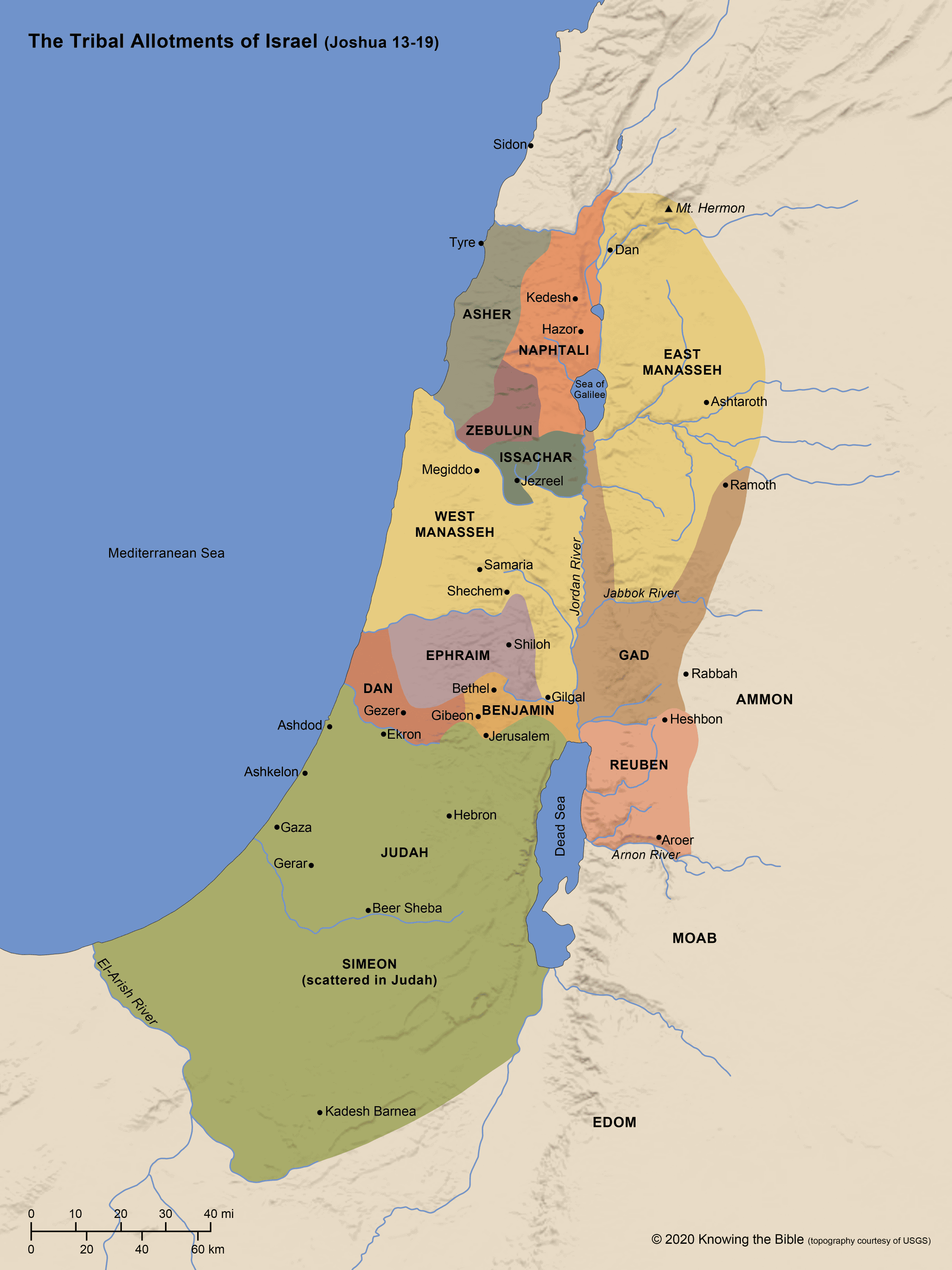
Tribal Territories in Ancient Israel
After entering the Promised Land, the tribes each received a portion of land—except Levi, who lived among the other tribes as priests.
- Judah received the southern region.
- Ephraim and Manasseh inherited central lands.
- Dan started in the west but migrated north.
The map of ancient Israel was more than geography—it was identity. Each tribe’s land reflected their role in the nation’s mission.
What Happened to the 12 Tribes After the Kingdom Split?
After King Solomon’s reign, the kingdom split into two:
- Northern Kingdom (Israel): 10 tribes, led by Ephraim
- Southern Kingdom (Judah): Judah and Benjamin, with Levi dispersed
The north was conquered by Assyria in 722 BCE, and its people were exiled. This began the story of the lost tribes.
The Mystery of the 10 Lost Tribes
When the Assyrian Empire conquered the Northern Kingdom of Israel in 722 BCE, ten of the twelve tribes were exiled and effectively vanished from history. These included Reuben, Simeon, Dan, Naphtali, Gad, Asher, Issachar, Zebulun, Ephraim, and Manasseh.
Unlike the Southern Kingdom (Judah), which returned from exile in Babylon, these tribes never re-emerged as identifiable communities.
Over the centuries, many theories have surfaced about where these tribes went. Some believe they may be found among:
- Ethiopian Jews (Beta Israel)
- The Pashtun tribes of Afghanistan
- Certain Indian and African communities
- Even some Native American groups
These claims often arise from local oral traditions or superficial similarities in customs. However, there is no verified historical, genetic, or archaeological evidence confirming that any modern people group descends from the ten lost tribes.
Despite popular fascination, the academic consensus is that the fate of the northern tribes remains unresolved.
From a biblical perspective, the mystery fuels anticipation. Prophets like Ezekiel (chapter 37) speak of a future reunification—a time when God Himself will restore all the tribes of Israel under one shepherd, pointing to the Messianic hope.
So while the historical trail grows cold, the spiritual promise remains alive.
The Tribe of Levi: Why They Were Set Apart
The Levites were chosen for sacred duty. They didn’t receive tribal territory; instead, they served in the Temple and lived in cities among the other tribes.
Their inheritance was spiritual, not agricultural: “Adonai is their inheritance” (Deuteronomy 10:9).
Judah and Benjamin: The Surviving Tribes
When the northern kingdom fell, Judah, Benjamin, and many Levites remained in the south. Even after Babylonian exile, they returned to rebuild Jerusalem.
Today, the term “Jew” derives from “Judah.” This tribe’s survival and prominence helped preserve Jewish identity, leading to the time of Yeshua and beyond.
The Tribes in End-Times Prophecy
The story of the 12 Tribes of Israel doesn’t end in the pages of ancient history. In fact, the Bible teaches that these tribes will play a central role in God’s future plans for the world—especially in the last days.
Revelation and the 144,000
The Book of Revelation contains a powerful vision of the end-times involving the tribes of Israel. In Revelation 7, the apostle John sees 144,000 sealed servants of God—12,000 from each tribe.
“Then I heard the number of those who were sealed: 144,000 from every tribe of Bnei-Yisrael…”
Revelation 7:4, TLV
What’s especially interesting is that the list in Revelation includes Joseph and Levi but omits Dan. Some scholars suggest this might hint at judgment or purification, while others see it as a symbolic or thematic decision, emphasizing the sanctity and completeness of God’s final community.
Whether literal or symbolic, the sealing of the tribes shows that God’s covenant with Israel remains intact—even in the apocalyptic future.
Ezekiel’s Vision of Reunification
The prophet Ezekiel offers one of the clearest pictures of the tribal reunion in the Messianic Age. In chapter 37, he speaks of two sticks—representing Judah and Joseph (Ephraim)—being joined together into one in the hand of the Lord.
“Say to them, thus says Adonai Elohim: ‘Behold, I will take the stick of Joseph—which is in the hand of Ephraim—and the tribes of Israel joined with him, and I will put them together with the stick of Judah, and make them one stick. They will be one in My hand.’”
Ezekiel 37:19, TLV
This powerful act symbolizes the healing of division and the restoration of unity among God’s people. It is also directly tied to the reign of the Messiah:
“My servant David will be king over them. They will all have one shepherd… They will walk in My ordinances and keep My rulings and do them.”
Ezekiel 37:24, TLV
Many believers in Yeshua see this as a future promise of peace and unity under the Kingship of Messiah—a return not only to the land but to covenant faithfulness.
A Role for the Nations
Gentile believers are not excluded from this prophetic hope. Paul describes the nations as wild olive branches grafted into Israel’s olive tree:
“But if some of the branches were broken off and you—being a wild olive—were grafted in among them and became a partaker of the root of the olive tree with its richness…”
Romans 11:17, TLV
This grafting in doesn’t replace Israel—it joins the nations to Israel’s promises. The full restoration includes all twelve tribes and all who have been joined to the God of Israel through faith in Yeshua.
Prophetic Timeline Involving the 12 Tribes of Israel
1. Division of the Kingdom (circa 931 BCE)
- After Solomon’s death, the united kingdom of Israel splits into Judah (South) and Israel (North).
2. Assyrian Exile of the Ten Tribes (722 BCE)
- The Northern Kingdom is conquered and exiled. These become known as the 10 Lost Tribes.
3. Babylonian Exile & Return (586–538 BCE)
- The tribes of Judah, Benjamin, and Levi are exiled and later return under leaders like Ezra and Nehemiah.
4. Prophetic Promise of Restoration (Ezekiel 37)
- God promises to reunite Judah and Israel under one shepherd, a reference to the coming Messianic King.
5. Sealing of the 144,000 (Revelation 7)
- In the last days, 12,000 from each tribe are sealed as servants of God—a sign of covenantal faithfulness and end-time mission.
6. Reign of the Messiah (Messianic Age)
- Under Yeshua’s rule, the tribes are restored, and the nations join Israel in worship and obedience (Isaiah 2:2-4, Micah 4:1-3).
7. New Jerusalem and the Twelve Gates (Revelation 21:12)
- The eternal city has twelve gates, each named for one of the tribes of Israel, showing their everlasting role in God’s plan.
What Christians Can Learn From the 12 Tribes
The 12 Tribes of Israel teach us about:
- Diversity in unity – Each tribe was unique, yet all were part of one people.
- Destiny – God’s calling on your life is not erased by mistakes.
- Covenant faithfulness – God remembers His promises, even when we forget.
For believers in Yeshua, understanding the tribes deepens our connection to the roots of our faith.
My Final Thoughts
The question “Who are the 12 Tribes of Israel?” leads us into a story of identity, redemption, and promise. These tribes weren’t perfect—but they were chosen. Their names still echo in Scripture, in tradition, and in the heart of God.
They remind us that each of us has a place in God’s plan, whether born into Israel or grafted in through faith. They call us to remember, to hope, and to walk in our own inheritance with reverence.
I’d love to hear your thoughts. Which tribe’s story speaks to you the most? Comment below and let’s talk about it together. And don’t forget to join us in our She Opens the Bible Study Group, where we explore Scripture and faith as a community.
Did you know Sue has a book on the 12 Tribes of Israel? You can check it out here!
FAQs
-
Why are there sometimes 13 tribes listed?
The tribe of Levi often isn’t counted because they weren’t given land. When Joseph’s two sons, Ephraim and Manasseh, are counted separately, the total comes to 13.
-
Are the 10 lost tribes really lost?
Historically, yes. Spiritually and prophetically, many believe they will be regathered in the Messianic Age.
-
What is the spiritual meaning of each tribe?
Each tribe symbolizes a spiritual characteristic—like Judah’s leadership or Issachar’s wisdom. These reflect traits God values.
-
Which tribe did Jesus come from?
Yeshua was born from the tribe of Judah, fulfilling messianic prophecy.
-
Are Christians spiritual descendants of the 12 tribes?
Believers in Yeshua are grafted into the covenant with Israel (Romans 11). They are not replacements but partakers in the promise.

About Our Author
Diane Ferreira is a Jewish believer in Yeshua, a published author, speaker, seminary student, wife, and proud mom. She is the author of several books, including The Proverbs 31-ish Woman, which debuted as Amazon’s #1 New Release in Religious Humor. She is currently pursuing her graduate degree in Jewish Studies, with her favorite topics being the early church and Biblical Hebrew. Diane writes and teaches from a unique perspective, bridging her Jewish heritage with vibrant faith in the Messiah to bring clarity, depth, and devotion to everyday believers.
When she’s not writing, studying, or teaching, you’ll find her curled up with a good book, crocheting something cozy, or researching her next trip.
📚 Learn more here! | 💬 Join the discussion on our Substack!
Tree of Life (TLV) – Scripture taken from the Holy Scriptures, Tree of Life Version*. Copyright © 2014,2016 by the Tree of Life Bible Society. Used by permission of the Tree of Life Bible Society.
Read Hosea you will see the judgement of the tribe of Ephraim, Joseph is its own Tribe and inherits the lands of the Ephraimites(aka Baal worshippers of Samaria ).
Very well done article, noble indeed…