
What Is My Spiritual Gift? A Biblical Guide to Finding Yours
Please note that this article may contain affiliate links. As an Amazon Associate, I earn on qualifying purchases at no additional cost to you. You can read more at the bottom of this page or read my full disclosure on my Affiliate Disclosure Page
If you’ve ever typed “what is my spiritual gift” into a search bar, you’ve probably been handed a quiz that promised answers and left you more confused than when you started. You’re absolutely not wrong for wanting something deeper… something that sounds like the Bible, not a personality test with Scripture sprinkled on top.
You want something that feels solid. Biblical. True.
Good. That’s exactly what we’re doing here. No gimmicks. Just God’s Word, real community, and a little faithfulness over time. Let’s get started!
What Is a Spiritual Gift?
A spiritual gift is a Spirit-given empowerment that equips believers in Yeshua to serve the Body of Messiah for its growth, unity, and mission, always under the Lordship of Yeshua and for God’s glory. See 1 Corinthians 12 and Ephesians 4 for the pattern.
Spiritual gifts are about purpose, not platform. Paul anchors the conversation in the Spirit’s work, never in status. The Greek word often used is charisma, a grace-gift.
In Hebrew thought, gift language can echo mattanah, a freely given present, and avodah, the work or service offered to God. Put simply, the Spirit gives for service, not spotlight. That is why Paul speaks about “the common good” and the building up of the Body, not self-branding.
Why do spiritual gifts exist? Because God loves His people and intends to bless the world through a unified, functioning community.
Think of Israel’s calling to be a light among the nations. In the early communities of believers in Yeshua, gifts created a living qahal, an assembly that actually moved with the Holy Spirit. Gifts serve people. Period.
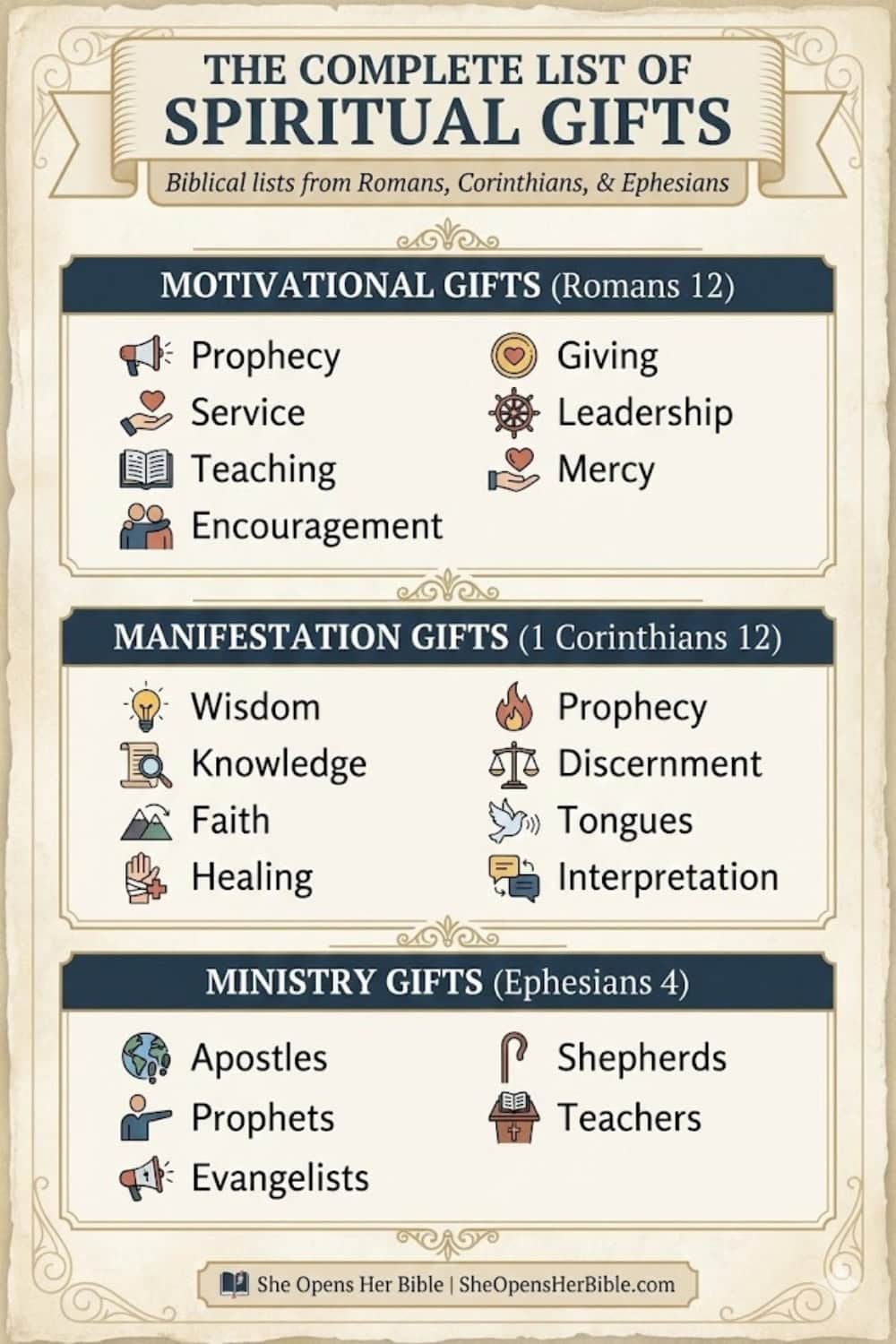
The Complete List of Spiritual Gifts in the Bible
Scripture does not give us one master list, but several complementary ones.
The Motivational Gifts (Romans 12)
- Prophecy: Speaking God’s heart with clarity and alignment to Scripture; Romans 12:6.
- Service: Meeting practical needs with joy; Romans 12:7.
- Teaching: Explaining truth so people understand and live it; Romans 12:7.
- Encouragement: Strengthening weary hearts with hope and counsel; Romans 12:8.
- Giving: Sharing resources with simplicity and generosity; Romans 12:8.
- Leadership: Guiding people with diligence and care; Romans 12:8.
- Mercy: Moving toward the hurting with compassion and presence; Romans 12:8.
The Manifestation Gifts (1 Corinthians 12)
- Wisdom: Spirit-given counsel for complex moments; 1 Corinthians 12:8.
- Knowledge: Spirit-revealed insight that serves a need; 1 Corinthians 12:8.
- Faith: Unusual confidence in God for a specific outcome; 1 Corinthians 12:9.
- Healing: God’s restorative work through prayerful ministry; 1 Corinthians 12:9.
- Miracles: God’s power displayed beyond normal means; 1 Corinthians 12:10.
- Prophecy: Spirit-led proclamation that builds up the Body; 1 Corinthians 12:10.
- Discernment: Recognizing what is of the Spirit and what is not; 1 Corinthians 12:10.
- Tongues: Spirit-enabled speech, best served with order; 1 Corinthians 12:10.
- Interpretation: Making a tongue intelligible to the Body; 1 Corinthians 12:10.
These are Spirit-initiated. They are not personality traits. They are not badges that prove you are more spiritually mature than someone else. The fruit of the Spirit is still the better measure of maturity.
The Ministry Gifts (Ephesians 4)
- Apostles: Pioneers sent to establish and extend Gospel work; Ephesians 4:11.
- Prophets: Voices that call God’s people to faithfulness and hope; Ephesians 4:11.
- Evangelists: Heralds who announce good news and equip others to do the same; Ephesians 4:11.
- Shepherds: Pastoral carers who guard and guide communities; Ephesians 4:11.
- Teachers: Builders who ground people in sound doctrine and practice; Ephesians 4:11.
Their purpose is “for the equipping of the kedoshim for the work of service, for building up the Body of Messiah” (Ephesians 4:12, TLV). Equipping is the point. The people do the work, together.
Are These Lists Exhaustive?
Not likely. Scripture emphasizes function over inventory. The Spirit distributes “as He wills” (1 Corinthians 12:11), which implies God is free to supply what the Body needs in a given time and place. Take the lists seriously, but do not turn them into a fence God cannot cross.
Spiritual Gifts vs Natural Talents: What’s the Difference?
Think of talents as abilities you can develop through practice, family shaping, or education. Gifts are empowerments the Spirit energizes for the Body’s good.
Overlap example: A naturally skilled communicator may also receive a teaching gift. The Spirit breathes on the ability so people are not just informed, they are transformed.
Difference example: Someone with no love for public speaking may be given a prophetic word in a moment that strengthens the congregation. That is a spiritual gift expressing God’s timing, not a rehearsed talent.
Scripture contrast: “There are varieties of gifts, but the same Ruach (Spirit)” (1 Corinthians 12:4, TLV). Talents are common to humanity. Spiritual gifts are the Spirit’s work through believers in Yeshua for a Kingdom purpose.
How to Identify Your Spiritual Gift (Without a Quiz)
Step 1: Prayer and Posture
Start with availability, not anxiety. Pray simply: “Lord, make me useful to Your people. I’m here.” In Hebrew thought, to hear and to obey run together. Shema is hearing that leans toward doing. Take that posture.
Quick starter prayer:
“Lord, I offer You my time and hands. Show me where to serve. Let love lead, not fear. In Jesus’ Name. Amen.”
Step 2: Serving in the Body
Gifts surface while you serve. Paul assumes believers belong to a Body and participate with it. Try simple things where there is need: hospitality, prayer teams, kids ministry, visitation, setup, mercy ministries, administration. As you serve, pay attention to what God seems to bless through you. Joy plus fruit is a strong indicator.
Step 3: Confirmation From Others
Genuine gifts get recognized, not just declared. You may feel drawn to teach, but the Church (the Body, not the building) will confirm if teaching through you produces clarity, repentance, comfort, or courage. Let mature believers speak into it.
Why Spiritual Gifts Aren’t Discovered in Isolation
Israel’s story is communal, and the early ekklesia (Church) lived that same way. The Spirit knits us together. Gifts fit like ligaments, not loose parts. Solitary discovery often turns into self-promotion. Communal discovery turns into service.
Common Questions About Spiritual Gifts
Can my spiritual gift change?
Your calling to love God and serve His people remains steady. How the Spirit uses you can shift with season, community needs, and maturity. Think of Joseph’s life: the form keeps changing, the hand of God does not.
Do I only have one spiritual gift?
Scripture suggests variety within a person and within a Body. You might consistently operate in one, and occasionally in others as the Spirit leads. The emphasis in Scripture is faithfulness, not collecting labels.
What is the “best” spiritual gift?
Paul points us to love as the most excellent way. Gifts without love create noise. Love makes even the smallest act powerful. “Pursue love, yet desire spiritual gifts” (1 Corinthians 14:1, TLV).
Can unbelievers have spiritual gifts?
In the strict sense, spiritual gifts are given by the Spirit to believers in Yeshua for the Body’s good. Unbelievers certainly have talents and can do great good, but the biblical pattern for charisma centers on the Spirit’s work in the believing community.
What if I’m afraid of using my gift publicly?
Start small. Pray with one person. Share a word of encouragement with a leader you trust and let them weigh it. Serve behind the scenes. Faith grows in small steps.
What if my gift doesn’t look like my friend’s?
Gifts are not copy and paste. The Spirit works through our personalities and histories. In the Bible, you see variety in how prophets spoke, how leaders led, and how praise sounded from one psalmist to another. Uniformity is not the goal, faithful usefulness is.
How do I keep my gift from becoming my identity?
Anchor yourself in the heart of the Shema: love God with all you are. When identity stays in Yeshua, gift-use stays healthy. Pursue the fruit of the Spirit more than the functions of the gifts. Character carries calling.
What Is the Purpose of Spiritual Gifts in a Local Congregation?
Spiritual gifts build up the Body in unity, maturity, and mission under Yeshua’s Lordship. They serve people, protect from error, and empower witness.
They:
- Equip believers to serve effectively.
- Strengthen faith through truth, comfort, and correction.
- Guard the community’s doctrine and practice.
- Mobilize mission beyond the walls.
How Do I Know if a Spiritual Gift Is Real and Not Just Emotion?
Scripture gives tests. Real gifts align with the Word, produce the fruit of the Spirit, and serve the common good. Out-of-order displays that elevate self or contradict Scripture are suspect.
Quick checks:
- Does it line up with Scripture, not just vibes?
- Does it point to Yeshua, not to the person?
- Does it bear good fruit over time?
- Is it confirmed by mature leaders?
The Heart Habits That Help Gifts Flourish
Let’s talk about the inner life that keeps gifts healthy.
- Humility: In Jewish tradition, Moses is described as very humble. The meek inherit influence that lasts. Humility keeps gifts from becoming performance.
- Chesed: Covenant kindness. Gifts without chesed bend toward pride. Gifts with chesed bend toward people.
- Shalom: Seek wholeness, not thrills. The Spirit’s presence brings order and peace, even when there is power.
- Study: Give yourself to Scripture. “Your word is a lamp to my feet” (Psalm 119:105, JPS). Gifts thrive when minds are steeped in God’s words.
- Community: Submit your impressions, rhythms, and decisions to leaders who love you. Accountability protects both you and the people you serve.

Biblical Images That Reframe the Question “What Is My Spiritual Gift”
Sometimes we make the question of “what is my spiritual gift” feel like picking a personality hat. Let’s reset the picture.
- Body: “For the body is not one part, but many” (1 Corinthians 12:14, TLV). A knee is not a celebrity; it is indispensable. So is the unseen ligament.
- House: “You also, as living stones, are being built up as a spiritual house” (1 Peter 2:5, TLV). Stones do not compete. They carry each other’s weight.
- Flock: Shepherding language reminds us gifts care for people, not clicks. People have names, stories, grief, and joy.
Hebrew Words That Enrich Our Understanding
A few Hebrew words that quietly sit under our English:
- Ruach: Breath, wind, Spirit. The same Ruach that hovered over the waters now empowers the Body. Power and presence in one Person.
- Mattanah: A gift freely given. Gifts are not wages. They flow from grace.
- Avodah: Work, worship, service. In Scripture, work and worship often overlap. Your gift is worship when it serves people and honors God.
- Emet: Truth. Gifts bend toward truth, never away from it. Teaching and prophecy especially must be soaked in emet.
- Shaliach: A sent one. While “apostle” is the New Testament term, the sent-one concept has roots in Jewish sending customs. The point is mission, not title.
Guardrails for Healthy Practice
You want fire without wildfire. Order without coldness. Here are simple guardrails.
- Let love lead. If love is thin, pause and re-center.
- Honor Scripture openly. Quote it, teach it, test ideas against it.
- Welcome evaluation. “Let the others weigh what is said” is wisdom, not suspicion.
- Avoid comparison. Envy and superiority both choke usefulness.
- Rest well. Gifts are not machines. Oil runs dry when you never stop.
Romans 12, 1 Corinthians 12, Ephesians 4: How They Interlock
Romans 12 sketches dispositions that often color how we serve. 1 Corinthians 12 shows the Spirit’s immediate activity for the Body’s need. Ephesians 4 sets the leadership gifts that equip people to do the work.
Together they answer your question from three angles: who you tend to be when you serve, what God may do through you in a moment, and how leaders help the whole church function.
A Simple Pathway You Can Start This Week
You may want something practical to try. Here it is.
- Day 1: Pray and read John 15. Ask for a willing heart.
- Day 2: Ask your pastor or group leader for one small, real need you can meet.
- Day 3: Serve that need with joy, then journal what you noticed God doing.
- Day 4: Ask two mature believers, “Where do you see God’s grace working through me?”
- Day 5: Read Romans 12 slowly. Which lines tug at your heart and energy?
- Day 6: Volunteer for one recurring role for a month. Watch for joy plus fruit.
- Day 7: Thank God, share with your leader, and keep going.
How Do I Ask God to Show Me My Gift?
Short answer: Ask simply, listen quietly, then act humbly.
Quick steps:
- Pray for a willing heart, not a perfect map.
- Read 1 Corinthians 12 and Ephesians 4.
- Serve a clear need in your congregation.
- Invite feedback from trusted leaders.
- Repeat for a season and notice patterns.
Mini Word Study: Gift and Grace
Charis is grace. Charisma is a grace-gift. That grammar matters. Gifts are grace in motion. When you hold that, you stop treating your gift like a personal brand and start treating it like God’s kindness moving through your life.
In the Tanakh, we see another thread: God fills people with skill for holy work, like Bezalel with wisdom and skill for the Tabernacle. The Source is the same, the focus is God’s dwelling among His people, and the result is worship that looks like service.
Mistakes We All Make When Asking What Our Spiritual Gift Is
- Treating gifts like identity labels rather than tools for love.
- Waiting to serve until we are “sure,” which usually means we never start.
- Confusing volume with power, or eloquence with truth.
- Ignoring fruit. If it is not blessing people, ask why.
- Chasing the rare while neglecting the needed. Mercy, hospitality, and helps often carry revivals nobody writes about.
Short Scripture Anchor Verses You Can Pray
- “Set a guard, Adonai, over my mouth” (Psalm 141:3, JPS) when you want to speak but need timing.
- “Abide in Me, and I will abide in you” (John 15:4, TLV) when you try to serve in your own strength.
- “Let all things be done for edification” (1 Corinthians 14:26, TLV) when planning any ministry moment.
Can I Use My Spiritual Gift Outside Church?
Yes, but keep the Body in view. Gifts build up believers and also witness to the world. Hospitality at your table, mercy in your workplace, wisdom in community decisions, evangelism in everyday conversations, leadership in volunteer teams, discernment when your friends need clarity. Just stay rooted in your local congregation so the gift stays healthy and accountable.
Are Spiritual Gifts Only for “Charismatic” Churches?
Spiritual gifts are for the whole Body. The Spirit did not carve out denominations. The New Testament instruction applies to all believers in Yeshua. Expression may vary by community, but the call to love, serve, and edify remains.
What If My Gift Brings Criticism?
Sometimes it will. Use the checks we listed earlier. If your leaders affirm you, and the fruit is real, keep serving with humility. If correction comes, receive it. A teachable spirit is a spiritual gift in motion.
My Final Thoughts
If you still feel unsure, breathe. God is not hiding your purpose behind a trick question. He is building you into a living stone among other living stones. You do not have to sort your entire spiritual gift profile today.
Walk with Yeshua, serve real people, invite feedback, and trust the Spirit to guide you step by step. The joy is not in the label, the joy is in the love that flows through you when you serve.
I would love to hear what stood out. Drop a comment with the question you’re still carrying or the small step you’re about to take this week.
And if you want community around this, come join our She’s So Scripture Substack. We’ll pray with you, cheer for you, and help you try things in a safe place until your gift finds its lane.
FAQs
-
How often should I “test” my gifts?
You do not need constant retesting. Serve faithfully for a season, evaluate fruit with trusted leaders, then adjust. Gifts mature with time, like character.
-
Can teens or newer believers use spiritual gifts?
Yes, within healthy oversight. Timothy was young. The Spirit is the same Spirit. Pair eagerness with guidance and Scripture.
-
What if I feel drawn to several gifts?
Start where your leaders see fruit already. Over time you may notice a primary lane with occasional moments in others.
-
Are leadership and teaching only for people on staff?
No. Ephesians 4 speaks to equipping the kedoshim, the holy ones, which is all believers. Many leaders and teachers serve bivocationally or voluntarily.
-
How do I avoid burnout while using my gift?
Build rhythms: Sabbath rest, Scripture, prayer, simple meals, honest friendships. Gifts run best on peace, not frenzy.
-
Can I ask God for a specific gift?
Paul says to “eagerly desire” spiritual gifts, especially those that build up the Body. Ask, then surrender the outcome to the Spirit’s wisdom.
-
What about gifts that seem controversial?
Keep Scripture open, character central, and community accountable. Seek unity, clarity, and love. Where there is order, humility, and leadership, there is safety.
-
How do I help my small group discover gifts?
Read 1 Corinthians 12 and Romans 12 together, pray, then try practical assignments for a month. Share stories weekly of where you saw grace at work.
-
Is there a biblical list of spiritual gifts I can print?
You can assemble one from Romans 12, 1 Corinthians 12, and Ephesians 4. Some add helps, hospitality, administration, and intercession from broader New Testament patterns. Remember, the lists guide function, not fence it in.
There is also the infographic at the beginning of the post. You can print that off and use it in your study binder.
-
I took a quiz and it contradicted my pastor’s feedback. Now what?
Weigh lived fruit and pastoral feedback more than a score. Talk it through. Then serve for a season in one area and reassess together.
If you skimmed to the end because life is a lot right now, here is your takeaway: Ask the Spirit to make you useful, serve where there is a need, listen to wise voices, and let love be the voice you never ignore. That is how “what is my spiritual gift” turns from a question into a life that quietly and powerfully bears fruit.

About Our Author
Diane Ferreira is a Jewish believer in Yeshua, a published author, speaker, seminary student, wife, and proud mom. She is the author of several books, including The Proverbs 31-ish Woman, which debuted as Amazon’s #1 New Release in Religious Humor. She is currently pursuing her graduate degree in Jewish Studies, with her favorite topics being the early church and Biblical Hebrew. Diane writes and teaches from a unique perspective, bridging her Jewish heritage with vibrant faith in the Messiah to bring clarity, depth, and devotion to everyday believers.
When she’s not writing, studying, or teaching, you’ll find her curled up with a good book, crocheting something cozy, or researching her next trip.
📚 Learn more here! | 💬 Join the discussion on our Substack!
Tree of Life (TLV) – Scripture taken from the Holy Scriptures, Tree of Life Version*. Copyright © 2014,2016 by the Tree of Life Bible Society. Used by permission of the Tree of Life Bible Society.
Tanakh: a New Translation of the Holy Scriptures According to the Traditional Hebrew Text. Philadelphia: Jewish Publication Society, 1985