
Cities of Refuge in the Bible: Justice and Sanctuary in Ancient Israel
Please note that this article may contain affiliate links. As an Amazon Associate, I earn on qualifying purchases at no additional cost to you. You can read more at the bottom of this page or read my full disclosure on my Affiliate Disclosure Page
The ancient world wasn’t an easy place to live. When something terrible happened—like someone losing their life—it could set off a chain reaction of fear, blame, and even revenge. But the cities of refuge in the Bible offered a different path.
They formed a vital part of ancient Israel’s judicial design, offering protection through law without compromising justice. These cities didn’t ignore justice—they helped make sure it was done properly.
In this post, we’ll walk through what the cities of refuge were, how they worked, and why they still matter today.
Don’t miss your free download of our Cities of Refuge in the Bible Study, Reflection, and Action Challenge Guide! This printable resource includes worksheets, thought-provoking questions, and action challenges to help you on your faith journey. Best of all, no sign-up is required—grab your copy at the end of this post!
What Were the Cities of Refuge?
In the Torah, God commanded the people of Israel to establish six special cities called arei miklat—Hebrew for “cities of refuge.” These cities were part of a larger framework of Torah law, created to deal with serious situations like the loss of life, but with justice that was both fair and measured.
If someone accidentally caused the death of another person, they could flee to one of these cities for safety. This kind of death, known in Jewish tradition as unintentional sin, was distinct from murder. There was no hatred or premeditation—it might have been a workplace accident or a moment of carelessness. Even so, the situation carried heavy consequences, and the person responsible wasn’t automatically cleared. They needed a safe place to stay until a proper judgment could be made.
Why was that necessary? In ancient Israel, the family of the deceased had the legal right to seek justice through a close relative called the goel hadam, the “avenger of blood.” This custom was rooted in the principle of Lex Talionis, or “eye for an eye,” which was common in many ancient cultures. But when a death occurred without intent, immediate vengeance wasn’t true justice—it would only deepen the tragedy.
So the cities of refuge protected people, but they also helped ensure that justice was carried out with wisdom. These weren’t hiding places—they were part of God’s legal design, as explored further below.
Biblical Foundation: Where the Cities of Refuge Are Found in Scripture
The idea of cities of refuge wasn’t something the Israelites made up on their own. It came straight from God, through His servant Moses, and was recorded in multiple parts of the Hebrew Bible. These passages lay out not just the names of the cities but the purpose behind them—and who was involved in putting the system into practice.
In Deuteronomy 4:41–43, we read that Moses was the first to set apart three of these cities on the east side of the Jordan River, even before the Israelites crossed into the Promised Land. These were early signs that God’s justice system would continue in the new land. Later, Deuteronomy 19:1–13 goes into more detail, explaining how the cities would be maintained and why the people had to take care to distinguish between murder and accidental killing.
Once the people entered Canaan, it became Joshua’s responsibility to carry out this command. In Joshua 20:1–9, God tells Joshua to appoint the remaining three cities on the west side of the Jordan. Joshua obeyed and, together with Eleazar the priest and the assembly of elders, officially established all six cities, making sure they were easy to reach and open to anyone who needed refuge.
This was a national effort, and it involved both spiritual and civil leadership. Joshua was the military and tribal leader. Eleazar, as the high priest’s son, represented religious authority. And the assembly—Israel’s group of appointed elders—was responsible for judging fairly. Together, they made sure that these cities weren’t just ideas, but functioning parts of a working justice system.
Legal and Moral Purpose of the Cities of Refuge
The laws about these cities draw a clear difference between murder and what we’d call manslaughter today. Someone who planned or meant to kill could not seek refuge. But someone who accidentally caused death—maybe from an accident or a fight that got out of hand—was not a murderer.
Still, their actions had consequences. That’s why the Torah made room for both mercy and justice.
As mentioned earlier, the role of the goel hadam, the avenger of blood, was not personal revenge. It was more like a legal duty. But even so, if the community didn’t step in to slow things down, an innocent person could die. So the cities acted as a kind of legal pause button.
And then there’s the high priest. In Numbers 35, we learn that the person who took refuge had to stay in the city until the death of the current high priest—a principle explored in depth later in this post.
“The assembly shall protect the manslayer from the blood-avenger, and the assembly shall restore him to the city of refuge to which he fled; and he shall live there until the death of the high priest who was anointed with the sacred oil… For he must remain in his city of refuge until the death of the high priest; after the death of the high priest, the manslayer may return to his landholding.
Numbers 35:25, 28 JPS Tanakh
Geographic Distribution of the Six Cities
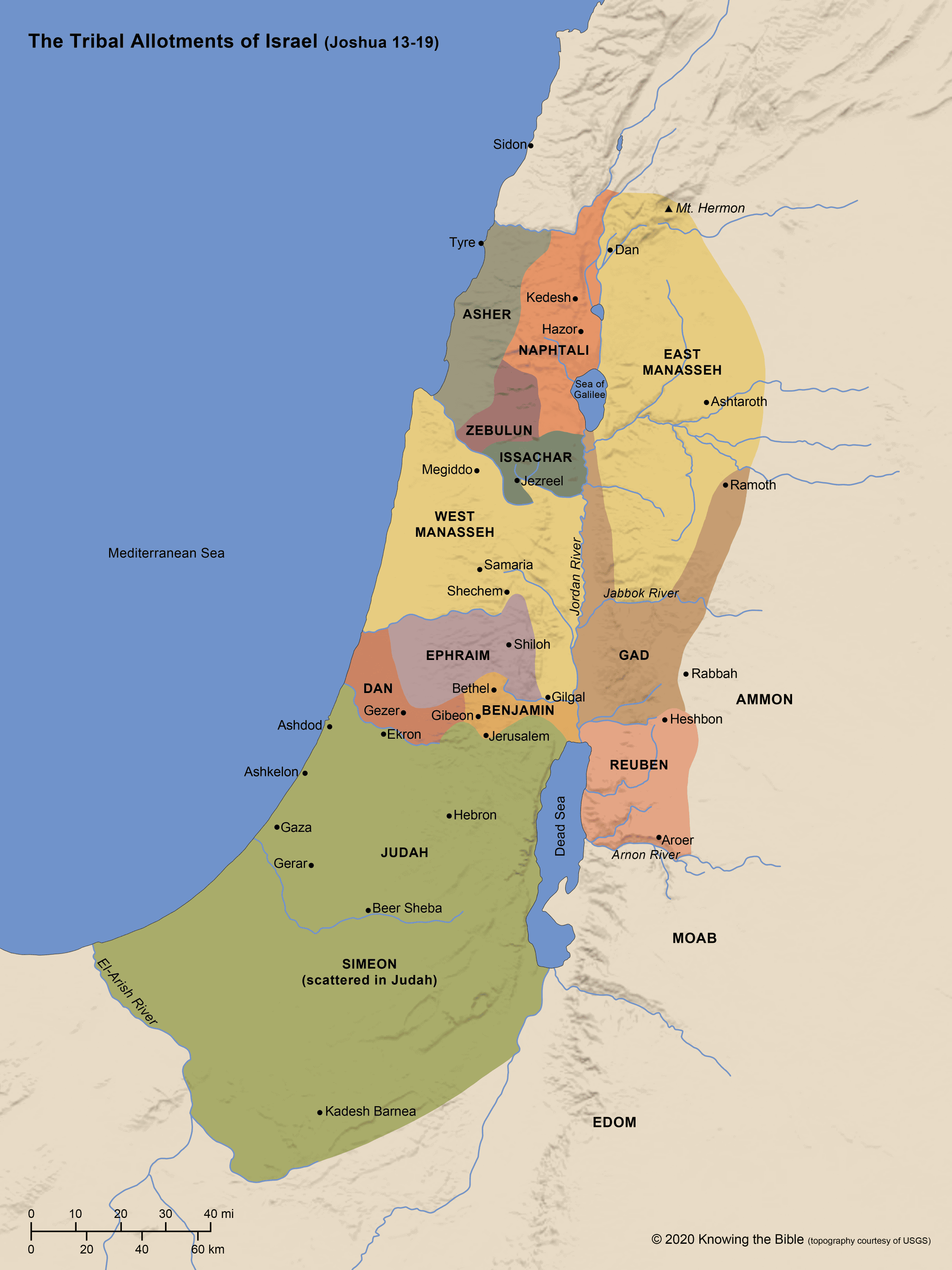
The six cities were spread evenly across the land so that anyone in Israel could get to one quickly. This mattered because in an emergency, time was critical.
- West of the Jordan River:
- Kedesh in the hill country of Galilee, in the territory of the tribe of Naphtali
- Shechem in the central hill country, within the tribal land of Ephraim
- Hebron located in the southern region of Judah
- East of the Jordan River:
- Bezer in the wilderness plateau, belonging to the tribe of Reuben
- Ramoth in the region of Gilead, part of Gad’s territory
- Golan in the region of Bashan, a territory given to the half-tribe of Manasseh
According to Jewish tradition (Makkot 10b), the roads to these cities were kept in excellent shape, and signs marked the way. The Hebrew word miklat—refuge—was written clearly to guide the manslayer to safety.
Refuge was written on signs at every crossroads marking the path to a city of refuge, so that the unintentional murderer would identify the route to the city of refuge and turn to go there.
Makkot 10b
Administrative and Religious Context
The cities of refuge were more than legal safe zones—they were part of a larger network of Levitical cities. According to Numbers 35:1–8, God commanded that the Levites, who were set apart for spiritual service, be given 48 cities scattered throughout the land. Among these, six were designated specifically as cities of refuge.
Why the Levites? Because they didn’t inherit tribal land like the other tribes of Israel. Instead, they were called to teach Torah law, offer counsel, and guide the people in worship and justice. Their cities were meant to be places of spiritual focus, free from family feuds or tribal pressure.
This made them the perfect hosts for the cities of refuge. When a manslayer arrived, the elders of the city—often Levites themselves—would hear the case and decide whether the person could stay. Their role helped ensure that judgment wasn’t influenced by tribal loyalty or emotional reaction.
In a broader sense, these cities reflect the ancient idea of sanctuary law—the notion that certain spaces are protected and holy, where justice can be paused and truth can be properly weighed. Unlike pagan cultures where sanctuary might be tied to a temple altar, in Israel, it was tied to God’s word and the fair administration of His law through trusted leaders.
Read more about the Tribe of Levi and the Priesthood at our post Story of Levi in the Bible – Tribe of Levi, Priesthood, and Redemption
Process of Seeking Refuge
When a person accidentally caused the death of another—what the Bible calls an unintentional killing—the first step was to flee immediately to the nearest city of refuge. These were not casual situations. The person was likely running for their life, knowing that the family of the deceased had the legal right to appoint that avenger of blood who could pursue them under Torah law.
As soon as the manslayer reached the city, they would go to the gate and present their case to the city’s leaders. This was often a group known as the assembly of elders—respected men who had the authority to make decisions in the community. The elders would give the person temporary protection while arrangements were made for a proper investigation and trial.
If the case was found to be one of unintentional sin, the person was allowed to live within the city under its protection. But there were conditions. They couldn’t just come and go freely. If they left the city, the avenger of blood still had the legal right to take their life, and the community was not held responsible.
This wasn’t punishment—it was protection with boundaries. The cities became a kind of spiritual and legal waiting room, a place to live in safety while still bearing the consequences of what had happened.

Historical and Cultural Relevance
The cities of refuge weren’t just about legal procedures—they played a vital role in holding together the social fabric of ancient Israel. In a tribal society where family and clan honor were central, a sudden death could ignite long-lasting feuds. The biblical system offered a built-in way to slow things down and prevent bloodshed.
This wasn’t only practical—it was deeply cultural. In a time when most justice systems were harsh and often carried out without full investigation, Israel’s approach was remarkably structured and compassionate. The fact that these cities were established by divine command shows that God wasn’t only interested in punishing wrongdoing—He cared about preserving life, even in the midst of tragedy.
Other ancient Near Eastern cultures had some form of asylum, often tied to pagan temples or powerful kings. But Israel’s sanctuary law was unique in that it was rooted in God’s covenant, not royal authority or superstition. It emphasized both accountability and mercy. No one could buy their way out of justice, and no one was condemned without a fair hearing.
Because of this balance, the cities helped prevent civil disorder. They offered a peaceful outlet for families dealing with grief and anger, and gave the accused a place to wait, reflect, and live—without fear of vigilante justice.
The structure also reminded the people that Torah law was meant to create a society marked by holiness, not just legal control. The goal wasn’t simply to avoid crime—it was to uphold righteousness in every part of life.
Archaeological and Scholarly Perspectives
When it comes to archaeology, not all six cities of refuge have been confirmed with certainty—but several are strongly supported by historical and biblical geography.
Hebron and Shechem, for example, are well-known ancient sites with deep biblical roots and clear archaeological profiles. Kedesh in the Upper Galilee has been excavated and shows evidence of being a significant fortified city.
Golan, in what is today the Golan Heights, also has archaeological remains that support its identification. Sites like Bezer and Ramoth are less definitively located, though scholars generally agree on their broader regions based on biblical clues and historical records.
In terms of scholarship, Jewish commentators have long emphasized the spiritual and moral significance of these cities. The Mishnah (Makkot chapters 2–3) goes into detail about how the cities were to be maintained, how trials were conducted, and the obligations of the community to keep the roads to these cities in good condition. The Talmud adds even more layers of reflection, exploring how accountability and forgiveness are meant to work together under divine law.
Some modern scholars also compare Israel’s refuge system with asylum laws in other ancient cultures. What stands out is how Israel’s version was deeply ethical. It was not about escaping punishment, but about pausing judgment until truth could be rightly revealed.
While archaeology gives us only partial confirmation, the combination of Scripture, tradition, and historical geography makes it clear that these were real cities with a real purpose—grounded in both justice and sacred responsibility.
Misconceptions and Clarifications
One of the biggest misunderstandings about the cities of refuge in the Bible is the idea that they were loopholes for criminals—places where someone could hide to avoid being punished. But that’s not what they were. These cities were part of a carefully designed legal system in Torah law, set up by God to protect people who had caused a death by accident, not on purpose.
Only those who had committed unintentional sin—where there was no hatred, planning, or intent to kill—could remain in the city. If someone had deliberately taken a life, even if they ran to a city of refuge, they were handed over to face full judgment. These were not places to escape justice. They were places to pause long enough to make sure justice was actually just.
There’s also the assumption that once someone reached a city of refuge, they were free to live as they pleased. But in reality, the person had to stay inside the city’s boundaries. If they left, the avenger of blood, could lawfully take their life, and the community would not be held responsible.
Each city was under the oversight of the assembly of elders, who were responsible for judging the case. These elders didn’t act out of emotion or tribal loyalty. Their job was to examine evidence and hear testimony. If the killing was found to be truly accidental, the person could stay in the city. If not, they were removed.
In short, the cities of refuge weren’t hiding places—they were part of a system designed by God to uphold both justice and mercy. They ensured that the innocent weren’t wrongly condemned and that every life—victim and accused—was treated with the seriousness it deserved.
The Role of the High Priest in the Legal Framework
One of the most unique aspects of the cities of refuge in the Bible was the connection to the high priest. According to Numbers 35, a person who had taken refuge for causing an unintentional death was required to stay in the city until the current high priest died. Only then could they return home safely, without fear of retaliation from the avenger of blood.
The Bible doesn’t explain exactly why the high priest’s death marked the end of this waiting period. But in Jewish tradition, the high priest was seen as a spiritual representative for the entire nation.
His role included entering the Most Holy Place once a year on Yom Kippur, the Day of Atonement, to make atonement for the sins of Israel. While not directly tied in Scripture to the cities of refuge, this annual act of national intercession gives us a picture of how deeply the high priest’s office was connected to the spiritual well-being of the people.
Many rabbis believed that the death of the high priest served as a kind of symbolic closure or release—not just for the individual who had taken refuge, but for the whole community. It marked the passing of one generation of leadership and opened the door for reconciliation and restoration.
This wasn’t a legal technicality. It was part of a bigger pattern in Torah law, where time, leadership, and sacred roles were woven into how justice and mercy were practiced. The high priest didn’t forgive the manslayer, but his death served as a signal that the season of waiting had ended—and the person could go free.
Broader Themes of Justice, Mercy, and Community Responsibility
At the heart of the cities of refuge in the Bible is a remarkable balance between justice and compassion. The system didn’t excuse wrongdoing, but it also didn’t rush to judgment. It made room for grief, for truth, and for the possibility that people sometimes make tragic mistakes without intending harm.
That balance is something we still wrestle with today. In modern terms, we might think of these cities as part of a restorative justice model—where the goal isn’t just punishment, but healing and right relationships. The cities of refuge remind us that real justice doesn’t come from revenge. It comes from careful listening, fair process, and wise leadership.
But this system also depended on the community. The elders had to judge cases fairly. The assembly of Israel had to maintain the cities and keep the roads in good repair. People had to respect the boundaries of the law and the lives of those taking refuge. Justice wasn’t just the responsibility of the priest or the judge—it was something everyone took part in.
There’s a quiet lesson here about accountability. Not just for individuals, but for the whole nation. A society that makes room for mercy is one that values every life—including the life of someone who’s made a serious mistake. That’s not weakness. That’s moral strength.
And then there’s the spiritual layer. God didn’t just care about how people worshiped—He cared about how they treated each other. Justice wasn’t separated from holiness. In fact, justice was one of the ways God’s holiness was revealed in everyday life.
Jewish Interpretations and Rabbinic Insights
Jewish tradition didn’t leave the cities of refuge in the past. The rabbis of the Talmud saw these cities not only as legal institutions but as windows into God’s heart for justice, mercy, and personal growth.
In Mishnah Makkot (chapters 2–3), the sages go into practical details: how wide the roads to the cities should be, how often they had to be repaired, and how signs were to be placed at crossroads with the word miklat (refuge) clearly written. These weren’t random rules—they were safeguards to make sure that justice remained accessible. Even the placement of signs was an act of compassion.
The Talmud (Makkot 10b–11a) explores deeper meanings behind the laws. Some sages ask why the release of a manslayer is tied to the high priest’s death. One view suggests that the high priest, as the spiritual leader of the people, bore a measure of shared responsibility for the spiritual climate of the nation. Others note that the high priest’s death created a fresh start for everyone, including the one who had taken refuge.
The rabbis also reflect on the difference between intentional sin and unintentional sin, noting that God’s mercy makes a way for those who didn’t mean to harm. Still, there’s an expectation of humility. The one in refuge must accept limits, live with consequences, and trust in God’s timing.
For later Jewish legal tradition (halakhah), the laws of the cities of refuge aren’t practiced today because they were tied to the land and the functioning Temple. But the values behind them—justice that seeks truth, mercy that protects life, and leadership that serves the people—are still foundational to Jewish thought and practice.
Legacy and Lessons from the Cities of Refuge
Although we no longer have literal cities of refuge, the values behind them are still deeply relevant. In a world where conflict, accidents, and misunderstandings still happen every day, the ancient model of justice in the Bible offers something profound: the idea that truth takes time, mercy is not weakness, and communities must protect the vulnerable without ignoring responsibility.
The cities of refuge in the Bible weren’t just legal tools. They were acts of obedience to God, grounded in a justice system that reflected His character. These cities remind us that fairness matters—not just in courts, but in our families, workplaces, and communities.
They also challenge us to look at how we respond when someone makes a mistake. Do we rush to judgment? Or do we make space for investigation, for compassion, and for the possibility of redemption?
In today’s terms, this might look like offering someone the benefit of the doubt. It might mean building systems that value accountability without shame. It might be advocating for justice reform, offering forgiveness, or even just listening before reacting. It might mean verifying information before propagating it.
The six cities, each tied to a different tribe of Israel and spread across the land, also show that justice wasn’t centralized. It was local, woven into the daily life of every region. That’s a reminder that justice and mercy start where we live—with the choices we make, the people we care for, and the paths we keep clear for others.
In the end, the cities of refuge call us to be a people who seek what is right, but who do it with gentleness, wisdom, and humility. That’s the kind of justice that reflects the heart of God.
My Final Thoughts
The cities of refuge in the Bible remind us that justice is not only about punishment—it’s about doing what is right for everyone involved. They reflect a system built on fairness, mercy, truth, and responsibility. In our world today, we could use more of that.
If this post helped you learn something new, or if you have a question or insight, I’d love for you to share it in the comments below. And if you’re looking for a deeper, supportive place to explore the Bible with others, join us in the She Opens Her Bible Study Facebook group—we’d love to have you!
Don’t forget to download your free copy of our Cities of Refuge in the Bible study, Reflection and Action Challenge guide below!
FAQs
What were the cities of refuge in the Bible?
They were six cities in ancient Israel where people who accidentally killed someone could seek safety and receive a fair trial.
How many cities of refuge were there?
There were six in total: three on each side of the Jordan River.
Who could flee to a city of refuge?
Anyone who unintentionally caused the death of another person.
What was the role of the high priest?
The person who fled had to stay in the city until the death of the high priest, after which they could go free.
Are there archaeological remains of these cities?
Some locations like Hebron and Shechem are known, but not all six cities have been definitively identified by archaeology.
Download Your Bible Study Guide


About Our Author
Diane Ferreira is a Jewish believer in Yeshua, a published author, speaker, seminary student, wife, and proud mom. She is the author of several books, including The Proverbs 31-ish Woman, which debuted as Amazon’s #1 New Release in Religious Humor. She is currently pursuing her graduate degree in Jewish Studies, with her favorite topics being the early church and Biblical Hebrew. Diane writes and teaches from a unique perspective, bridging her Jewish heritage with vibrant faith in the Messiah to bring clarity, depth, and devotion to everyday believers.
When she’s not writing, studying, or teaching, you’ll find her curled up with a good book, crocheting something cozy, or researching her next trip.
📚 Learn more here! | 💬 Join the discussion on our Substack!
Resources:
Tel Shechem
Tree of Life (TLV) – Scripture taken from the Holy Scriptures, Tree of Life Version*. Copyright © 2014,2016 by the Tree of Life Bible Society. Used by permission of the Tree of Life Bible Society.
Tanakh: a New Translation of the Holy Scriptures According to the Traditional Hebrew Text. Philadelphia: Jewish Publication Society, 1985