
Mary of Bethany: The Devoted Disciple at the Feet of Jesus
Please note that this article may contain affiliate links. As an Amazon Associate, I earn on qualifying purchases at no additional cost to you. You can read more at the bottom of this page or read my full disclosure on my Affiliate Disclosure Page
Mary of Bethany has a way of drawing people in. Maybe it’s her quiet strength or the way she always seems to know where Yeshua is and places herself right there. Whatever it is, her story leaves a deep impression.
You won’t find long monologues from her in Scripture, but her actions speak loudly. She teaches us how to sit, how to listen, how to grieve, and how to worship with everything we have.
In a world that often praises doing over being, Mary of Bethany reminds us what it means to just be with Yeshua. And in that stillness, we find something powerful: true discipleship.
Be sure to download your free copy of our printable Mary of Bethany Bible Study, Reflection and Action Challenge guide with worksheets at the end of this post! No sign up required!
Who Was Mary of Bethany?
Mary of Bethany shows up in three powerful Gospel scenes. She lived in the town of Bethany, a small village not far from Jerusalem. Her siblings were Martha and Lazarus, and their home was a place Yeshua visited more than once.
That tells us a lot right there. He felt welcomed there. He taught there. And in that home, Mary carved out a place at His feet.
When we talk about Mary of Bethany in the Bible, we’re not talking about Mary Magdalene. That confusion comes up a lot, and we’ll clear that up in a bit. But first, let’s look at the scenes where Mary’s faith shines.
Mary of Bethany in the Bible
The first time we meet Mary is in Luke 10:38–42. Yeshua is visiting the home she shares with her sister, Martha. While Martha gets busy preparing the meal and handling the hosting, Mary does something unexpected. She sits at Yeshua’s feet and listens.
In the ancient Jewish world, sitting at someone’s feet was the posture of a disciple. It wasn’t just about being close; it was about learning. The Hebrew word for disciple is talmid, and to be a talmid was to attach yourself to the teaching of a rabbi.
Mary, a woman in a culture where men typically held that role, chooses to be a talmid of Yeshua. And He affirms her for it.
Later, in John 11, we see her again, this time in heartbreak. Her brother Lazarus has died. When she sees Yeshua approaching, she falls at His feet again. Same posture. Different moment. She brings her grief to the only One who can hold it.
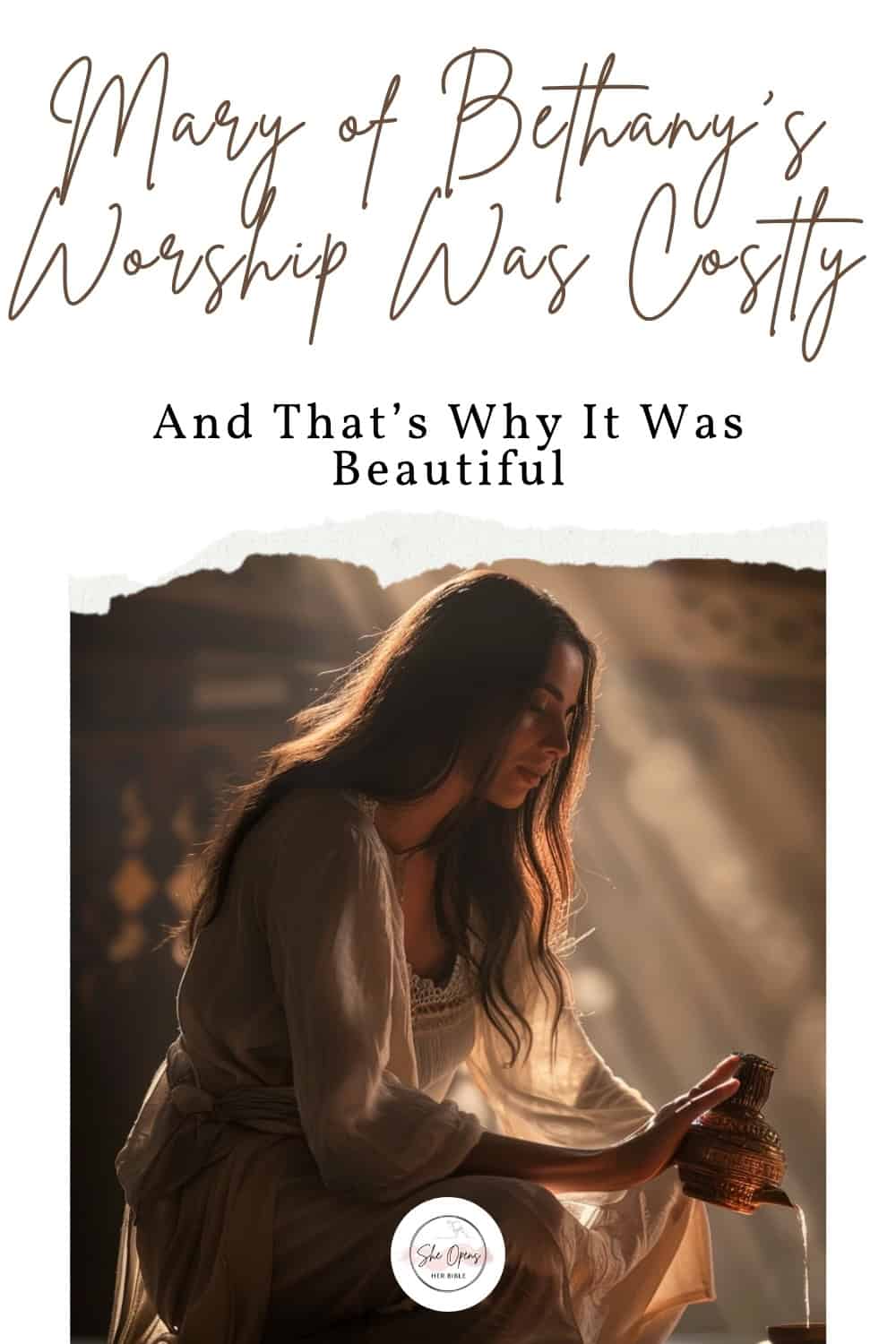
And in John 12, just before Passover, Mary comes forward with a jar of expensive nard—spikenard, likely imported from the Himalayas. She breaks it and pours it on Yeshua’s feet, wiping them with her hair. This wasn’t a small act. That jar could’ve been sold for a year’s wages. It was a costly, extravagant act of love. And again, she’s at His feet.
Mary of Bethany vs Mary Magdalene
This is where people sometimes get confused. Mary of Bethany and Mary Magdalene are two separate women. Mary Magdalene is from Magdala, a town near the Sea of Galilee, and she plays a different role in the Gospels.
She was delivered from seven demons (Luke 8:2), became a faithful follower, and is the first witness to the resurrection (John 20:1–18).
Mary of Bethany is not mentioned as traveling with Yeshua’s larger group of disciples, but she’s deeply connected to Him through her home, her heart, and her worship.
Church history sometimes blurred these Marys together, but in the text, they remain distinct. When we keep them separate, we see more clearly what each woman brings to the story of redemption.
Lessons from Mary of Bethany
Mary’s life gives us more than one lesson. She teaches through her posture, her priorities, and her worship.
The Power of Listening and Stillness
Mary chose to sit and listen while Martha moved and managed. Yeshua tells Martha that Mary chose the good portion. He doesn’t scold Martha for serving, but He gently corrects her anxiety. The Hebrew concept of shema means more than just hearing. It means to listen with intent to obey. Mary shema’d with her whole being.
Extravagant Worship and Sacrifice
The act of anointing Yeshua with perfume wasn’t just emotional. It was prophetic. She was preparing Him for burial. She gave the best she had, not just in material terms, but in spiritual insight.
The Hebrew Scriptures speak of costly offerings. In 2 Samuel 24:24, David says:
“I will not offer burnt offerings to Adonai my God that cost me nothing.””
TLV
Mary lived that principle with her whole heart.
Faith in the Midst of Grief
When Lazarus dies, Mary doesn’t stop believing. She doesn’t understand, but she still brings her broken heart to Yeshua. That’s faith. Not the absence of questions, but the presence of trust in the face of loss.
Mary of Bethany’s Theological Importance
Mary wasn’t just being kind or expressive. She was living out theology. She embodied a kind of discipleship that was relational, sacrificial, and deeply prophetic.
A Model for Discipleship
Discipleship isn’t only about what we do. It’s about who we become. Mary was being shaped by Yeshua’s words and presence. She wasn’t trying to earn her place. She was receiving it. She reminds us of Psalm 27:4:
“One thing have I asked of Adonai,
TLV
that will I seek:
to dwell in the House of Adonai
all the days of my life,
to behold the beauty of Adonai,
and to meditate in His Temple.”
Her Role in Foreshadowing Jesus’ Death
When Mary anointed Yeshua, she didn’t just show affection. She declared, whether she knew it or not, that His time had come. Yeshua Himself said her act would be remembered wherever the Good News is told.
The Connection to the Resurrection Narrative
Although Mary of Bethany is not mentioned at the resurrection, her relationship with Yeshua is deeply rooted in resurrection hope. She believed in it even before Lazarus was raised. Her story points us to the greater resurrection that Yeshua would soon bring.
Contrasting Mary and Martha
Martha is active. Mary is attentive. And both are loved.
When Yeshua says, “Mary has chosen what is better,” He’s not shaming Martha. He’s lifting up the importance of presence. It’s not about being more spiritual. It’s about choosing intimacy over anxiety, even for a moment.
Symbolism of Anointing Jesus’ Feet
In Jewish tradition, anointing was reserved for priests and kings. The Hebrew word mashach means to anoint, and it’s where we get the term Mashiach, which means Messiah. Mary’s act connected Yeshua’s mission with that royal, priestly calling.
Nard: The Fragrance of Devotion
Nard was rare and precious. Its aroma would have filled the whole room. And that’s what true worship does. It lingers. It fills the space. It affects everyone near.
Why Judas Objected and What Jesus Said
Judas saw Mary’s act as wasteful. But Yeshua saw it as beautiful. His reply? “Leave her alone. She set it aside for the day of My burial.” It was a moment of deep honor. Judas saw dollars. Yeshua saw devotion.
Jesus’ Relationship with Mary, Martha, and Lazarus
This little family held a special place in Yeshua’s life. He wept with them. He stayed with them. Their home became a resting place for the One who often had no place to lay His head.
Feminine Faith and Voice in Scripture
Mary of Bethany stands in a long line of women who trusted God in deeply personal ways—Hannah, Ruth, Miriam, Deborah. But she also foreshadows the New Covenant reality where women and men alike sit at the feet of the Rabbi and learn.
Mary of Bethany in Christian Tradition
Mary has been honored in many traditions. Some call her the first contemplative. Some see her as a patron saint of worship. But what matters most is how her story continues to call us back to the feet of our Messiah.

Modern Reflections on Mary of Bethany
Mary of Bethany’s story may be ancient, but it has a quiet way of showing up in our modern walk, especially when we least expect it. Today, she challenges the way we think about spiritual maturity. Too often, we equate spiritual strength with productivity, with knowledge, or with visible leadership. Mary’s life points us in another direction entirely.
In a culture shaped by speed and efficiency, her witness reminds us that spiritual depth often grows in unhurried spaces. She doesn’t give us a system to follow. Instead, she draws us into a kind of faith that is relational, not transactional. Her life raises a subtle but profound question: How much of our faith is shaped by love, and how much by duty?
Mary also pushes us to consider how we handle moments that aren’t clearly “spiritual.” The Gospels don’t show her preaching, leading, or performing miracles. And yet, her life becomes sacred because of her nearness to Yeshua.
In our own time, that challenges us to reframe what it means to live a holy life. It may be less about doing big things and more about living close to the Presence of God.
This is especially meaningful for those who feel unseen in their faith journey. Mothers in the thick of parenting, caregivers tending to aging parents, students quietly holding onto their convictions all find in Mary a picture of someone whose faith was not flashy, but deeply precious to Yeshua.
And there’s something else. Mary’s story can help restore the balance between action and reflection in today’s faith communities. Her presence invites congregations and ministries to create space for contemplation, not as a luxury but as a necessity.
In Jewish life, there’s a long-standing rhythm of pausing, of sanctifying time, much like the way Shabbat interrupts the week. Mary becomes a kind of human Shabbat, reminding us to stop and recognize holiness in the moment.
So even now, Mary of Bethany is helping us reimagine discipleship. Not as a ladder to climb, but as a relationship to nurture. A path that sometimes begins by simply sitting still, knowing we’re already loved, and letting that love change everything.
Practical Applications for Today’s Believer
Listening Before Acting
You don’t have to do everything. You do need to be present. Start your day with silence. Sit with the Word. Ask Yeshua to speak. Then listen.
Offering Your Best to Jesus
Whatever your jar of nard is, your time, your energy, your resources, offer it. Not because you have to. Because you love Him.
Living a Faith-Filled Life of Worship
Worship isn’t just music. It’s the posture of your life. It’s how you sit at His feet when the world says, “Get up and do something.”
My Final Thoughts
Mary of Bethany’s story is simple, but it’s also revolutionary. In a world that pulls us in every direction, she invites us to come sit down. To be still. To pour out whatever we have at the feet of the One who gave us everything.
If her story stirred something in you, share it. Comment below and tell us how her example speaks to your journey. And if you want more content, join us on our She’s So Scripture Substack! Let’s walk this path of faith together.
And don’t forget to download your free copy of our Mary of Bethany Bible Study, Reflection and Action Challenge guide below!
FAQs
Is Mary of Bethany the same as Mary Magdalene?
No. Mary of Bethany was the sister of Martha and Lazarus. Mary Magdalene came from Magdala and had a different story. Their lives and roles are unique in the Gospels.
What can we learn from Mary of Bethany?
We learn the value of presence, the beauty of worship, and the strength of a quiet but devoted faith.
Where is Bethany located today?
Bethany is a village on the eastern slope of the Mount of Olives, known today as al-Eizariya in Arabic.
What does it mean to sit at Jesus’ feet?
It means to take the posture of a disciple, to listen, to learn, and to honor Yeshua as Rabbi and Lord.
What does the anointing with oil symbolize in her story?
It symbolizes worship, sacrifice, and preparation for death and burial. It points to Yeshua’s role as the Anointed One—our Messiah.
Download Your Printable Study Guide

About Our Author
Diane Ferreira is a Jewish believer in Yeshua, a published author, speaker, seminary student, wife, and proud mom. She is the author of several books, including The Proverbs 31-ish Woman, which debuted as Amazon’s #1 New Release in Religious Humor. She is currently pursuing her graduate degree in Jewish Studies, with her favorite topics being the early church and Biblical Hebrew. Diane writes and teaches from a unique perspective, bridging her Jewish heritage with vibrant faith in the Messiah to bring clarity, depth, and devotion to everyday believers.
When she’s not writing, studying, or teaching, you’ll find her curled up with a good book, crocheting something cozy, or researching her next trip.
📚 Learn more here! | 💬 Join the discussion on our Substack!
Tree of Life (TLV) – Scripture taken from the Holy Scriptures, Tree of Life Version*. Copyright © 2014,2016 by the Tree of Life Bible Society. Used by permission of the Tree of Life Bible Society.