
How to Study the Bible by Topic – Meet the Free Tool That Does the Exegetical Work for You
Here is the truth nobody tells you about how to study the Bible by topic: gathering a list of verses about “faith” and calling it a study is a little like collecting ingredient labels and calling it a meal.
The verses are there. The nutrition facts are there. But nothing has actually been cooked.
Most topical study guides hand you a concordance, wish you luck, and send you off to pull Psalms and Proverbs out of context until you feel spiritually full. And you might, briefly. Until the next Tuesday when you’re back to square one wondering what the Bible actually says about the thing you’re studying.
What a genuinely exegetical topical study gives you is something different. It gives you the Hebrew root word that reframes the entire concept. It gives you the canonical thread tracing the topic from Torah to Revelation so you see how it develops, not just where it appears. It gives you the Second Temple context that explains what a first-century Jewish reader already knew when she heard that word.
It tells you what English translations quietly smooth over. And it shows you exactly how Yeshua steps into the middle of the whole story and fulfills what every earlier passage was reaching toward.
That is not a verse list. That is a map.
Already familiar with our tool? Skip directly to it!
Written by Diane Ferreira, a seminary graduate student and biblical studies educator with 8 years of experience in exegetical Bible study and women’s ministry.
What Is an Exegetical Topical Bible Study?
Exegesis means drawing out what the text actually says rather than reading into it what we hope it says. An exegetical topical study asks not just where the Bible mentions a topic, but what the Bible is doing with that topic across the full sweep of Scripture.
It means asking:
What is the Hebrew or Greek word at the root of this concept, and what does that word’s meaning reframe for me?
How does this topic first appear in the Torah, and how does it develop through the Prophets, the Writings, the Second Temple period, the Gospels, the Epistles, and finally Revelation?
What did a first-century Jewish reader already know that I, reading in English translation two millennia later, have no way of knowing without help?
What common misunderstandings about this topic does Scripture itself correct? And how does Yeshua specifically embody, fulfill, and transform this concept?
These are the questions seminary trains you to ask. They are also the questions that change how you read your Bible for the rest of your life.
Why Most Topical Bible Study Falls Short
The topical Bible study method has a well-documented weakness, and even its advocates acknowledge it: pulling verses out of context is genuinely risky. Collect enough decontextualized verses about any topic and you can make the Bible say almost anything.
The solution is not to avoid topical study. The solution is to do it with enough context that the risk evaporates.
That means:
- Knowing the canonical location of each passage, meaning where it falls in the story of Scripture and what that location implies.
- Knowing the Hebrew or Greek concept underneath the English word, because English translations make interpretive choices that aren’t always visible on the surface.
- Knowing the historical and liturgical context of the original audience. Knowing the theological trajectory, meaning where the concept is headed and what it ultimately arrives at.
That kind of topical study used to require a seminary library, fluency in biblical languages, and several hours per topic. It doesn’t anymore.
How to Study the Bible by Topic with the Exegetical Edit Study Map — Our Free Tool
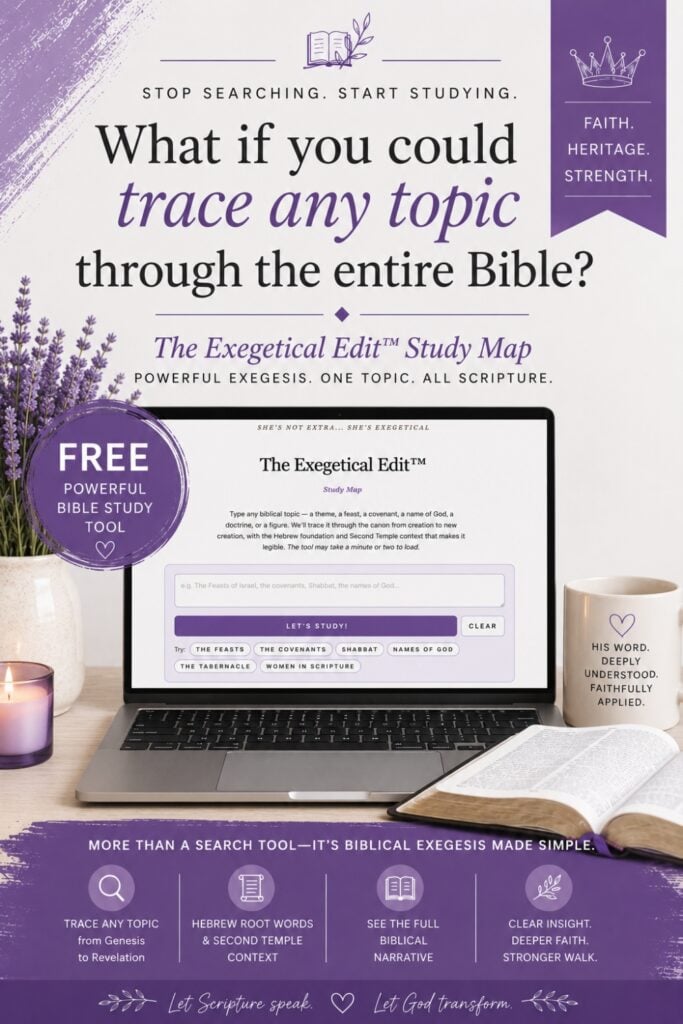
The Exegetical Edit Study Map is a free tool built into this page. Type in any Bible topic and it generates a complete exegetical study map for you, including the Hebrew foundation and root meaning, a canonical thread tracing the topic from creation to new creation, Second Temple and liturgical context, what English readers typically miss in translation, how Yeshua embodies and fulfills the concept, key passages to read with specific guided instructions, common misconceptions addressed directly, and reflection and discussion questions you can print.
No concordance. No seminary degree. No five-browser-tab research spiral.
Just open your Bible and follow the map.
Topics to try: The Feasts. The Covenants. Shabbat. Names of God. The Tabernacle. Women in Scripture. Or type in anything that’s been sitting in the back of your mind.
She's not extra... she's exegetical
The Exegetical Edit™
Study Map
Type any biblical topic — a theme, a feast, a covenant, a name of God, a doctrine, or a figure. We'll trace it through the canon from creation to new creation, with the Hebrew foundation and Second Temple context that makes it legible. The tool may take a minute or two to load.
This tool is AI-assisted. The studies are generated by Claude (Anthropic’s AI) using a framework I built — one that reflects everything I care about in biblical study: tracing a topic through the whole canon from creation to new creation, the Second Temple context that makes the Brit Hadashah legible, the Hebrew foundation beneath every theological concept, and the honest scholarship that names popular misconceptions for what they are. Every section, every prompt, every theological guardrail in this tool came from me.
Think of it the way you’d think of any study resource — a commentary, a biblical theology, a study Bible introduction. It’s a starting place, not a stopping place. The richest study still happens when you take what you find here back to the text itself, sit with the canonical thread passage by passage, and ask what a 1st century Jewish reader would have already understood about this topic before they ever opened the Brit Hadashah. That’s where the depth lives.
How to Use the Map
Enter your topic in the search field and select “Let’s Study.” The map generates several sections. Here is how to work through them:
Start with the Hebrew Foundation. Before you read a single passage, let the root meaning of the word reframe your expectations. The Hebrew concept behind a topic is often doing something the English word cannot fully carry. Read the root, sit with the insight in the italics beneath it, and let it change the question you bring to the text.
Then read the Canonical Thread chronologically. The entries are dated and placed in their era of Scripture. Do not skip the italicized summary lines beneath each section heading; those are the interpretive keys. They tell you what is happening theologically in that era, not just historically.
Move to What This Is Not. This section names the most common misreads of the topic head-on. Read it before you go to the passages, so you are not accidentally confirming a misunderstanding you already hold.
Use the Key Passages section as your actual reading plan. Each passage comes with a specific instruction for what to look for. These are not suggestions. They are the passages that carry the most exegetical freight on this topic.
Take the Questions for Study and Reflection to your journal, your small group, or your teaching prep. They are written to push past observation into interpretation and application.
Finally, use the Keep Studying links to follow the threads that caught your attention. The topics in that section are theologically connected to what you just studied and will deepen rather than repeat it.
Selah
The richest Bible study has always required a guide. For most of church history, access to the tools for that kind of study was limited to the educated, the ordained, or the institutionally trained. That has never been the design. The Word was breathed out for every person who would open it, not only for those with a library card to a seminary stacks room.
This tool does not replace your study. It opens the door so you can actually do it. The encounter with the text still belongs to you.
Selah.
Frequently Asked Questions
-
What is a topical Bible study?
A topical Bible study is a method of studying Scripture by choosing a specific theme or concept and gathering every relevant passage across the whole Bible to understand what God’s Word says about that subject. Unlike a book-by-book study, a topical study traces one thread from Genesis to Revelation.
-
What makes an exegetical topical study different from a regular topical study?
An exegetical topical study goes beyond collecting verse lists. It examines the original Hebrew or Greek word at the root of the topic, traces the concept’s development canonically through the whole of Scripture, considers the historical and Second Temple context, identifies common translation gaps, and traces how the topic is fulfilled in Yeshua. This produces interpretation rather than just information.
-
How do you trace a topic through the entire Bible?
Tracing a topic canonically means following it through each major era of Scripture: Torah, the Prophets and writings, the Second Temple period, the Gospels, the Epistles, and Revelation. At each stage you ask how the concept is introduced, developed, complicated, refined, and ultimately fulfilled. The Exegetical Edit Study Map does this automatically for any topic you enter.
-
Why does the Hebrew word matter for Bible study?
Many English Bible translations make interpretive choices that are not visible in the translated text. The Hebrew root of a word often carries a meaning, metaphor, or relational nuance that the English equivalent cannot fully convey. Knowing the root reframes your reading and prevents misunderstanding topics like sacrifice, covenant, rest, or holiness.
-
What is Second Temple context and why does it matter?
The Second Temple period (roughly 516 BCE to 70 CE) is the world Jesus and his disciples inhabited. It shaped how first-century Jewish readers heard every word he spoke and every text he quoted. Understanding what Jewish worship, law, and expectation looked like in that era makes the New Testament dramatically more legible.
-
What is the best free tool for topical Bible study?
The Exegetical Edit Study Map at She Opens Her Bible of course! It is a free tool that generates a complete exegetical study map for any Bible topic, including Hebrew roots, canonical thread, Second Temple context, what English readers miss, how Yeshua fulfills the topic, key passages, and printable study questions.
Check Out Our Other Tools
Like this study tool? Well, we have more!

About Our Author
Diane Ferreira is a Jewish believer in Yeshua, a published author, speaker, seminary student, wife, and proud mom. She is the author of several books, including The Proverbs 31-ish Woman, which debuted as Amazon’s #1 New Release in Religious Humor. She is currently pursuing her graduate degree in Jewish Studies, with her favorite topics being the early church and Biblical Hebrew. Diane writes and teaches from a unique perspective, bridging her Jewish heritage with vibrant faith in the Messiah to bring clarity, depth, and devotion to everyday believers.
When she’s not writing, studying, or teaching, you’ll find her curled up with a good book, crocheting something cozy, or researching her next trip.
📚 Learn more here! | 💬 Join the discussion on our Substack!