
Meaning of El Roi: The Hebrew Name of God That Means He Sees You
Please note that this article may contain affiliate links. As an Amazon Associate, I earn on qualifying purchases at no additional cost to you. You can read more at the bottom of this page or read my full disclosure on my Affiliate Disclosure Page

When we explore the many names of God in Scripture, each one opens a window into His character and His covenantal heart. One especially tender name is “El Roi”—meaning “The God Who Sees.” This name, first spoken by Hagar in Genesis 16:13, reveals a God who notices the unnoticed, who attends to the cries of the outcast.
For those walking through seasons of invisibility, heartache, or solitude, the meaning of El Roi is a profound assurance: our God is not distant or indifferent. He is the One who sees us, intimately and compassionately. In Yeshua, El Roi is made manifest—He not only sees, but walks among us, bearing our sorrows and knowing our hearts.
So let’s take a closer look at what it means to know El Roi—the God who sees you.
What Does El Roi Mean?
After encountering the angel of Adonai in the wilderness, Hagar does something no one else in Scripture had done before—she gives a name to God: El Roi, “the God who sees me.” But what exactly does this name reveal?
In Hebrew, the word “El” (אֵל) means God, conveying divine strength, sovereignty, and might. It appears in many names and titles, each emphasizing different facets of God’s nature.
The word “Roi” (רֹאִי) comes from the Hebrew root ra’ah (רָאָה), which means to see. Yet biblical seeing is more than visual perception—it’s about recognition, understanding, and engagement. This is the kind of seeing that draws near, that responds, that redeems.
So when Hagar calls God El Roi, she is not simply saying “God notices me.” She is declaring, “God understands me. God sees into the depths of my pain. God is with me even here.”
In Hebrew thought, names are not random—they express essence and mission. The name El Roi captures God’s personal involvement in human suffering. He is not a distant deity, but One who enters into our wilderness moments, offering both presence and promise.
For all who have ever felt invisible, overlooked, or cast aside, the meaning of El Roi is a divine embrace: You are seen. You are known. You are loved.
The God Who Sees: Hagar’s Story of Encounter and Hope
Hagar and the God Who Sees
The name El Roi (אֵל רֳאִי) is a powerful Hebrew title of God, first spoken by a woman in deep distress—Hagar, the Egyptian servant of Sarai (later Sarah), Abraham’s wife. Found in Genesis 16, this encounter with the divine reveals a God who sees not only nations and kings, but also the afflicted and forgotten.
Sarai, unable to bear children, gives Hagar to Abraham to conceive on her behalf. But once Hagar becomes pregnant, tension and jealousy ignite. Sarai mistreats her, and Hagar flees, a marginalized woman lost in the wilderness—physically, emotionally, and spiritually.
There, in her moment of despair, Hagar meets the malach Adonai—the angel of the Lord. He delivers not only instruction, but also a blessing. She is told to return, yet with a divine promise: that her son, Ishmael, will become the father of a great multitude.
Moved beyond words by this encounter, Hagar gives God a name—El Roi, “the God who sees me”—and names the well Be’er-Lachai-Roi, “the well of the Living One who sees me.”
וַתִּקְרָ֤א שֵׁם־יְהוָה֙ הַדֹּבֵ֣ר אֵלֶ֔יהָ אַתָּ֖ה אֵ֣ל רֳאִ֑י כִּ֣י אָֽמְרָ֗ה הֲגַ֥ם הֲלֹ֛ם רָאִ֖יתִי אַחֲרֵ֥י רֹאִֽי׃
Genesis 16:13, TLV
“So she called Adonai who was speaking to her, ‘You are the God who sees me.’ For she said, ‘Would I have gone here indeed looking for Him who looks after me?’”
In a world that often overlooks the vulnerable, the meaning of El Roi reminds us that our God sees with compassion. As believers in Yeshua, we understand this even more intimately—He not only sees, but enters our suffering, walks beside us, and redeems us. El Roi sees you.
This moment in the wilderness wasn’t just about survival—it became a revelation. From it, we learn the deeper meaning of one of God’s most tender names: El Roi.
Theological Insights from El Roi
God’s Omniscience and Compassion
The name El Roi affirms not only God’s omniscience—His complete knowledge of all things—but also His profound compassion. In the wilderness, God saw Hagar, not as a servant or outsider, but as a person in distress. He responded not with judgment, but with care and promise. This is the nature of El Roi: not a distant observer, but a compassionate God intimately involved in human suffering.
His seeing is not passive; it’s active and redemptive. He does not merely know—He cares. He moves toward the broken, the overlooked, and the rejected. This offers deep reassurance: our struggles are not hidden from Him, and our pain does not go unnoticed.
Psalm 139:1–4 captures this beautifully:
“Adonai, You have searched me and known me. You know when I sit down and when I rise up; You discern my thoughts from afar. You observe my journeying and my resting, and You are familiar with all my ways.”
TLV
This echoes the heart of El Roi: a God who is present, personal, and full of mercy.
El Roi Throughout the Bible
The vision of El Roi—the God who sees and responds—is woven throughout Scripture. In Psalm 33:13–15, we read:
“From heaven the Lord looks down and sees all mankind; from His dwelling place He watches all who live on earth—He who forms the hearts of all, who considers everything they do.”
TLV
This isn’t just a theological truth; it’s an invitation to trust that God is aware of every movement of our lives—and that His gaze is filled with love.
In the Apostolic Writings, we see the fullness of El Roi embodied in Yeshua the Messiah. He doesn’t just walk among the people; He sees them—truly sees them.
In Mark 6:34:
“When Yeshua came ashore, He saw a large crowd and felt compassion for them because they were like sheep without a shepherd. So He began to teach them many things.”
TLV
Yeshua responds with compassion, not just teaching truth but tending souls.
And in Luke 19:1–10, Yeshua sees Zacchaeus, a man society had overlooked and despised. Though small in stature and rejected by many, Zacchaeus was seen, called by name, and transformed by Yeshua’s presence.
Just as El Roi saw Hagar and promised her a future, Yeshua sees us—and calls us into transformation, belonging, and blessing.
The name El Roi is not just part of Hagar’s story—it’s part of ours. Whether in a desert, a crowd, or a sycamore tree, the God who sees still looks upon us with compassion, through the eyes of Yeshua our Messiah.
The Relevance of El Roi Today
Finding Comfort in the God Who Sees
In a world where it’s easy to feel invisible—lost in a crowd, drowned out by noise, or dismissed in the age of filtered lives and fleeting attention—the name El Roi speaks directly to our hearts. It reminds us that we are not overlooked by the One who truly matters.
Whether it’s the quiet ache of loneliness, the weight of grief, or the struggle of feeling unseen in our relationships or calling, El Roi assures us: You are seen. You are known. You are loved.
In our digitally connected yet emotionally fragmented world, many carry unspoken pain behind smiling screens. The God who saw Hagar in the wilderness still sees each of us in our private deserts. He knows the burdens we carry—and He doesn’t just watch; He draws near.
When we feel unseen by others, misunderstood, or isolated in our pain, El Roi becomes more than a name—it becomes an anchor. His presence brings real shalom (peace), not just by observing our suffering but by entering into it with us through the Ruach ha-Kodesh (Holy Spirit), and ultimately through the person of Yeshua, our High Priest who was “tempted in all the same ways—yet without sin” (Hebrews 4:15 TLV).
Whether you’re navigating illness, loss, rejection, or uncertainty, El Roi meets you there. In Him, we find the assurance that no part of our story is too small or too painful to escape His attention.
“You keep count of my wanderings. You put my tears in Your bottle. Are they not in Your book?”
Psalm 56:9 TLV
He is the God who sees—and He is the God who stays.
Seeing Ourselves and Others Through the Eyes of the God Who Sees
In a world where identity is often shaped by comparison, performance, or public approval, the name El Roi—the God who sees—offers a healing truth: our worth is not determined by others’ perception, but by God’s unwavering attention and love.
El Roi sees each of us completely. He sees not only what others notice, but what we try to hide—our insecurities, our wounds, and our unspoken dreams. And still, He calls us beloved.
In the wilderness, El Roi saw Hagar when no one else cared to look. Today, El Roi sees you—wherever you are, in whatever condition you find yourself. This truth reshapes our self-worth. We are not valuable because we are seen by the world, but because we are seen by El Roi, the Creator who gazes with compassion, not judgment.
Knowing El Roi means knowing that every detail of our lives matters to God. Every tear, every triumph, every question of the heart is known to Him. That awareness becomes a spiritual anchor when the world tries to tell us we are not enough.
But it doesn’t end there. To believe in El Roi is also to live like Him. Just as El Roi sees and values us, we are called to look with His eyes—especially toward those the world often ignores. When we reflect Him to others, we restore dignity, offer belonging, and become instruments of His love.
Yeshua, the visible image of El Roi, did this continually. He saw Zacchaeus in the tree, the woman who touched His cloak, and even the thief on the cross. In every moment, He affirmed the unseen and declared them known.
So today, let El Roi define your worth. And let your eyes be trained by His—eyes that see deeply, love fully, and lift others up.
Let the God Who Sees Define Your Worth
Recognizing that God sees us fully—our struggles, hopes, and hidden battles—challenges us to view our lives through His perspective rather than our own. Just as Hagar was noticed in her distress and given a promise for her future, we too can trust that our circumstances are not unseen and that there is meaning in our journey.
This kind of trust requires faith—especially when the road ahead is unclear or when our present feels heavy. Yet believing in the One who sees is not only about acknowledging His knowledge, but also His deep care and purposeful design. His vision for our lives is broader and more merciful than we can comprehend.
When we allow ourselves to be defined by His gaze instead of human expectations, we begin to live with confidence. Our worth no longer depends on performance or popularity, but on being known and loved by the Creator.
This perspective calls us to walk in alignment with His heart—seeking His guidance through prayer, engaging deeply with His Word, and choosing trust over fear. This is not a passive waiting, but an active participation in His unfolding plan, knowing He walks with us even when the way is hidden.
In Yeshua, we see this truth most clearly—God’s love made visible, His attention made personal, His compassion extended to the unseen.
My Final Thoughts: The Ever-Present El Roi
Exploring the meaning behind the name El Roi draws us into the heart of a God who is both all-knowing and deeply compassionate. For those who follow Him, this name becomes more than theology—it becomes personal. It assures us that we are never hidden, never forgotten. We are fully seen, fully known, and fully loved.
In the rhythm of daily life, it’s easy to feel overlooked or insignificant. But the truth that we live under the watchful, loving eye of the One who sees transforms how we view ourselves—and how we view others. It offers both comfort and calling.
To embrace the reality of this God is to step into a relationship of intimacy and trust. It’s where identity is grounded, peace is found, and purpose is renewed. We are invited to live not only as those who are seen—but as those who see others with compassion, extending His love into a world in need.
So as you go forward, may you carry this truth with you: you are never alone, never invisible, and always cherished by the One who sees you.
Looking for a devotional reflection on how El Roi meets you in your daily life and struggles? Read our heartfelt post on how the God Who Sees brings comfort, peace, and hope in every season: El Roi – The Lord Who Sees and 6 Ways He Sees You Today.
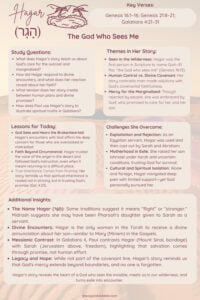
Download Study Notes on Hagar
FAQs
What does El Roi mean in the Bible?
El Roi is a Hebrew name for God meaning “The God Who Sees.” It appears in Genesis 16 when Hagar, the Egyptian servant of Sarai, names God after experiencing His compassionate attention in the wilderness.
Where does the name El Roi appear in the Bible?
The name El Roi appears in Genesis 16:13 when Hagar names God after He appears to her in her moment of despair. It is the only time this name appears in the Bible.
Why is knowing the Name El Roi important for Christians today?
El Roi reminds Christians that God sees every detail of our lives. In moments of loneliness, suffering, or feeling overlooked, the name El Roi reassures us that we are fully known and deeply loved.

About Our Author
Diane Ferreira is a Jewish believer in Yeshua, a published author, speaker, seminary student, wife, and proud mom. She is the author of several books, including The Proverbs 31-ish Woman, which debuted as Amazon’s #1 New Release in Religious Humor. She is currently pursuing her graduate degree in Jewish Studies, with her favorite topics being the early church and Biblical Hebrew. Diane writes and teaches from a unique perspective, bridging her Jewish heritage with vibrant faith in the Messiah to bring clarity, depth, and devotion to everyday believers.
When she’s not writing, studying, or teaching, you’ll find her curled up with a good book, crocheting something cozy, or researching her next trip.
📚 Learn more here! | 💬 Join the discussion on our Substack!
Tree of Life (TLV) – Scripture taken from the Holy Scriptures, Tree of Life Version*. Copyright © 2014,2016 by the Tree of Life Bible Society. Used by permission of the Tree of Life Bible Society.
Powerful reminders and truths. Thank you for this post! Very timely 🙂
Thank you Nicole!!
the enemy is always working!!! But God got you and he won’t let you down. You are seen and you are important
Thank you so much!! Blessings!!
I resonate with this post a lot. I am a new blogger too and I often like I am not good enough or I am not interesting enough for people to like me and my content.
It is tough starting out. I would love to read your blog!! What is your link?
I feel this way SO often, and not just on social media, but in real life, too. You’re right that it’s a tactic of Satan. He wants us to feel hurt and retreat. The best thing we can do is paste a big smile on and reach out to other people who look lonely! 🙂 Great post!
Thank you Amy!! It appears so many of us struggle with the same attacks! It is great that we can share with eachother and know we are not alone!!
I had these exact thoughts this week!!! Thanks for the encouragement, its so nice knowing I’m not alone!!
You are definitely not alone..I am glad it helped you see that!!
I feel I am in a season of loneliness and it is hard. Especially with social media and you see all these happy photos and you just aren’t feeling that way. Or you feel you are missing out. Great post!
I am sorry you are feeling that way Ashley..I will definitely be praying for you. I know that feeling all too well.
Oh man, that note about if you only have 100 friends but one of them has 2000+? Hits home. I have multiple friends like that and it’s definitely nice to know that it’s the algorithm’s fault, not those people’s, for not interacting with my posts.
Yes it is sometimes easy to miss because we often think that because we can see theirs that they can see ours and its not so! One way to help them see your posts more is to interact with theirs a lot. Then the algorithm will show them yours more…not all of them of course but more of them.
Yes! This is so true! It is easy to believe our feelings, but our feelings lie so often and we have to make sure our focus is on God and on things that are true, not how we feel. I’ve certainly been there. Like you said, everyone seems to land there at some point or another.
Absolutely! It is something we all go through at one point or another!! Thanks Kristin!
Such a great, relatable post. I have been blogging for 6 years and barely anyone reads my stuff. But the hardest part for me wasn’t outside people not reading, but the fact that people I know personally and shared my first stuff with (my life story) wouldn’t read it. That hurt. And then I thought I’d “prove them wrong” by posting it anyway and having lots of outside people read it, showing them how readable and valuable it was. But that didn’t happen either. So I had to wrestle with a lot of deep feelings like you talk about. And the conclusion I came to is that if God was pleased with it and if it helps me to write (being a lonely, introverted person who doesn’t have many people to talk things over with), then it had to be good enough. It is worth it, even if people don’t read it. (Plus, if I write as I feel led to, it’s there for God to use if ever He should want to use it. And it adds more godly stuff to an online world that’s full of trash. The more godly stuff, the better – which is why we need every post from every Christian who feels called to write. It adds up to a huge resource of godly information for anyone who needs it.) You can see my post about this at https://lovehealme.blogspot.com/2017/09/all-good-things.html. Keep writing! You’ve got a great, encouraging way with words!
Heather I just went over to your blog and your post is wonderful. I left a comment. Please do not give up on what you are doing. That is what the enemy wants you to do. Just keep thinking audience of one!! What you are doing DOES matter!! I will be praying for you and I thank you for your encouragement even while you are struggling with those feelings yourself.
Thanks for sharing this powerful message. We do so often feel invisible and as if we don’t matter to others. God sees us. We desire to be known by others, which is a legitimate desire, but many other things (not just including social media) can make us feel glossed over, which the enemy then plays on. This is something close to my heart. I wrote a blog post on this same theme a couple of months back.
Thank you Robert! I would love to read your post!! I knew other people had to struggle with the same feelings…I just didnt realize how much!!
You’re welcome Diane. Yes, it’s definitely something a lot of people struggle with, myself included.
The link to my blog post is here: https://drawingontheword.com/biblical-truths-to-remember-whenever-you-feel-invisible/
Hope you find it helpful.
I loved it and I actually shared it to my Facebook page so others can read it. Excellent post Robert. And it did bring up a good point I forgot about in mine…the ever growing trend of ignoring someone’s emails or messages. I can’t tell you how much that bothers me…we have merely discovered more ways to be rude and ignore people and I think people forget that it can really hurt someone. Thank you for sharing your post!!