
Jephthah’s Daughter: The Tragic Faith of an Unnamed Woman in Judges 11
Please note that this article may contain affiliate links. As an Amazon Associate, I earn on qualifying purchases at no additional cost to you. You can read more at the bottom of this page or read my full disclosure on my Affiliate Disclosure Page
Have you ever made a promise that came out of your mouth before your brain had a chance to stop it? Jephthah did. And his promise changed everything; not just for him, but for his daughter. Her name isn’t even recorded, but her faith still echoes through the centuries.
Jephthah’s Daughter stands out as one of the most heartbreaking and haunting stories in Scripture, tucked right in the middle of Judges 11; a time when Israel was caught in a cycle of chaos, compromise, and desperate prayers.
Let’s explore this story and what we can learn from it.
Be sure to download your free copy of our printable Story of Jephthah’s Daughter Bible Study, Reflection and Action Challenge guide with worksheets at the end of this post!
Who Was Jephthah?
Jephthah’s story starts rough. He was the son of a harlot (Judges 11:1), rejected by his half-brothers, and cast out of his father’s house. He grew up in exile in the land of Tob… basically, the wilderness of nobodies.
Yet somehow, that’s exactly where God began shaping him into a warrior and leader. When Israel found itself in trouble with the Ammonites, the very people who once shunned Jephthah came begging for his help.
The time of the Judges was wild… no kings, no order, and every man doing what was right in his own eyes. It was spiritual anarchy with a side of idolatry. When Jephthah stepped up to lead Israel’s army, he wasn’t just fighting the Ammonites. He was fighting years of rejection, shame, and the weight of proving himself.
Jephthah’s Vow and Victory
Before the battle, Jephthah made a vow to the Lord:
“If You will indeed give the sons of Ammon into my hand, then it shall be that whatever comes out of the doors of my house to meet me when I return in peace from the sons of Ammon, it shall be the Lord’s, and I will offer it up as a burnt offering.”
Judges 11:30–31
That’s a big promise. The Hebrew word used here for “whatever” (asher) can also mean “whoever.” Jephthah was likely picturing an animal wandering out of his courtyard, not a person.
But vows in the ancient world were binding. Scripture says:
“It is better for you not to vow
Ecclesiastes 5:4–5 TLV
than to vow and not pay.
5 Don’t let your mouth lead your flesh to sin,
and don’t say before the messenger,
“It was a mistake!”
Why should God be angry at your voice
and destroy the work of your hands?
Jephthah’s vow was rash, but sincere. He wanted victory so badly, he tried to secure it with a promise.
And he got it. The Lord gave him victory over the Ammonites. Israel was saved. The outcast became the hero.
Until he came home.
The Tragedy at Mizpah
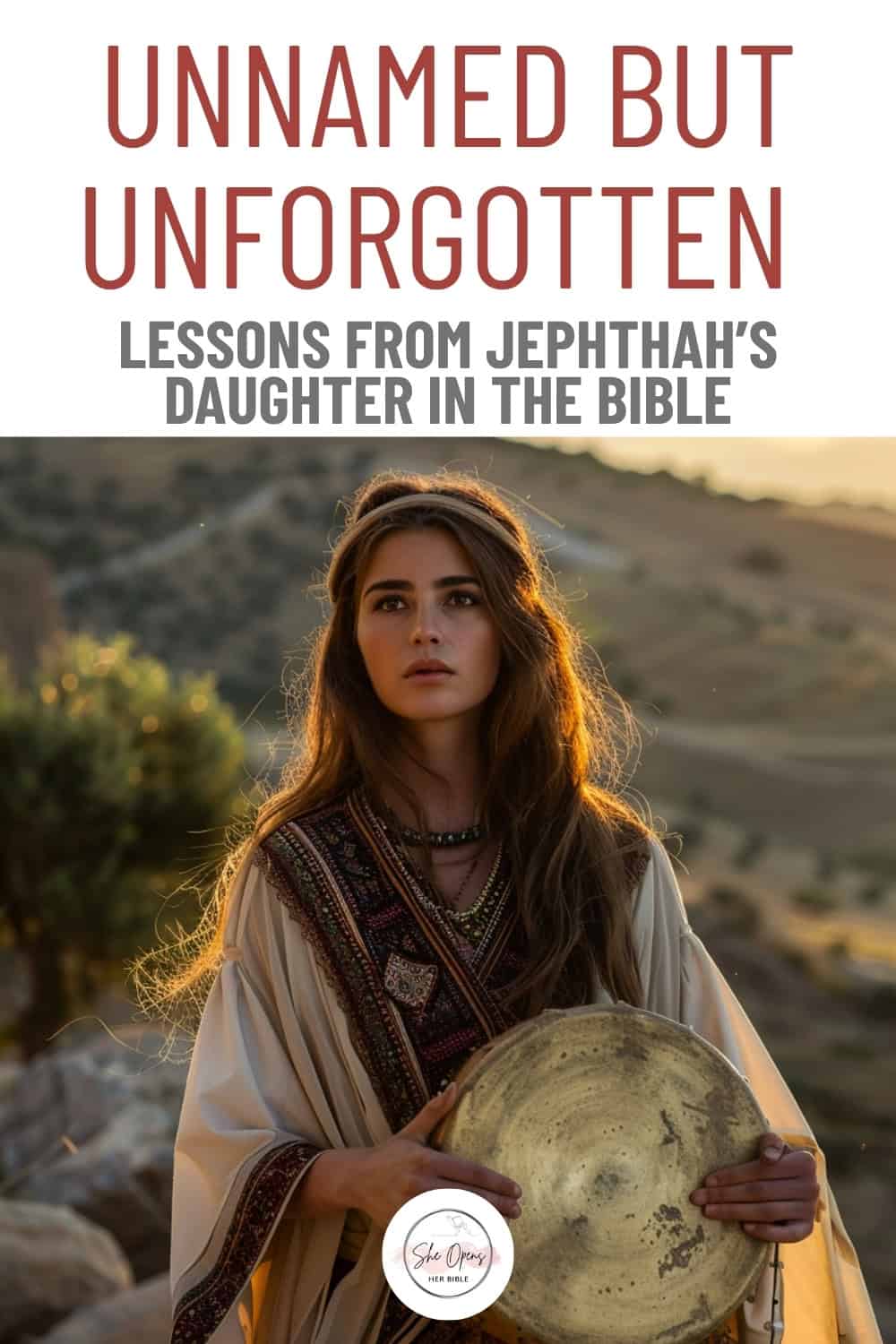
Jephthah returned to his house in Mizpah, full of triumph… and there she was. His daughter. His only child. Coming out with tambourines and dancing, celebrating her father’s return. The Hebrew text emphasizes her joy, her innocence, her complete lack of awareness of what her father had said to God.
When Jephthah saw her, he tore his clothes and cried:
“Alas, my daughter! You made me bow down in grief—you’ve made me miserable!”
Judges 11:35 TLV
Yes… if you are tracking with me you caught that! He gaslights her! He shifts the weight onto her, but really, it was his own vow that crushed them both. And yet, she doesn’t rage. She doesn’t resist.
She simply says:
“My father, you have opened your mouth to Adonai,” she said to him. “Do to me what proceeded from your mouth—since Adonai brought vengeance on your enemies, the children of Ammon.”
Judges 11:36 TLV
That’s the moment that stops me every time. This unnamed woman chooses faith over fear, obedience over outrage. She asks only one thing:
“Let this thing be done for me. Let me be alone two months, so that I may go on the mountains and mourn my virginity, I and my companions.”
Judges 11:37 TLV
Two months. To lament what would never be: no marriage, no children, no legacy. In the culture of ancient Israel, a woman’s legacy was her lineage. She wasn’t just mourning her life; she was mourning the end of her father’s name.
Jephthah’s Daughter
Was She Really Sacrificed?
This question has haunted scholars, rabbis, and readers for centuries. The Hebrew phrase “olah” (burnt offering) usually refers to an actual sacrifice. But some Jewish commentators, like those from the Talmudic period, believed Jephthah didn’t kill her but consecrated her to lifelong service… dedicated to the Lord like a Nazirite, living in seclusion.
There’s also a small but significant linguistic debate: the Hebrew conjunction “vav” (ו) in Jephthah’s vow could mean “and” or “or.” If the correct translation were “or,” Jephthah’s vow might have meant, “I will dedicate it to the Lord, or offer it as a burnt offering.” That reading would mean that if it were a person, they’d be dedicated, not destroyed.
Whichever interpretation you hold, both are devastating. Either Jephthah killed his daughter, or he condemned her to a lonely life of isolation. Either way, Jephthah’s Daughter became a living sacrifice.
Her Faith and Courage
The more you read her story, the more you realize that Jephthah’s daughter shows more faith than her father. He tried to manipulate God through a vow. She simply trusted God through surrender. She didn’t have a name written in Scripture, but she had courage written on her soul.
In ancient Jewish tradition, the daughters of Israel would go out each year for four days to commemorate her (Judges 11:40). They remembered her faith, her grief, and her obedience. This wasn’t just some ritual, it was reverence. It was the nation’s way of saying, “We won’t forget the girl who stood still when faith cost everything.”

Lessons from Jephthah’s Daughter
- Think Before You Promise
Vows are serious business. Proverbs says, “It is a trap to dedicate something rashly and only later to consider one’s vows.” Jephthah’s story reminds us that sincerity isn’t a substitute for wisdom. God doesn’t need our bargaining; He wants our obedience. - Faith Can Be Costly
Jephthah’s daughter teaches us that obedience sometimes hurts. Faith doesn’t always look like victory; it can look like surrender, sacrifice, and still choosing to trust. - God Sees the Unnamed
She’s never named, but she’s never forgotten. The Bible doesn’t record her name, but Jewish tradition preserved her story. In the kingdom of God, anonymity doesn’t equal insignificance. - Our Words Carry Weight
Jephthah spoke carelessly and it changed the course of his family. How many times have we made emotional promises to God… “If You just do this, I’ll never do that again”? God doesn’t need transactions; He desires truth. - Grief and Faith Can Coexist
Her two-month lament wasn’t weakness. It was sacred space. Mourning isn’t faithlessness, it’s honesty before God. She showed that obedience can live alongside heartbreak.
Modern Reflections: When Promises Become Prisons
Most of us haven’t made vows like Jephthah’s, but we’ve made emotional promises to ourselves and others: “I’ll never trust again.” “I’ll always take care of everyone else first.” “I’ll prove them wrong.” These are our modern vows. And like Jephthah’s, they can trap us. The Lord invites us to break the chains of rash vows… to trade striving for surrender.
My Final Thoughts
Jephthah’s Daughter doesn’t fit neatly into our ideas of faith stories with happy endings. But maybe that’s the point. Her story isn’t about victory, it’s about faith that stays when everything else breaks. It’s about a woman whose obedience echoed louder than her name.
If you’ve ever felt unseen, uncredited, or caught in the fallout of someone else’s decisions, take heart. God saw her, and He sees you. The daughters of Israel remembered her; we can too.
Now I’d love to hear from you… what speaks to you most in Jephthah’s daughter’s story? Do you see yourself in her faith, her loss, or her quiet strength?
Drop a comment below and join my She Opens the Bible Study Facebook group to keep the conversation going. Let’s honor her together, one lesson at a time.
If Jephthah’s Daughter’s story shook you, you’ll want to grab a copy of Texts of Terror by Phyllis Trible. It’s one of those rare books that doesn’t just retell Scripture, it wrestles with it. Trible takes the stories of women who’ve been silenced, shamed, or forgotten and gives them their voice back.
It’s pretty academic, yes, but also deeply moving. I read it in one day because it is the kind of book that’ll have you highlighting, sighing, and whispering “wow” under your breath. Perfect for anyone who wants to understand how God’s Word still speaks through the pain, not around it.
And don’t forget to download your free copy of our Jephthah’s Daughter Bible Study, Reflection and Action Challenge guide below!
FAQs
-
Was Jephthah’s daughter actually killed?
Scholars are divided. Some believe she was literally offered as a burnt offering, others that she was dedicated to lifelong service to God. Either view emphasizes her obedience and the cost of her father’s vow.
-
Why isn’t her name given?
In ancient storytelling, anonymity often heightened the moral focus. Her namelessness draws attention not to identity, but to action… to what she did and what her story teaches.
-
What does this story teach believers today?
That faith isn’t always neat or easy. It teaches the danger of careless words, but also the beauty of courageous obedience. It challenges believers in Yeshua to trust God’s character even when circumstances don’t make sense.
-
Did Jephthah regret his vow?
Oh I am sure! However, the text suggests a deep anguish, but no repentance. His silence at the end speaks volumes. The tragedy of Jephthah’s story is that he learned the cost of his words too late.
Download Your Study Guide

About Our Author
Diane Ferreira is a Jewish believer in Yeshua, a published author, speaker, seminary student, wife, and proud mom. She is the author of several books, including The Proverbs 31-ish Woman, which debuted as Amazon’s #1 New Release in Religious Humor. She is currently pursuing her graduate degree in Jewish Studies, with her favorite topics being the early church and Biblical Hebrew. Diane writes and teaches from a unique perspective, bridging her Jewish heritage with vibrant faith in the Messiah to bring clarity, depth, and devotion to everyday believers.
When she’s not writing, studying, or teaching, you’ll find her curled up with a good book, crocheting something cozy, or researching her next trip.
📚 Learn more here! | 💬 Join the discussion on our Substack!
Tree of Life (TLV) – Scripture taken from the Holy Scriptures, Tree of Life Version*. Copyright © 2014,2016 by the Tree of Life Bible Society. Used by permission of the Tree of Life Bible Society.