
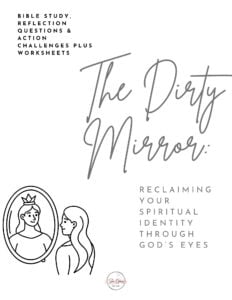
The Dirty Mirror: Reclaiming Your Spiritual Identity Through God’s Eyes
Please note that this article may contain affiliate links. As an Amazon Associate, I earn on qualifying purchases at no additional cost to you. You can read more at the bottom of this page or read my full disclosure on my Affiliate Disclosure Page
Some mornings, everything feels just a little off. You’re rushing to get out the door, and even the small things don’t go right. That was me one day, scrambling to pull myself together when I stopped at the bathroom mirror to check my reflection.
What I saw didn’t seem right—not because something was wrong with my face, but because the mirror was a mess. It was streaked and foggy from the shower, smudged with fingerprints, and dotted with flecks of toothpaste. I squinted, trying to get a clearer view, but all I could focus on were the marks on the glass. It wasn’t until later that I realized how perfectly this moment captured something I’d been struggling with spiritually.
Our spiritual identity works a lot like that mirror. We try to see who we are, but the reflection is distorted. It’s not the truth that’s broken—it’s the lens we’re looking through. Shame, insecurity, old labels, and fear smudge the surface, leaving us with a version of ourselves that God never spoke over us. And unless we recognize it, we’ll keep believing that cloudy image is all there is.
Through a Christian worldview, we discover that our identity begins and ends with God’s truth, not our circumstances.
In this post, I want to talk about what it means to clean that mirror—to reclaim your spiritual identity by seeing yourself the way God sees you.
Be sure to download your free copy of our printable Spiritual Identity Bible study, Reflection and Action Challenge guide with worksheets at the end of this post! No sign up required!

Understanding Spiritual Identity
What Is Spiritual Identity?
Spiritual identity is the truth of who you are in the eyes of God—not in the eyes of others, or even your own. It’s the deep, unchangeable identity you carry as someone created in the image of God (b’tzelem Elohim) and restored through your relationship with Yeshua.
You are made in the Imago Dei—the image of God (Genesis 1:27)—which means your identity is not earned or assigned by the world, but given by the Creator Himself
This kind of identity doesn’t fluctuate with your emotions, your past, or your circumstances. The world tries to assign value based on performance, popularity, or perfection. But in the economy of God, value is inherent. It’s rooted in covenant, not comparison. It’s about who you belong to—not what you achieve.
Why Our Spiritual Identity Gets Distorted
Just like that fogged-up mirror, the reflection of your spiritual identity can get covered in layers you didn’t even realize were there. Sin. Trauma. Pride. Words spoken over you years ago. Expectations that you never chose but still carry.
We internalize these things like smudges on a mirror, and after a while, we don’t know where the dirt ends and our identity begins. We mistake old wounds for truth. We interpret silence as rejection. And we start acting out of a place that’s been shaped by distortion, not by God’s voice.
Cultural vs. Kingdom Identity
Culture tells us we are what we do, how we look, or who we impress. It defines identity through roles—mother, employee, influencer, survivor. But none of those things are the core of who you are. They’re seasons, gifts, or challenges—not your essence.
Your covenant identity, on the other hand, is constant. It’s defined by God’s declaration, not man’s validation. You are a child of God, called, set apart, and sealed. Whether you’re in a season of waiting, building, healing, or leading—that identity never changes.
Biblical Foundations of Identity in Christ
You Are a New Creation (2 Corinthians 5:17)
Pauline theology is rich with identity language. Throughout the New Testament, Paul uses terms like ‘in Messiah,’ ‘adopted,’ and ‘sealed by the Spirit’ to describe the believer’s new identity. He tells us:
“Therefore, if anyone is in Messiah, he is a new creation. The old things have passed away; behold, all things have become new.”
TLV
This isn’t metaphorical—it’s spiritual reality. When you come into covenant with Yeshua, you’re not just patched up. You’re made new. Your identity isn’t based on your former failures. It’s anchored in a redemptive relationship.
Child of God, Chosen and Loved
The Scriptures are filled with reminders of your place in God’s family.
“See how glorious a love the Father has given us, that we should be called God’s children—and so we are!”
1 John 3:1 TLV
In Ephesians 1, we’re told He “chose us in Messiah before the foundation of the world… in love He predestined us for adoption as sons through Yeshua.”
This isn’t casual language. It’s covenant language. You are not tolerated—you are treasured. You’re not barely welcome—you’re fully adopted.
God’s Perspective: Seeing with Heavenly Eyes
Your identity is not built on effort, but on grace and justification—God’s mercy extended through Yeshua, which redefines who you are.
Zephaniah 3:17 paints a beautiful picture of God’s heart toward you:
“Adonai your God is in your midst—
TLV
a mighty Savior!
He will delight over you with joy.
He will quiet you with His love.
He will dance for joy over you with singing”
That’s how God sees you—even when you can’t see it yourself.
Psalm 139 reminds us that we are “fearfully and wonderfully made.” You were formed with intention. There’s no defect in your design.
The Dirty Mirror: Recognizing the Distortions
Signs of a Distorted Spiritual Identity
Many believers experience a spiritual identity crisis when their circumstances and inner wounds distort what God has declared over them. You might be struggling with a distorted identity if you:
- Constantly second-guess your worth
- Battle shame, even after repentance
- Try to earn God’s approval through performance
- Compare yourself to others and feel like you always fall short
- Feel disconnected from your purpose or calling
These are indicators that the spiritual mirror might be dirty.
How False Labels Take Root
False beliefs often take root through unhealed soul wounds—moments of trauma or silence that shaped how we see ourselves. Sometimes it’s something someone said—years ago—that never left you.
Other times, it’s what you didn’t hear that spoke just as loudly. Silence, rejection, abandonment, unmet expectations—all of these create fertile ground for false labels to take root.
The enemy is called the accuser for a reason. His voice may sound familiar because it often mimics ours. But anything that contradicts what God has spoken over you is a lie, no matter how logical it feels.
The Spiritual Battle for Identity
Ephesians 6:12 reminds us that our struggle isn’t “against flesh and blood, but against… the spiritual forces of evil.” This includes attacks on your identity. If the enemy can’t steal your salvation, he’ll try to steal your confidence—because a believer who doesn’t know who they are is easier to defeat.

Renewing the Mirror: Healing and Clarity Through Christ
Psalm 51:12 and the Clean Heart
“Create in me a clean heart, O God, and renew a steadfast spirit within me.”
psalm 51:12 TLV
David didn’t just ask for forgiveness—he asked for restoration. Repentance wipes the glass. It clears away what’s been covering up your true reflection. When you return to God, He doesn’t just take you back. He washes you clean.
This renewal is part of the greater process of sanctification—being continually shaped into the image of Messiah through the Spirit’s work.
The Role of Scripture in Rebuilding Identity
Romans 12:2 says:
“Do not be conformed to this world but be transformed by the renewing of your mind.”
TLV
One of the best ways to clean your spiritual mirror is to fill it with truth. Write out what God says about you. Meditate on it. Replace every lie with a verse.
Here are a few ways to do that:
- Keep a journal of lies you believed vs. what Scripture says
- Memorize key verses about your identity
- Speak them out loud during prayer
Practicing God-Reflection: Prayer and Worship
Prayer isn’t just about asking—it’s about aligning. Worship reminds your soul of who God is, and in that light, your true identity starts to come into focus. In His presence, your value becomes undeniable.
Practical Steps to See Yourself Through God’s Eyes
Journaling Prompts for Identity Clarity
- What labels have I believed that God never gave me?
- What Scriptures speak directly to how God sees me?
- When have I felt most myself in God’s presence?
- What wounds may still be affecting my view of my worth?
Speak Life: Affirmations Based on Scripture
Try these 10 “I am” affirmations rooted in truth:
- I am made in God’s image (Genesis 1:27)
- I am fearfully and wonderfully made (Psalm 139:14)
- I am a child of God (1 John 3:1)
- I am chosen and dearly loved (Colossians 3:12)
- I am a new creation in Messiah (2 Corinthians 5:17)
- I am God’s workmanship (Ephesians 2:10)
- I am free from condemnation (Romans 8:1)
- I am more than a conqueror (Romans 8:37)
- I am sealed with the Holy Spirit (Ephesians 1:13)
- I am not forgotten—God rejoices over me (Zephaniah 3:17)
These affirmations are not just about self-esteem—they’re about God-esteem: seeing your worth through His eyes.
Community and Accountability
God designed us for community. Sometimes we need someone else to help clean the mirror—to gently point out where the lies have settled and to remind us of the truth. Surround yourself with people who know Scripture and will speak it over you.
Living From Your Restored Identity
Walking in Purpose, Not Performance
When your identity is secure, you stop striving for approval. You begin to serve from a place of rest. You stop asking, “Am I enough?” and start asking, “What has God called me to do?”
Staying Aligned in a Distracting World
Keep coming back to the truth. Read the Word. Pray. Worship. Write down the truth and revisit it often. Identity isn’t a one-time revelation—it’s a daily renewal.
Becoming the Reflection of Christ to Others
When you know who you are, you reflect that to others. You offer peace in chaos. Grace instead of gossip. Purpose instead of pressure. You become a mirror—cleaned and polished—reflecting His love to a distorted world.
Spiritual formation is the lifelong journey of aligning our hearts and minds with who God says we are.
My Final Thoughts
That foggy mirror showed me just how easy it is to misread your reflection. Maybe you’ve been doing the same without even knowing it. But your spiritual identity is still there, waiting to be revealed, restored, and lived out.
Ask God to clean the mirror. Let Him remove the lies, wash away the fear, and speak truth where shame once lived.
I’d love to hear your thoughts. What helps you reconnect with your true identity? Leave a comment and let’s start the conversation.
And if you’re looking for a space to grow, heal, and be reminded of who you are in God, join our She Opens Her Bible Study forum. You belong here.
Don’t forget to download your free copy of our Spiritual Identity Bible study, Reflection and Action Challenge guide below!
FAQs
-
What does the Bible say about spiritual identity?
The Bible says your spiritual identity is rooted in being created in the image of God (Genesis 1:27) and being made new through faith in Yeshua (2 Corinthians 5:17). Believers are called children of God, heirs, and co-laborers with Messiah. Identity in Scripture is not based on what we do, but on who we are in relationship with God.
-
How do I know if I have a distorted self-image spiritually?
A distorted spiritual self-image often shows up through chronic insecurity, shame, perfectionism, or believing lies about your worth. If you struggle to receive God’s love or feel like you’re constantly falling short, it may be a sign that your spiritual mirror needs some cleaning through truth and healing.
-
What scriptures can I read about identity in Christ?
Some key scriptures include:
2 Corinthians 5:17 – You are a new creation
1 John 3:1 – You are a child of God
Ephesians 1:4-5 – You are chosen and adopted
Romans 8:1 – You are not condemned
Psalm 139 – You are wonderfully made
These verses help restore a right view of who you are in God’s eyes. -
How do I overcome false beliefs about myself?
Overcoming false beliefs begins with identifying the lies and replacing them with truth from God’s Word. Journaling, prayer, Scripture meditation, and community support are practical ways to renew your mind and align your heart with how God sees you. Romans 12:2 is key to this transformation process.
-
How can I see myself the way God sees me?
Start by spending time in Scripture and prayer, asking God to reveal His truth about your identity. Invite the Holy Spirit to help you recognize areas where lies have taken root. Worship, community, and quiet reflection can also bring clarity. Remember, God rejoices over you and sees you as His beloved.
Download Your Free Printable Study Guide With Worksheets

About Our Author
Diane Ferreira is a Jewish believer in Yeshua, a published author, speaker, seminary student, wife, and proud mom. She is the author of several books, including The Proverbs 31-ish Woman, which debuted as Amazon’s #1 New Release in Religious Humor. She is currently pursuing her graduate degree in Jewish Studies, with her favorite topics being the early church and Biblical Hebrew. Diane writes and teaches from a unique perspective, bridging her Jewish heritage with vibrant faith in the Messiah to bring clarity, depth, and devotion to everyday believers.
When she’s not writing, studying, or teaching, you’ll find her curled up with a good book, crocheting something cozy, or researching her next trip.
📚 Learn more here! | 💬 Join the discussion on our Substack!
Tree of Life (TLV) – Scripture taken from the Holy Scriptures, Tree of Life Version*. Copyright © 2014,2016 by the Tree of Life Bible Society. Used by permission of the Tree of Life Bible Society.